
How to Identify the Philip II Gold Half Stater
A collector's guide to recognizing Philip II's gold half stater by its Heracles head, eagle-on-thunderbolt reverse, small size, and gold weight.
Read the full Philip II Gold Half Stater encyclopedia entry →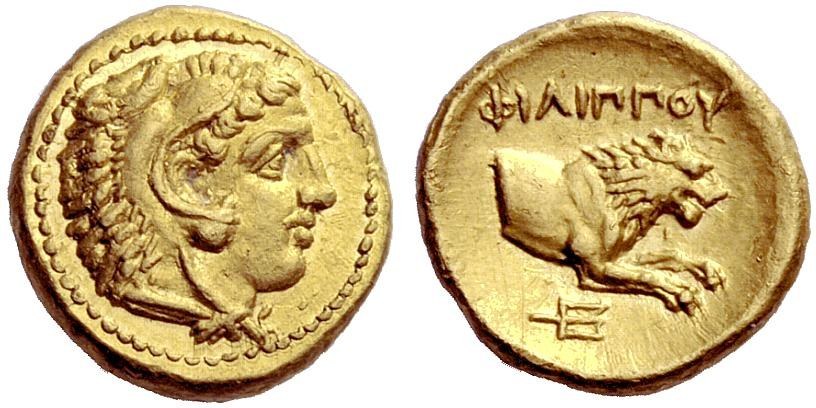
Start with the metal and the size. This is a small, thick disc of bright, untarnished gold that feels heavy for how little it is, weighing on the order of about 4 grams and measuring only roughly 12 to 14 mm across. Real ancient gold keeps a warm yellow color and does not tone or corrode, so a small "gold" coin of this type that looks dull, coppery, or tarnished should be treated with suspicion.
Read the obverse next. You are looking for the head of a youthful Heracles facing right, often wearing the lion's skin as a headdress. Check the crown of the head and the neckline for the lion's paws or muzzle; that detail helps separate Heracles from other youthful male heads such as Apollo, which appears on the full gold stater instead. There is no inscription on this side, so the character of the head does the work.
Turn to the reverse and confirm the eagle standing on a thunderbolt. Look for the abbreviated royal name of Philip and for small control letters or symbols placed in the field; these marks vary between issues and are exactly what specialists use to classify and date a coin. The eagle-and-thunderbolt pairing distinguishes this fractional gold type from the two-horse chariot that appears on Philip's full gold stater.
Mind the denomination and the look-alikes. Philip struck gold in several sizes, so weigh the coin before calling it a half stater: a full stater sits near 8.6 grams, a half near 4 grams, and smaller fractions lighter still. Philip's gold was also copied in antiquity, including by Celtic tribes whose imitations grow progressively more abstract and stylized, and the full stater in particular was reproduced far more than the fractions.
Finally, weigh authenticity carefully because this is a high-value gold coin. Confirm the weight and diameter against published figures, look for the crisp but hand-made irregularity of a true ancient strike rather than the soft edges and seams of a cast copy, and be wary of unnaturally sharp detail added by tooling. Modern forgeries of Philip II gold are common, so for any serious purchase rely on specialist attribution or third-party certification and, where possible, documented provenance.
Frequently asked questions
How do I tell this half stater from the full gold stater?
Check the types and the weight. The full stater shows the head of Apollo with a two-horse chariot on the reverse and weighs near 8.6 grams; this half stater shows Heracles with an eagle on a thunderbolt and weighs roughly 4 grams, about half as much.
Is the head Heracles or Apollo?
On this type it is Heracles, usually shown wearing the lion's skin. Look for the lion's paws or muzzle around the head and neck. Apollo, who appears laureate on Philip's full gold stater, has no lion skin.
What are the small letters and symbols on the reverse?
They are the abbreviated name of Philip together with control marks used by the mint. These vary between issues and are what specialists use to attribute and date a coin, so they are worth recording carefully.
What are the main warning signs of a fake?
Dull or coppery color instead of warm gold, weight or diameter that is off, a seam or bubbly surface from casting, or unnaturally sharp tooled detail. Because Philip II gold is valuable and often forged, seek specialist certification for any significant coin.