How to Identify the Peace Silver Dollar
A guide to identifying the Peace Silver Dollar (1921-1935) by its bare-headed Liberty obverse, perched eagle reverse, mint marks, and how it differs from the Morgan Dollar.
Read the full Peace Silver Dollar encyclopedia entry →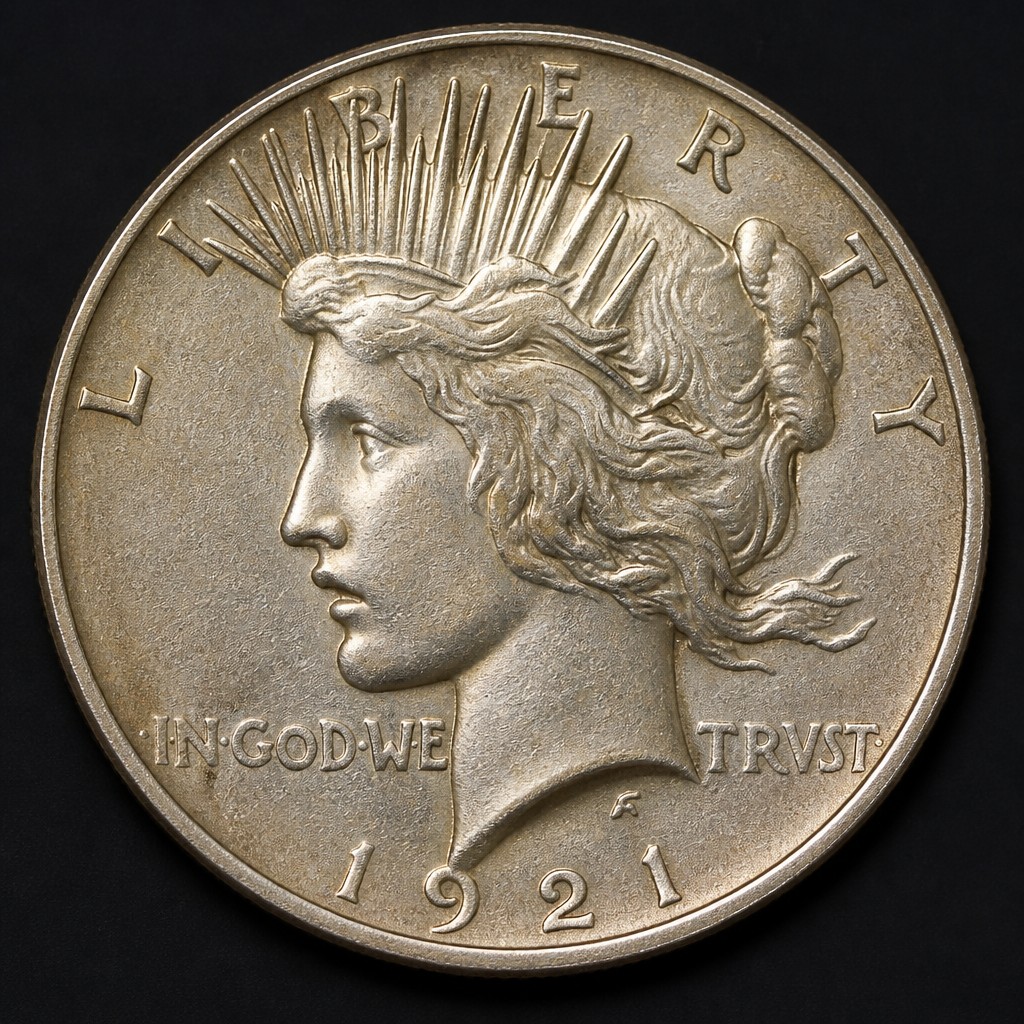
What It Is
The Peace Silver Dollar was struck by the United States Mint from 1921 to 1928 and again in 1934-1935, commemorating the peace that followed World War I. It succeeded the Morgan Dollar and was designed by Anthony de Francisci, whose wife is often said to have served as an inspiration for the youthful, optimistic portrait of Liberty.
Obverse (Front)
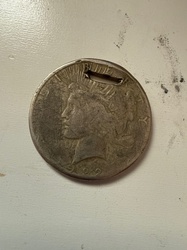
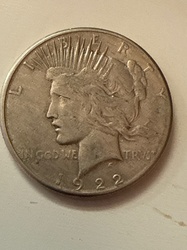
The obverse shows a left-facing, bare-headed portrait of Liberty with windswept hair and a radiate crown of sunrays, rather than a cap. "LIBERTY" arcs above her head, and "IN GOD WE TRUST" appears to the lower left, with the date below the bust.
Reverse (Back)
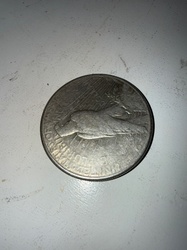
The reverse shows a bald eagle at rest, perched on a rock, holding an olive branch, with rays of the rising sun behind it. The word "PEACE" appears below the eagle, with "UNITED STATES OF AMERICA" and "E PLURIBUS UNUM" arcing around the top, and "ONE DOLLAR" beneath.
Size, Weight, Metal, and Edge
The coin measures 38.1 mm in diameter and weighs 26.73 grams, composed of 90% silver and 10% copper, matching the Morgan Dollar's specifications. The edge is reeded.
Mint Marks
The mint mark is located on the reverse, beneath the "ONE" in "ONE DOLLAR," near the eagle's wing. No letter indicates Philadelphia; look for "D" (Denver) or "S" (San Francisco).
Telling It Apart From Similar Coins
The Peace Dollar is easily distinguished from the Morgan Dollar by its bare-headed Liberty with visible sunrays rather than a capped head, and by its resting eagle on a rock (with the word "PEACE") rather than a wreathed eagle with spread wings. The first-year 1921 issues were struck in higher relief and show a noticeably sharper, more three-dimensional portrait than the flatter relief used from 1922 onward.
Grading at a Glance
Look for definition in the hair strands around Liberty's face and neck, and in the feathers on the eagle's wing and breast. Wear first shows on Liberty's cheekbone and hairline, and on the eagle's breast and top of the wing. A lustrous, unworn coin often retains a soft, satiny sheen across the open fields.
Authenticity Red Flags
Because 1928 and 1934-S are among the more valuable dates, altered mint marks and dates are a known concern; examine the area around the mint mark for tooling marks, an uneven surface, or a font that doesn't match genuine examples. A cast counterfeit will often show a grainy texture, softer design details, and possibly a seam line around the edge, and any coin that fails a weight check (26.73 grams) or shows an incorrect diameter should be treated with suspicion. The relief height is another clue: a coin claiming to be a scarce high-relief 1921 should show noticeably deeper, more rounded features than the flatter dies used in later years.
Frequently asked questions
How do I tell a Peace Dollar from a Morgan Dollar?
The Peace Dollar shows a bare-headed Liberty with sunrays and a resting eagle on a rock with the word 'PEACE,' while the Morgan Dollar shows a capped Liberty and a wreathed eagle with spread wings.
Where is the mint mark on a Peace Dollar?
On the reverse, below the word 'ONE' in 'ONE DOLLAR,' near the eagle's wing.
Why do 1921 Peace Dollars look different from later years?
The 1921 issue was struck in higher relief, giving it a sharper, more sculptural look compared to the flatter relief used starting in 1922.
What years were Peace Dollars minted?
They were struck from 1921 to 1928, and again in 1934 and 1935.
Peace Silver Dollar identified by the community
Recent Peace Silver Dollar coins identified with Coin Identifier.