
How to Identify the Panama-Pacific Exposition Quarter Eagle
A collector's checklist for confirming a genuine 1915 Pan-Pac $2.50 gold commemorative — the hippocamp obverse, eagle reverse, size, mint mark, and fakes.
Read the full Panama-Pacific Exposition Quarter Eagle encyclopedia entry →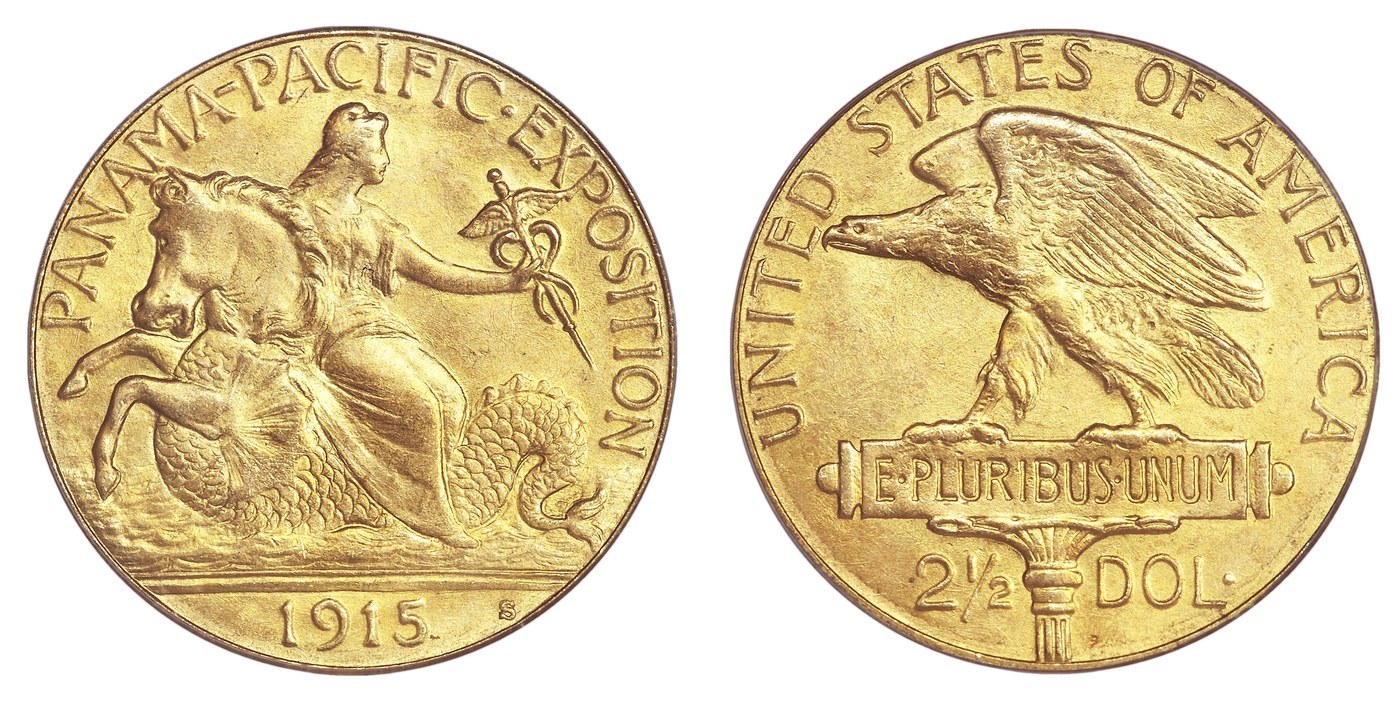
Begin with the obverse, which is the strongest diagnostic. A genuine Panama-Pacific quarter eagle shows a female figure (Columbia) riding a hippocamp — a sea-horse with a horse's front and a curling fish tail — and holding a caduceus staff. The inscription 'PANAMA-PACIFIC EXPOSITION' arcs around the design and the date is 1915. No regular-issue U.S. gold coin carries this mythological maritime scene, so it is a quick and reliable confirmation.
Turn to the reverse, which must show a standing eagle with spread wings on a standard, the motto 'E PLURIBUS UNUM', 'UNITED STATES OF AMERICA', and the denomination written as '2½ DOL'. Look for the 'S' mint mark that marks the San Francisco Mint. If the reverse reads '1 DOL' or shows a different design, you are looking at a different Pan-Pac issue, not the quarter eagle.
Check size and metal. The quarter eagle is a small coin, about 18 mm across, and is struck in 90% gold with a reeded edge, so it should feel dense for its size and show a rich yellow tone. It is much smaller than the exposition's $50 pieces and distinct from the Pan-Pac gold dollar, which uses a different obverse portrait.
Watch for look-alikes and reproductions. Because this is a valuable gold commemorative, counterfeits, cast copies, and gold-plated fakes exist. Warning signs include incorrect weight or diameter, mushy or seamed detail, a wrong-color surface, or any magnetic response (genuine gold is non-magnetic). Souvenir 'copies' may also lack the sharp relief of a struck coin.
For any significant purchase, rely on authentication rather than eye appeal. Weigh and measure the coin, compare it to reference images of a certified example, and for higher-value pieces insist on third-party grading (PCGS or NGC) and reputable dealers. The combination of the correct obverse allegory, 1915 date, 'S' mint mark, '2½ DOL' reverse, and correct physical specifications together confirms a genuine coin.
Frequently asked questions
How do I tell the quarter eagle from the Pan-Pac gold dollar?
The quarter eagle's reverse reads '2½ DOL' and its obverse shows Columbia on a hippocamp with a caduceus. The gold dollar reads '1 DOL' and uses a different obverse portrait, so read the denomination and check the design.
Where is the mint mark and what should it be?
All examples were struck in San Francisco and carry an 'S' mint mark. A Pan-Pac quarter eagle with no 'S' or a different mark should be treated with suspicion.
What size and metal should the coin be?
It is a small quarter eagle, roughly 18 mm in diameter, struck in 90% gold with a reeded edge. Wrong weight, diameter, color, or any magnetism points to a counterfeit.
Should I get it authenticated?
Yes, for anything beyond a low-value curiosity. This is a scarce, frequently faked gold commemorative, so verify specifications and use PCGS or NGC certification and trusted dealers for valuable pieces.