
How to Identify the Panama-Pacific $50 Gold (Round)
A massive 1915-S commemorative $50 gold piece marking the Panama-Pacific Exposition, featuring Minerva and an owl, and standing as the largest and heaviest coin the U.S. Mint has ever struck.
Read the full Panama-Pacific $50 Gold (Round) encyclopedia entry →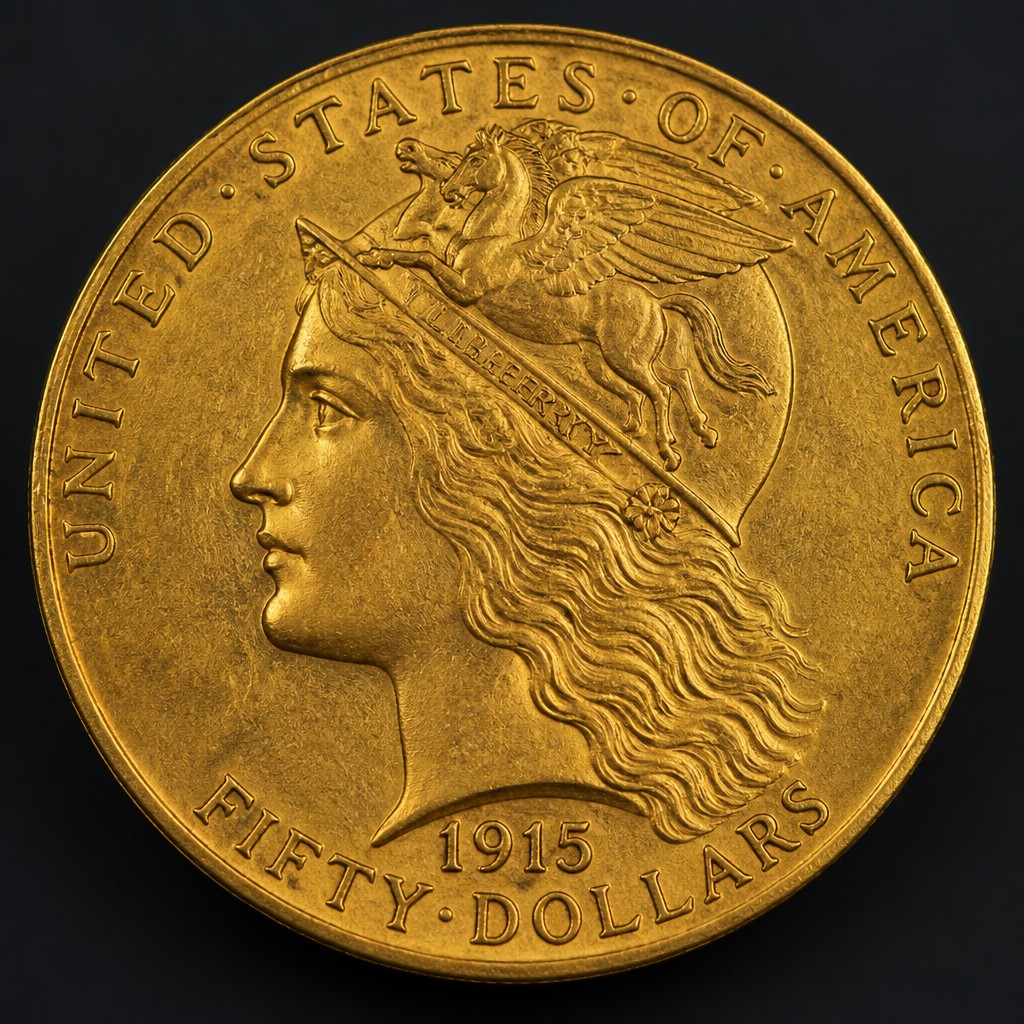
What It Is
The Panama-Pacific $50 Gold piece is a 1915 commemorative struck to mark the Panama-Pacific International Exposition in San Francisco, celebrating the completion of the Panama Canal. It was issued in both round and octagonal formats, with the octagonal shape recalling the pioneer octagonal $50 "slugs" of the California Gold Rush era; this guide covers the round version. It remains the largest and heaviest coin ever struck by the United States Mint.
Obverse Design
Designed by Robert Aitken, the obverse shows a helmeted head of Minerva, goddess of wisdom, facing left, with PANAMA-PACIFIC EXPOSITION and SAN FRANCISCO around the border and the date 1915 below.
Reverse Design
An owl perches on a branch of California pine, symbolizing wisdom, surrounded by UNITED STATES OF AMERICA, FIFTY DOLLARS, and IN GOD WE TRUST.
Size, Weight, Metal & Edge
44mm in diameter and roughly 83.5 grams, struck in .900 fine gold with a reeded edge — both far larger and heavier than a standard double eagle.
Mint Marks
An S mintmark for San Francisco appears on the coin, since this issue was struck exclusively at the San Francisco Mint for sale at the exposition.
Telling It Apart From Similar Coins
The round $50 shares its exact designs with its octagonal companion piece; the only difference between the two is the overall shape of the planchet, with the octagonal version also showing small dolphins in its corners. Do not confuse this coin with a regular double eagle, which is considerably smaller and lighter and carries an entirely different Liberty-head or Saint-Gaudens design.
Judging Condition at a Glance
Check Minerva's cheek and helmet crest on the obverse, and the owl's breast and the pine branch detail on the reverse, for wear. Because these coins were sold as commemoratives rather than placed into circulation, most surviving examples show little true wear, so surface marks, scratches, or evidence of cleaning are usually the more relevant condition concerns.
Authenticity Red Flags
Given the coin's substantial size and value, cast counterfeits are a real risk. Genuine pieces should show crisp, deeply struck design elements consistent with the size and weight described above. Any example that feels notably lighter than expected, shows a seam line around the edge, or has soft or mushy detail should be treated as suspect.
Frequently asked questions
What's the difference between the round and octagonal Panama-Pacific $50 gold coins?
They share identical obverse and reverse designs; only the shape of the planchet differs, with the octagonal version also featuring small dolphins in its corners.
Is this really the largest U.S. coin ever made?
Yes, at 44mm in diameter and roughly 83.5 grams, it is both the largest and heaviest coin the U.S. Mint has ever struck.
Where was this coin minted?
Exclusively at the San Francisco Mint, indicated by the S mintmark, and sold at the 1915 Panama-Pacific International Exposition.
What do the Minerva and owl symbolize?
Minerva represents wisdom and civilization, while the owl perched on a pine branch reinforces the same theme of wisdom associated with the exposition's classical imagery.