
How to Identify the Palestine 2 Mils
A collector's checklist for the British Mandate Palestine 2 Mils: the trilingual PALESTINE legend, olive-sprig reverse, solid bronze fabric, and look-alike cautions.
Read the full Palestine 2 Mils encyclopedia entry →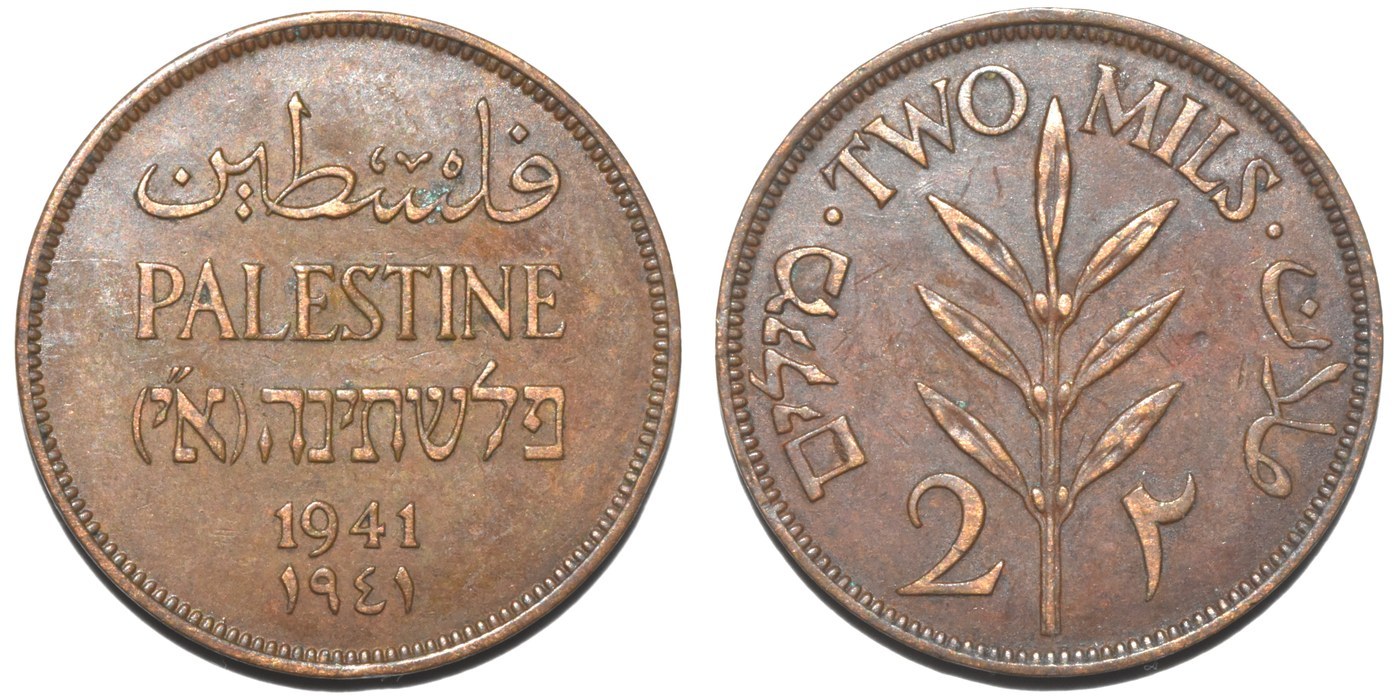
Begin with the inscriptions, which are the surest identifier. The coin names the country as PALESTINE in English, with the same name repeated in Arabic and in Hebrew; the Hebrew form reads Palestina followed by the aleph-yod abbreviation for Eretz Israel. If you do not see all three scripts and the word Palestine, you are not looking at this issue.
Read the reverse to fix the denomination. It should state TWO MILS in English, with Arabic and Hebrew equivalents, and carry a small olive sprig or branch as its central device. This is the key step that separates the 2 Mils from the almost identical 1 Mil, so confirm the numeral and word read two, not one.
Check the physical fabric. The 2 Mils is a small solid bronze coin, brown to reddish in tone, with no central hole and no monarch's portrait. That combination rules out the holed cupronickel 5, 10 and 20 mils of the same series, which have a pierced center, and rules out ordinary British colonial coins that would show the King's head. The date appears with the country name and places the coin in the 1920s-through-1940s Mandate window.
Watch for look-alikes and condition traps. The 1 Mil is the closest confusion, differing mainly in size and stated value, so always verify the wording. Because these coins are inexpensive, outright forgery is uncommon, but harshly cleaned or artificially recolored bronze is frequently seen and depresses value; look for unnatural brightness or a grainy, scrubbed surface. Corrosion and heavy wear are common on circulated pieces, so judge grade from the sharpness of the legends and olive sprig.
When in doubt, weigh and measure the coin against published specifications for the 2 Mils and compare it side by side with a trusted reference image, matching every script and the olive-branch device rather than relying on a single feature.
Frequently asked questions
How do I tell the 2 Mils from the 1 Mil?
Both are small solid bronze coins with the same trilingual PALESTINE obverse. The decisive difference is the reverse value: this coin must read TWO MILS, and it is slightly larger than the 1 Mil. Always confirm the stated denomination.
Does the Palestine 2 Mils have a mint mark?
There is no distinct mint mark to hunt for on the coin. Identify it instead by the trilingual legends, the TWO MILS reverse with olive sprig, the solid bronze fabric, and the date.
Why is there no king's portrait like other British coins?
Mandate Palestine coinage deliberately omitted a royal portrait and used neutral inscriptions and an olive-sprig motif across three languages. The absence of a monarch's head is itself a useful identifying trait.
Is a shiny, bright example more valuable or suspicious?
Original red or red-brown bronze luster is desirable and commands a premium, but an unnaturally bright or grainy surface can signal harsh cleaning or recoloring, which reduces value. Favor coins with even, undisturbed original surfaces.