
How to Identify the Oregon Trail Memorial Half Dollar
A collector's checklist for confirming an Oregon Trail half dollar — the wagon and standing-Indian designs, silver specs, date and mint mark, and authentication cautions.
Read the full Oregon Trail Memorial Half Dollar encyclopedia entry →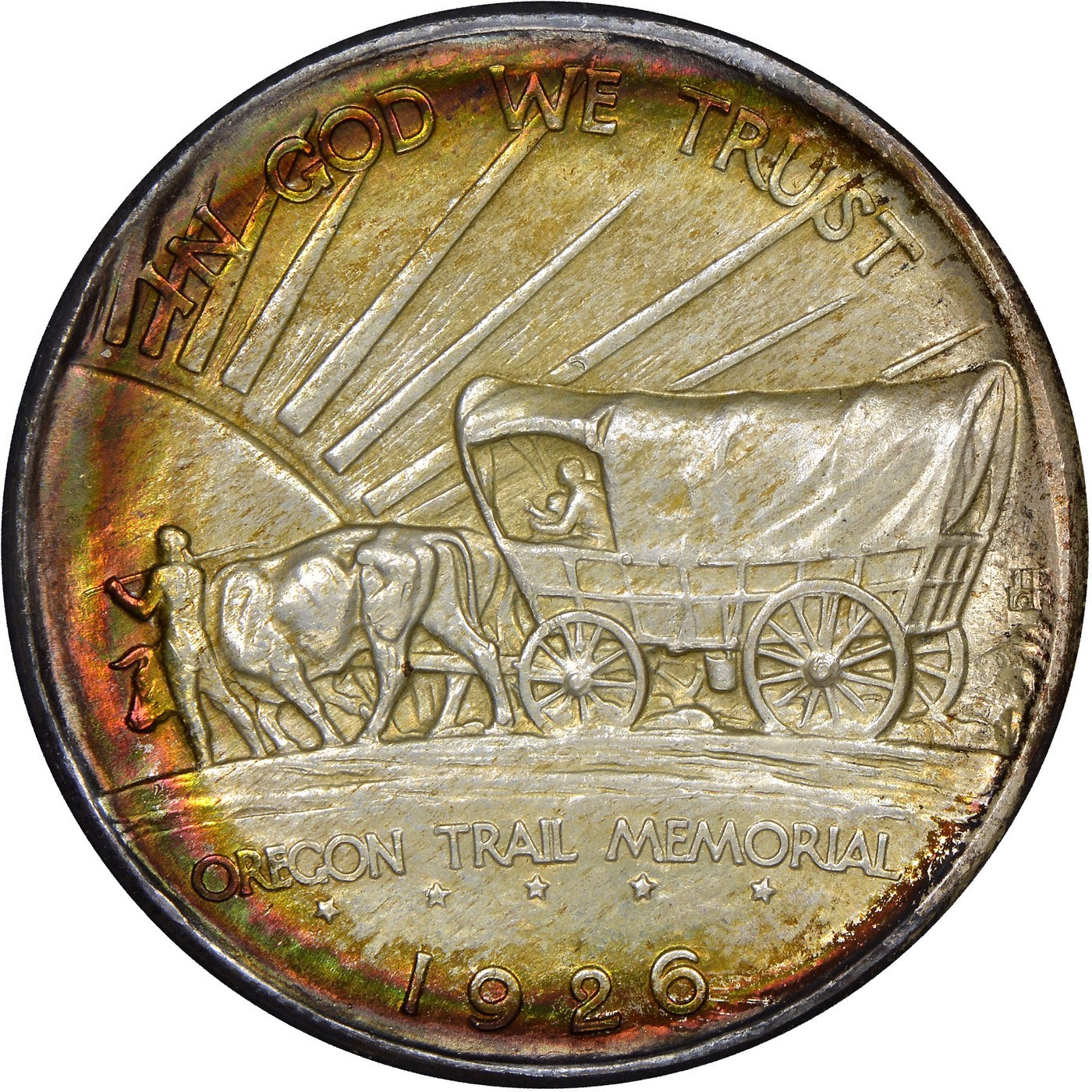
Start with the two designs, which are the surest identifiers. The wagon side (shown in these photos) carries a covered wagon and ox team with a pioneer driving west, ringed by 'OREGON TRAIL MEMORIAL' and a date. The opposite side shows a standing Native American with an outstretched arm in front of an outline map of the United States. If both of these motifs are present on a silver half dollar, you have the Oregon Trail type; no other U.S. coin combines them.
Confirm the physical specifications. The coin should be about 30.6 mm in diameter, weigh close to 12.5 grams, and be struck in .900 fine silver with a reeded edge — the same size and metal as a circulating half dollar of the era. A calibrated scale and calipers are the most reliable check; a piece that is off in weight or diameter is a warning sign.
Read the date and mint mark to pin down the exact issue. The date appears on the wagon side. The mint mark, if any, is also on that side near the ground line: blank for Philadelphia, 'S' for San Francisco, 'D' for Denver. Because the type was struck across many years and three mints, the date-and-mint combination determines both the specific issue and much of the value, so examine it carefully under magnification.
Watch for look-alikes and altered pieces. The design is unique enough that it is rarely confused with other coins, but collectors should be alert to cleaned or artificially toned examples, added or altered mint marks meant to imitate scarce dates, and outright counterfeits of the more valuable late-1930s issues. Because so many survive in high grade, worn or dull surfaces on a piece being sold as pristine deserve scrutiny.
For any higher-value date or grade, rely on professional authentication rather than eye appeal alone. Third-party grading services such as PCGS and NGC will confirm authenticity, verify the date and mint mark, and assign a grade, which is especially important for the scarce dates where a genuine, correctly attributed coin is worth many times a common one.
Frequently asked questions
How do I know it's an Oregon Trail half dollar and not another commemorative?
Look for the covered wagon with an ox team and pioneer on one side and a standing Native American against a U.S. map on the other, on a silver half dollar. That specific pairing identifies the Oregon Trail type.
What should the coin weigh and measure?
About 12.5 grams and roughly 30.6 mm in diameter, struck in .900 fine silver with a reeded edge. Figures that are noticeably off from these are a counterfeit or alteration warning sign.
Does the date on the coin tell me how rare it is?
Partly. Rarity depends on the date and mint mark together. Early high-mintage years like 1926 are common, while several late-1930s dates and mints are scarce, so read both the year and the mint mark before judging value.
Should I get the coin authenticated?
For common early dates in average condition it is optional, but for scarce dates or high grades professional grading by a service such as PCGS or NGC is strongly recommended to confirm authenticity and the mint mark.