
How to Identify the Omani Rial (Baisa Coinage)
The subsidiary baisa coinage of the Sultanate of Oman, recognizable by the crossed khanjar daggers emblem, Arabic script, and denominations of 1,000 baisa to the rial.
Read the full Omani Rial (Baisa Coinage) encyclopedia entry →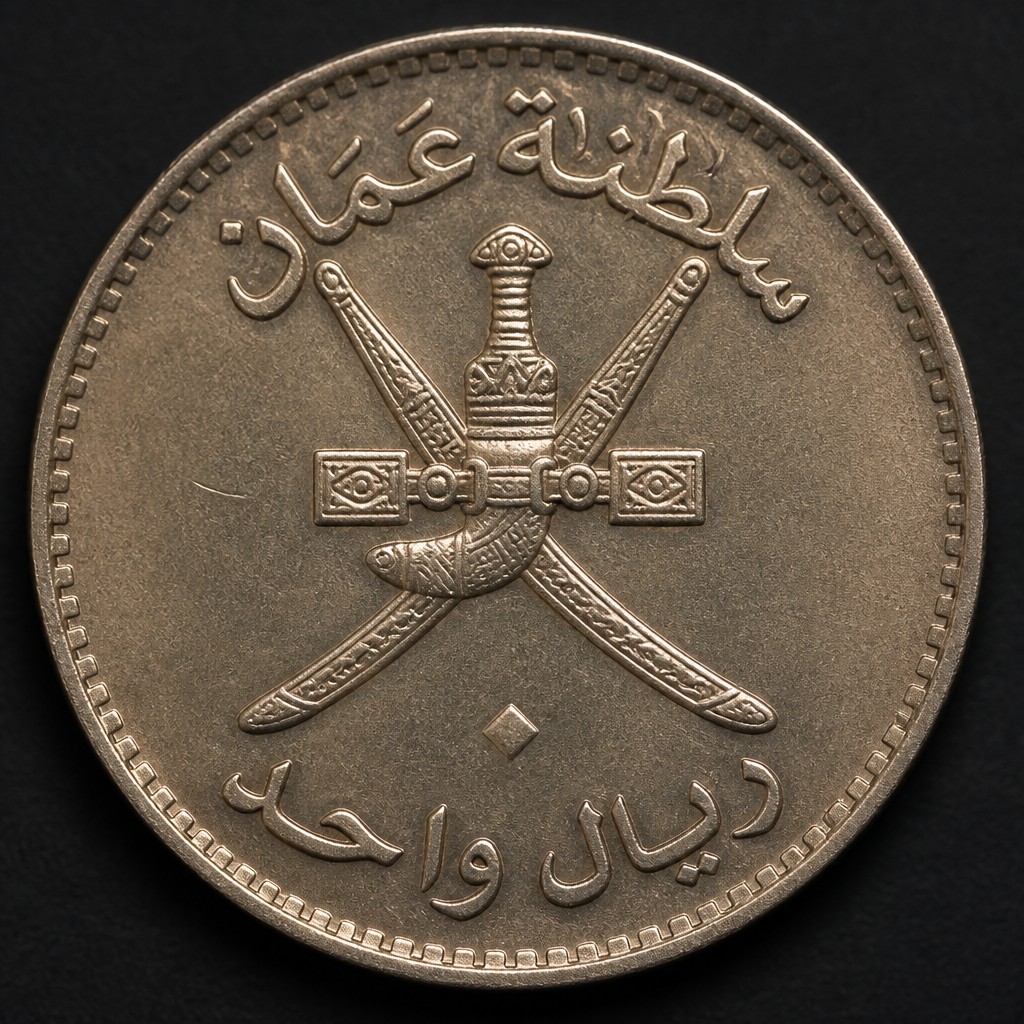
What It Is
The Omani rial is divided into 1,000 baisa, and Oman's modern baisa coinage dates mainly from the reign of Sultan Qaboos bin Said starting in 1970, replacing earlier Maria Theresa thaler-based and Gulf rupee-influenced currency systems that had circulated in the region. Denominations commonly include 5, 10, 25, 50, and 100 baisa pieces.
Obverse Design & Inscriptions
The obverse typically features Oman's national emblem: a khanjar (curved dagger) sheathed and crossed with two swords, a symbol deeply tied to Omani heritage. Arabic text names the Sultanate of Oman and, on many issues, the ruling Sultan.
Reverse Design & Inscriptions
The reverse states the denomination in Arabic and Western numerals along with the date, usually given in the Gregorian calendar alongside or instead of the Hijri calendar depending on the issue. A decorative border or pattern often frames the numeral.
Size, Weight, Metal & Edge
Baisa coins are struck in base metals, with bronze commonly used for the lowest denominations and cupro-nickel or similar white-metal alloys for higher ones. Size and weight increase with denomination, and edges vary between plain and reeded; some coins use a scalloped or ridged rim to assist identification by touch.
Mint Marks & Where to Find Them
Omani baisa coins generally do not carry a distinct mint-mark letter. The most useful identifying features are the specific khanjar-and-swords emblem design, the wording "Sultanate of Oman" (or "Muscat and Oman" on earlier issues), and the date, which together narrow down the exact issue.
Telling It Apart From Similar Coins
Earlier coinage from the region was titled "Muscat and Oman" before the country's official renaming to the "Sultanate of Oman" in 1970, so checking the exact wording of the legend is the fastest way to separate older and newer issues. Compared with other Gulf coinage, the khanjar-and-crossed-swords emblem is distinctly Omani and does not appear on Bahraini, Qatari, Kuwaiti, or Emirati coins.
Judging Condition at a Glance
The fine curved lines of the khanjar handle and blade wear down first with circulation, so a crisp, well-defined dagger outline with separated details indicates a higher-grade coin, while a smoothed, indistinct blob in that area indicates heavy wear. Also check that the date and denomination numerals remain fully legible.
Authenticity Red Flags
As with most low-denomination circulation coinage, deliberate counterfeiting for profit is uncommon, but watch for inconsistent surface color suggesting re-plating, a weight or diameter that does not match the standard for the stated denomination, and blurry or double-struck design elements that suggest a poor-quality unofficial strike rather than genuine mint production.
Frequently asked questions
What does the emblem on Omani coins represent?
It is a khanjar, a traditional curved Omani dagger, shown sheathed and crossed with two swords, a national symbol that appears on most Omani coinage and the country's flag-related imagery.
How many baisa make up one Omani rial?
One thousand baisa equal one Omani rial, making baisa coins the everyday subsidiary denomination used for small transactions.
How do I tell an older 'Muscat and Oman' coin from a newer one?
Read the Arabic legend carefully; coins from before 1970 are titled 'Muscat and Oman,' while coins from 1970 onward read 'Sultanate of Oman,' reflecting the country's official renaming.
Is the khanjar design unique to Oman among Gulf coins?
Yes, the crossed khanjar-and-swords emblem is distinctly Omani and is not used on neighboring Bahraini, Qatari, Kuwaiti, or Emirati coinage.