
How to Identify the Old Spanish Trail Half Dollar
A collector's checklist for confirming a genuine 1935 Old Spanish Trail half dollar — the cow's-head device, yucca-and-map reverse, silver specs, and cautions.
Read the full Old Spanish Trail Half Dollar encyclopedia entry →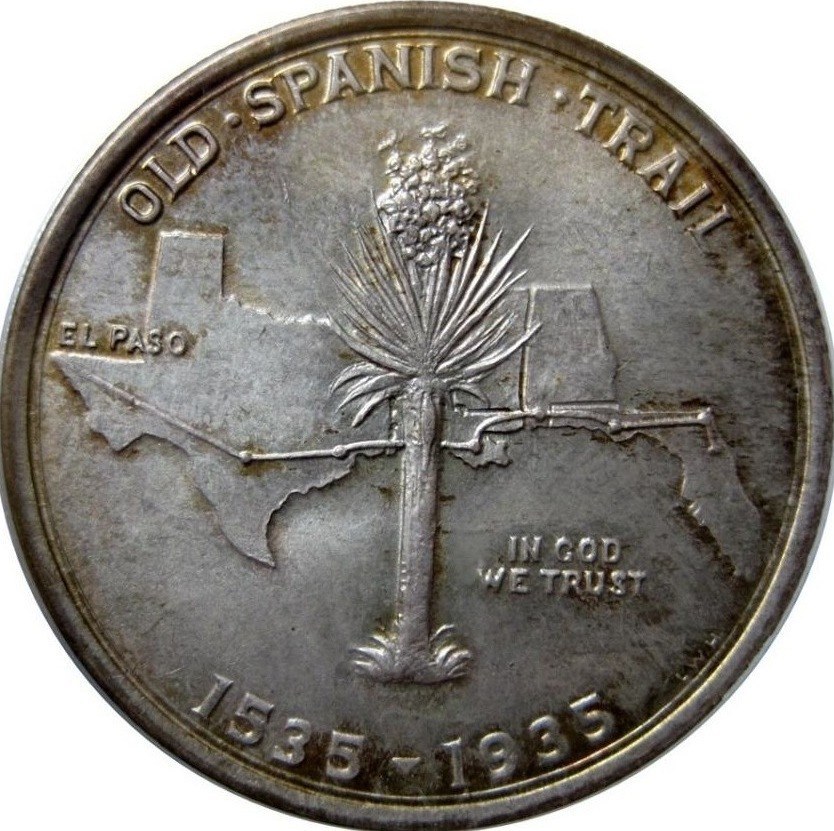
Start with the main device, which is unmistakable. A genuine Old Spanish Trail half dollar shows the head of a longhorn cow or steer facing the viewer — a deliberate pun on the name Cabeza de Vaca ("cow's head"). This side also carries HALF DOLLAR, the year 1935, and the anniversary dates 1535 and 1935. That frontal cow's head combined with those dates is specific to this type and identifies it at a glance.
Confirm the opposite side, which depicts a yucca plant (Spanish bayonet) superimposed on a map of the southern United States tracing the trail route. If a listing instead describes portraits, a Liberty figure, or unrelated buildings, it points to a different commemorative or a misidentification; the correct pairing is the cow's head with the yucca-and-map.
Check the physical specifications. The coin is standard half-dollar size: about 30.6 mm in diameter, roughly 12.5 grams, 90% silver with a reeded edge. A calibrated scale and calipers are the most reliable tools, and genuine silver is non-magnetic with a neutral gray-white color. Weight or diameter well outside these figures is a warning sign.
Do not look for a mint mark. Every example is dated 1935 and was struck at Philadelphia, so no mint mark should appear. Its absence is expected, and a piece bearing an added mint mark should be treated with suspicion.
Because this is a scarcer, higher-value commemorative, authentication matters. Watch for cleaning, artificial toning, added or re-engraved detail, and cast-surface texture. For any significant purchase, favor coins certified by a major third-party grading service (PCGS, NGC) over raw pieces judged by eye appeal alone, since low-mintage commemoratives are the ones most worth counterfeiting or doctoring.
Frequently asked questions
What is the fastest way to confirm this coin?
Look for the frontal longhorn cow's head together with the year 1935 and the dates 1535 and 1935. That cow's-head device is unique to the Old Spanish Trail type and confirms it quickly.
What is on the other side of the coin?
A yucca plant (Spanish bayonet) superimposed on a map of the southern United States that traces the trail route between its Florida and Texas endpoints.
What should the coin weigh and measure?
About 12.5 grams and roughly 30.6 mm in diameter, struck in 90% silver with a reeded edge. Figures well outside those specs are a counterfeit warning sign.
Should the coin have a mint mark?
No. It was struck at Philadelphia and carries no mint mark. A piece with an added mint mark should be treated with suspicion.