
How to Identify the Nummus of Constantine I
A collector's guide to confirming a Constantine I bronze by its portrait, obverse legend, size, metal, and mint mark, with authentication cautions.
Read the full Nummus of Constantine I encyclopedia entry →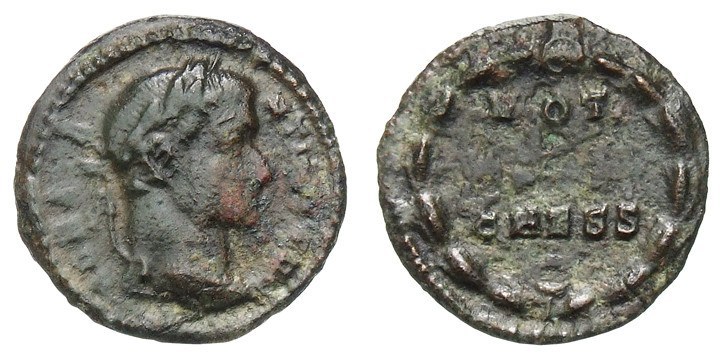
Start with the portrait. This coin shows a bust of Constantine facing right, which on his issues may appear laureate, rosette- or pearl-diademed, or helmeted depending on the date. A right-facing male imperial portrait on a small fourth-century bronze points to a nummus of this era; the exact ruler is confirmed by the legend.
Read the obverse legend to name the emperor. Constantine's coins carry his name and titles in abbreviated Latin around the rim, commonly including CONSTANTINVS together with AVG for Augustus, or NOB C / CAES on earlier junior issues. The lettering runs clockwise around the portrait, and even a partial reading of CONSTANTINVS is usually enough to attribute the coin. Be aware that his sons (Constantine II, Constantius II, Constans) used similar names, so read the legend fully where possible.
Check size, weight, and metal. Expect a small bronze coin roughly 17-25 mm across and only a few grams; the exact size depends on the date, because the nummus was reduced over Constantine's reign. Genuine surfaces are usually brown, green, or grey with age, occasionally with traces of the original thin silvering. The metal is non-magnetic. A coin that looks like bright, heavy modern silver, or that sticks to a magnet, is a warning sign.
Use the reverse and mint mark when they are legible. This image does not clearly show the reverse, so the exact type cannot be read here. On a complete coin the reverse design and legend identify the type, and the small mint mark in the exergue (below the reverse design) identifies the issuing mint — abbreviations such as those for Trier, Rome, Siscia, Antioch, or Constantinople — both essential for a precise attribution and for judging any premium.
Apply authentication caution. Because Constantinian bronzes are common and inexpensive, outright forgeries are less of a concern than with rare coins, but tooled, cast, and artificially patinated examples do exist. Look for crisp, unmushy lettering, natural wear consistent with age, and a patina that sits in the recesses rather than a painted-on surface. For anything sold as scarce or high-grade, buy from a reputable dealer and favor coins with a clear provenance.
Frequently asked questions
What feature tells me this is a coin of Constantine and not his sons?
The obverse legend. Constantine I reads CONSTANTINVS, but his sons Constantine II, Constantius II, and Constans used similar names, so read the full legend where possible rather than relying on the portrait alone.
What size and metal should a genuine example be?
A small bronze coin roughly 17-25 mm across and only a few grams, the exact size depending on date. Surfaces are typically brown, green, or grey, sometimes with traces of silvering, and the metal is non-magnetic.
Why does the mint mark matter?
The mint mark in the reverse exergue identifies which imperial mint struck the coin and helps pin down the exact type. It cannot be checked here because the reverse is not clearly visible in this image.
Are these coins often faked?
Because they are common and cheap, outright fakes are relatively uncommon, but tooled, cast, or artificially patinated pieces exist. Favor crisp lettering, natural wear, and recessed patina, and buy scarcer examples from reputable sources.