
How to Identify the Nova Eborac Copper
A 1787 state copper struck for New York, named from the Latin 'Nova Eboraca' for New York, identified by its seated figure obverse and standing Indian or seated Liberty reverse varieties.
Read the full Nova Eborac Copper encyclopedia entry →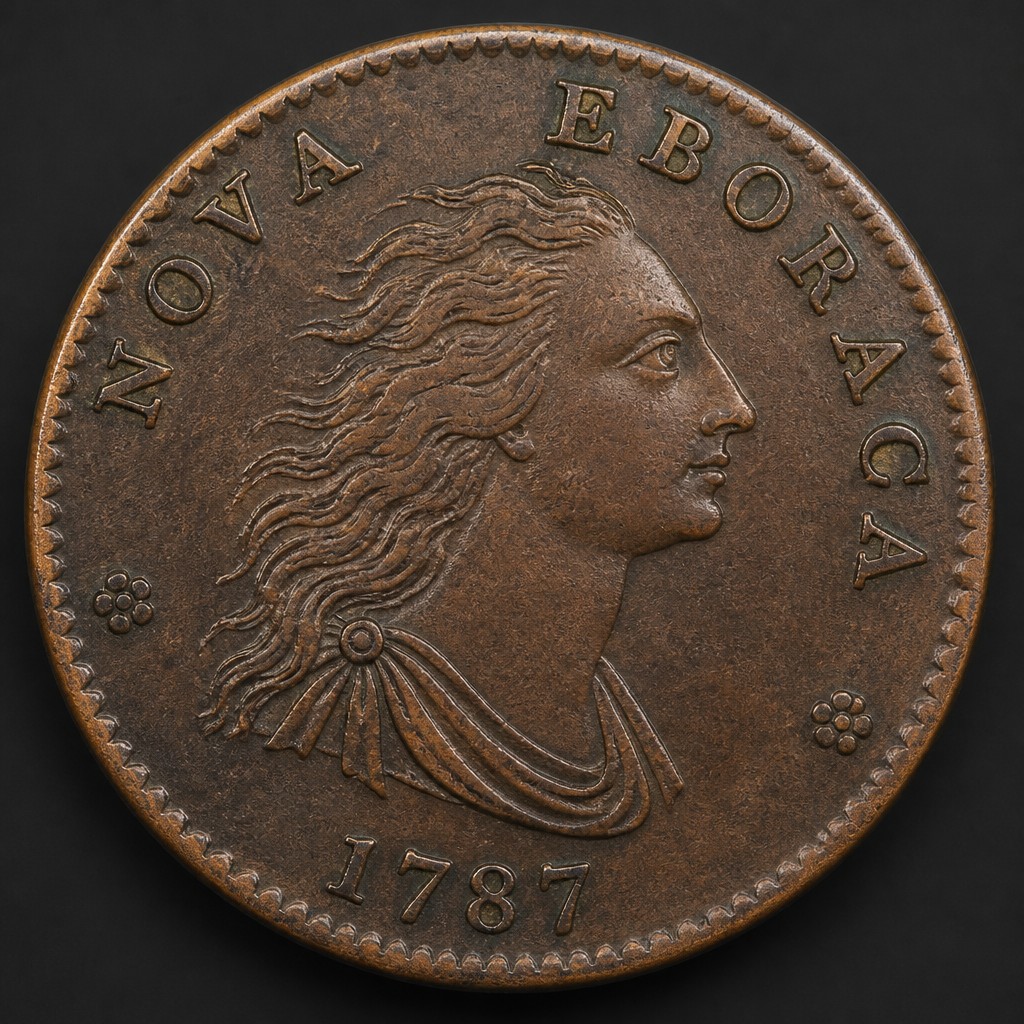
What It Is
The Nova Eborac Copper was struck in 1787, one of several state-authorized or privately produced coppers that filled the need for small change in New York during the Confederation period before a national coinage system was established. "Nova Eborac" is a Latinized form of "New York," referencing the city's former name Eboracum-linked heritage used decoratively on coinage of the era.
Obverse Design & Inscriptions
The obverse shows a seated figure facing left, generally interpreted as a classical female figure, with the legend NOVA EBORAC around the border and the date 1787 below.
Reverse Design & Inscriptions
Reverse designs vary by die variety: some show a walking or standing Native American figure, while others show a seated Liberty-like figure facing right. The legend and border details differ slightly between these types, which numismatists use to classify the several known Nova Eborac varieties.
Size, Weight, and Metal
These are copper coins roughly the size of a large cent of the period, around 28-29 mm in diameter, with weight in the range typical of contemporary state coppers, generally between 5 and 8 grams depending on striking quality and wear.
Mint Marks
No mint marks are present; Nova Eborac coppers were not struck at a formal government mint with mint-mark conventions. Attribution instead depends on comparing the seated figure's pose and the reverse device against documented die varieties from research on 1787-dated New York-related coppers.
Telling It Apart From Similar Coins
Nova Eborac coppers are sometimes confused with other 1787-dated coppers of the Confederation period, such as Connecticut coppers or the Fugio cent, but the NOVA EBORAC legend is the clearest identifier. Because dies were sometimes mismatched or shared with other issues of the period, some reverse types seen paired with a Nova Eborac obverse also appear on other contemporary coppers, so careful comparison of both sides together is important for correct attribution.
Judging Condition at a Glance
Look at the seated figure's drapery and the reverse figure's outline for strike sharpness. As with most 18th-century hand-struck coppers, uneven striking was common even on new coins, so some weakness in certain areas does not necessarily indicate heavy circulation wear; overall smoothness and loss of fine linework across the whole coin is the better indicator of a well-worn example.
Authenticity Red Flags
Given the value collectors place on rare Confederation-era coppers, contemporary and modern counterfeits exist. Signs of a problem piece include cast texture with tiny surface bubbles or pitting, an incorrect diameter or weight compared to documented genuine specimens, and mismatched or anachronistic lettering styles. Because attribution among 1787 state coppers can be technical, comparing a candidate coin closely to published die varieties, or seeking an experienced early American copper specialist's opinion, is the best path to a confident identification.
Frequently asked questions
What does 'Nova Eborac' mean?
It is a Latinized form of the name New York, used decoratively on the coin's obverse legend.
What reverse designs appear on Nova Eborac coppers?
Known varieties show either a standing Native American figure or a seated figure resembling Liberty, depending on the specific die pairing.
Does the Nova Eborac Copper have a mint mark?
No, it has no mint mark since it wasn't struck at an official government mint; identification relies on design and legend.
How do I avoid confusing this with other 1787 state coppers?
Look for the NOVA EBORAC legend on the obverse, which is unique to this issue even though some reverse dies were shared with other period coppers.
Why do genuine Nova Eborac coppers sometimes look unevenly struck?
Hand-operated screw presses and worn dies were common in the 1780s, so uneven strikes are typical of genuine coppers from this era and not necessarily a sign of wear or a fake.