
How to Identify the Nova Constellatio Copper
A private-issue copper struck in the 1780s featuring a radiant all-seeing eye surrounded by thirteen stars, with the Latin motto NOVA CONSTELLATIO.
Read the full Nova Constellatio Copper encyclopedia entry →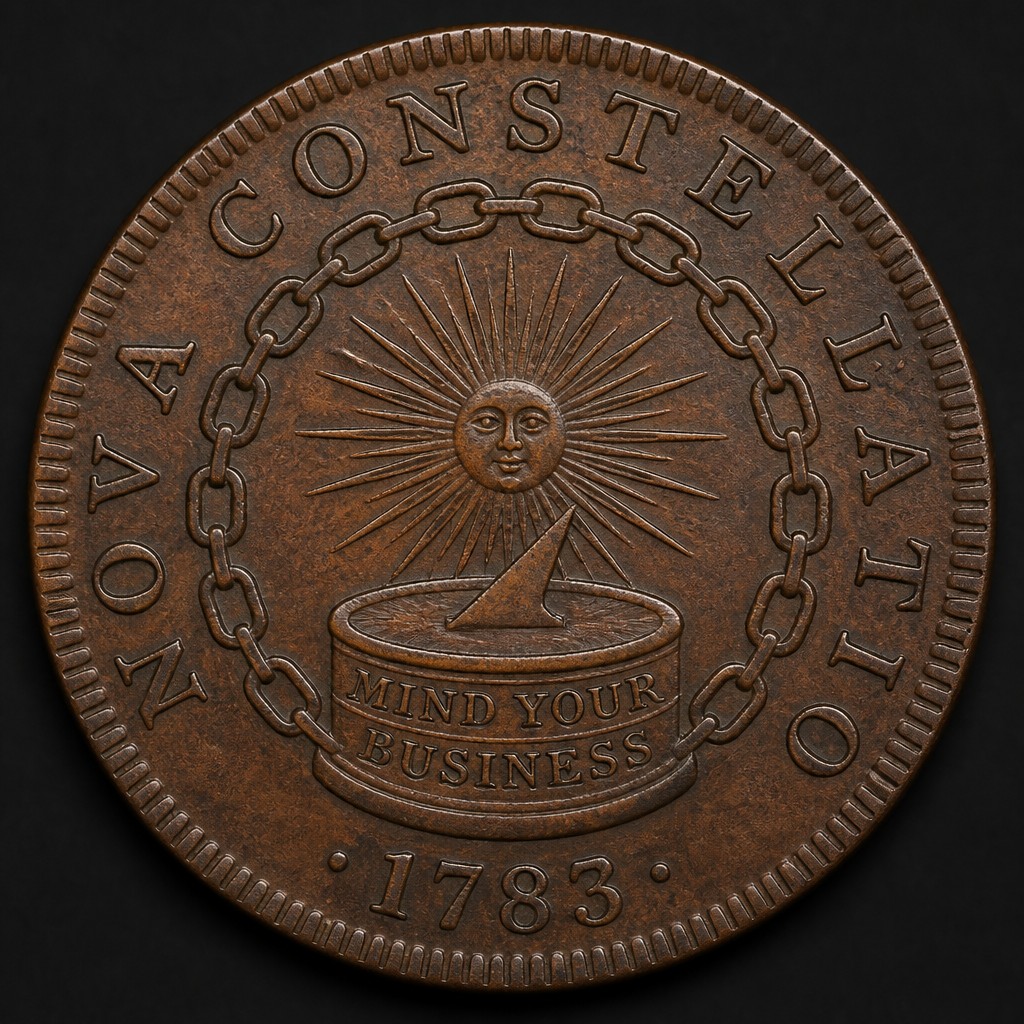
What It Is
The Nova Constellatio Copper is a privately produced token-like coin from the mid-1780s, made primarily in Birmingham, England for circulation in the newly independent United States. Its name comes from the Latin motto meaning "new constellation," a reference to the young nation.
Obverse Design
The obverse features a radiant eye at the center, surrounded by rays and encircled by thirteen six-pointed stars representing the original states. The Latin legend "NOVA CONSTELLATIO" curves around the design, with the date below.
Reverse Design
The reverse displays the abbreviation "U.S." at the center inside a wreath, with the legend "LIBERTAS JUSTITIA" (Liberty and Justice) around the border.
Size, Weight, and Metal
Struck in copper, these pieces are similar in diameter to a large cent, roughly 28mm, with weight typically in the range of 8-10 grams depending on the specific die variety. The edge is plain on most examples.
Mint Marks
No mint mark appears since production was contracted privately rather than run through an official mint; identification relies on die variety and the arrangement of stars and rays around the central eye.
Telling It Apart From Similar Coins
The all-seeing eye and star motif is distinctive and should not be confused with other Confederation-era coppers like the Constellatio design used on related contemporary tokens with different star counts, or with state coppers bearing eagle or shield reverses. Careful counting of the stars and comparing ray patterns helps separate genuine die varieties from later fantasy pieces.
Judging Condition at a Glance
High-grade pieces show crisp rays emanating from the eye and clear individual points on each star. On worn coins, the central eye can flatten first, so check the surrounding stars and the wreath on the reverse for remaining detail when grading circulated examples.
Authenticity Red Flags
Because this design has been reproduced as a collector's fantasy piece and in decorative reproductions, watch for overly uniform, sharp modern lettering, incorrect star counts, or a suspiciously light weight. Genuine 18th-century coppers typically show natural circulation wear, minor planchet flaws, and slightly uneven striking rather than the machine-perfect finish of modern strikes.
Frequently asked questions
What does the eye symbol on this coin represent?
It is a radiant, all-seeing eye motif surrounded by stars, symbolizing providence watching over the new United States.
How many stars surround the eye?
Standard examples show thirteen stars, one for each of the original states, though exact arrangement varies by die.
Where was the Nova Constellatio Copper actually made?
Most were struck in Birmingham, England, then shipped to America for circulation, rather than being made in any American mint.
What material is it struck in?
It is a plain copper coin, similar in size to a large cent.