
How to Identify the Norwegian Speciedaler
Norway's traditional large silver coin from the 19th century, identified by its lion-and-axe national emblem and portrait of the Swedish-Norwegian union king.
Read the full Norwegian Speciedaler encyclopedia entry →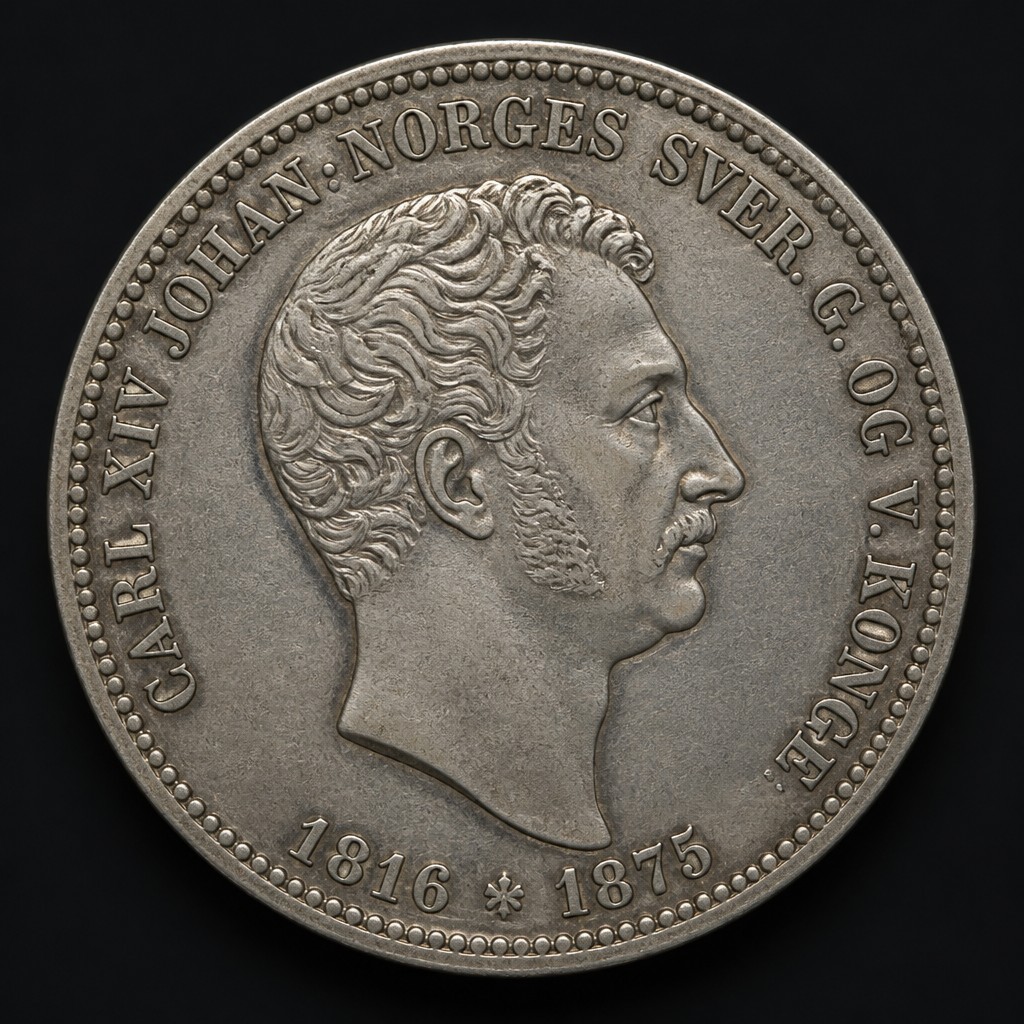
What Is the Norwegian Speciedaler?
The Speciedaler was Norway's principal silver coin denomination from the early 19th century until the country adopted the krone in 1875 alongside Sweden and Denmark. Many examples were struck during the period of union between Norway and Sweden (1814–1905), so they often carry the portrait of a king who ruled both nations.
Obverse Design
Depending on the specific issue, the obverse either shows a profile portrait of the reigning king — such as Carl XIV Johan, Oscar I, Carl XV, or Oscar II — or a crowned royal monogram. Legends typically reference the king's title over both Sweden and Norway, reflecting the political union of the era.
Reverse Design
The reverse centers on Norway's national emblem: a crowned lion rampant holding a battle axe, a design rooted in medieval Norwegian heraldry. The denomination "SPECIEDALER" and the date usually appear around or below the lion, often within a wreath or decorative border.
Size, Weight & Metal
As with other Scandinavian speciedaler coins, this is a substantial silver piece, generally struck at roughly .875 fineness, weighing close to 28 to 29 grams, with a diameter in the range of 38 to 40 millimeters.
Mint Marks
Norwegian coins of this period were produced at the Kongsberg mint. Small initials belonging to the mint master of the time can appear near the rim, which collectors use to help identify specific varieties within a given date.
Telling It Apart from Similar Coins
The lion-with-axe emblem is the fastest way to confirm a Norwegian origin, distinguishing it immediately from the Danish triple-lion-and-hearts arms and the Swedish three-crowns design. Since Norway and Sweden shared the same monarch for most of the 19th century, the obverse portrait alone will not tell the two apart — always check the reverse emblem.
Judging Condition at a Glance
Examine the lion's mane and the fine details of the axe head, along with the king's hair if a portrait is used — these raised areas wear down first. A coin in higher grade shows crisp claws and a well-defined crown above the lion's head, while a heavily circulated piece shows a smoothed, rounded lion outline and softened lettering.
Authenticity Red Flags
Watch for coins with a flat or lifeless strike on the lion's features, incorrect edge finishing compared to known genuine pieces, and weights that deviate meaningfully from the expected 28 to 29 gram range. As with other historic Scandinavian crowns, artificially bright or heavily polished surfaces should raise questions about past cleaning or alteration.
Frequently asked questions
What replaced the Norwegian Speciedaler?
The krone replaced the Speciedaler in 1875 as part of the Scandinavian Monetary Union.
What is depicted on the reverse?
Norway's national emblem: a crowned lion rampant holding a battle axe.
Why does a Norwegian Speciedaler sometimes show a Swedish king?
Norway and Sweden were united under one monarch from 1814 to 1905, so many coins share portraits with Swedish Riksdaler issues from the same kings.
How can I tell it apart from a Swedish or Danish coin of the same era?
Check the reverse emblem — Norway uses a lion with an axe, Sweden uses three crowns, and Denmark uses crowned lions with hearts.
Where were these coins minted?
At the Kongsberg mint in Norway, with mint master initials sometimes visible near the rim.