
How to Identify the Newfoundland One Cent
Collector checks for the bronze Newfoundland large cent: reverse wording, Edward VII portrait, size and metal, the H mint mark, and look-alikes.
Read the full Newfoundland One Cent encyclopedia entry →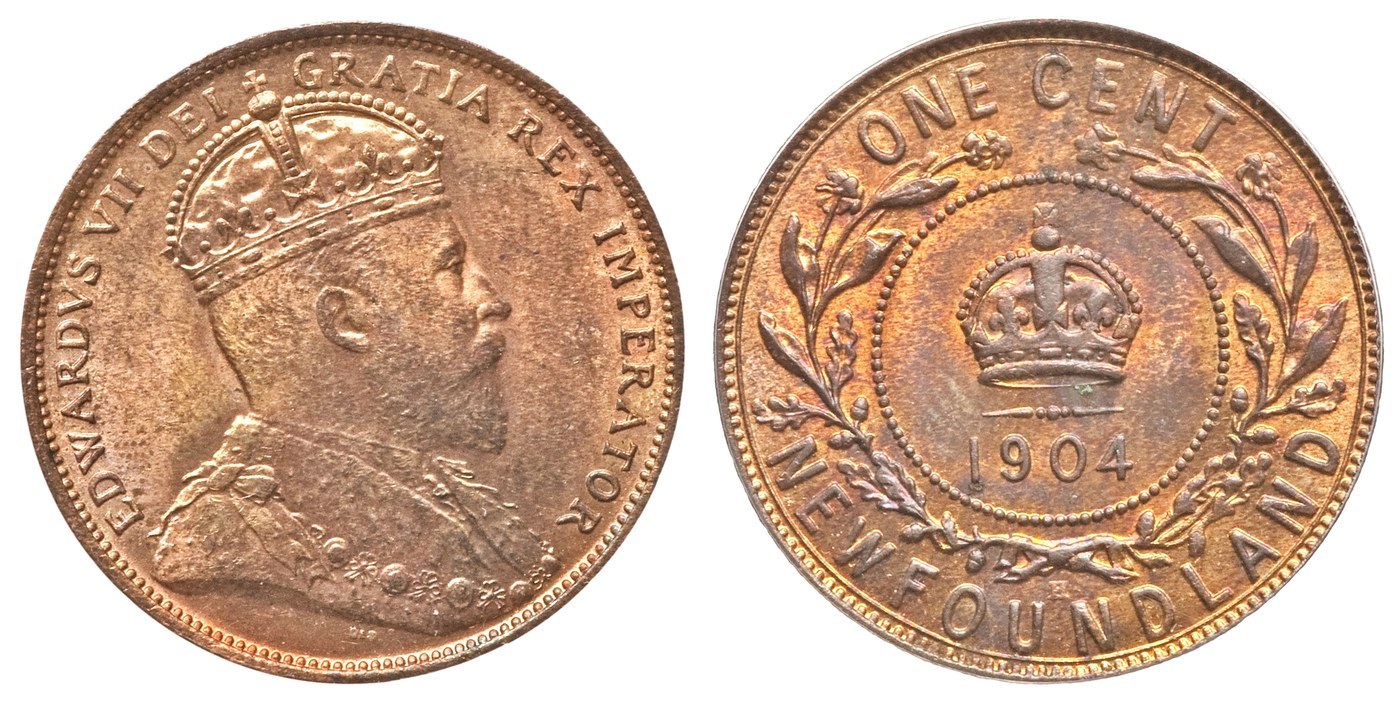
Begin with the reverse, because the wording settles the country at once. Look for a wreath enclosing ONE CENT and NEWFOUNDLAND, with the date beneath. That NEWFOUNDLAND legend is the key diagnostic; a similar-looking cent reading CANADA is the Canadian large cent, and a British penny shows Britannia rather than a wreath.
Turn to the obverse to fix the reign. On this type you see a bare, right-facing head of Edward VII and a Latin legend along the lines of EDWARDVS VII DEI GRATIA REX IMPERATOR. Read the date carefully; Edward VII Newfoundland cents exist only for 1904, 1907, 1908 and 1909. A bearded left-facing bust points to Victoria, and a crowned or older-looking king to George V, both different types in the same series.
Use the physical standard as a cross-check. A genuine large cent is bronze, weighs about 5.67 grams, measures roughly 25.5 mm across, has a plain edge, and is non-magnetic. A coin that is silver-coloured, magnetic, much lighter, or much smaller is not this bronze cent.
Check for a mint mark on the 1904 issue. A small H below the date indicates striking at the Heaton Mint in Birmingham; its absence indicates a Royal Mint striking. The H is a legitimate mint mark, not damage, so do not mistake it for a fault or an added letter.
Mind the look-alikes and handle cleaning cautiously. The Canadian large cent of the same era is almost identical in size and metal and differs mainly in the legend and portrait, so confirm the NEWFOUNDLAND wording before attributing the coin. Because bronze tones naturally, avoid polishing a promising piece; original brown or red-brown surfaces matter to value, and for a scarce date or high grade it is worth seeking a second opinion from a reputable dealer.
Frequently asked questions
How do I tell a Newfoundland cent from a Canadian one?
Read the reverse legend. A Newfoundland cent spells NEWFOUNDLAND within the wreath, while the Canadian large cent reads CANADA. The two are otherwise very similar in size and metal.
Where is the mint mark on a 1904 cent?
On the reverse, a small H below the date marks a Heaton Mint (Birmingham) striking. Coins with no letter were struck at the Royal Mint in London.
What should a genuine large cent weigh and measure?
About 5.67 grams in bronze, roughly 25.5 mm in diameter, with a plain edge and no magnetic response. Significant deviation suggests a different coin or a fake.
Should I clean a Newfoundland cent to identify it?
No. Cleaning damages the surfaces and lowers value. If wear makes the date or legend hard to read, use magnification and good light rather than abrasives.