
How to Identify the Newfoundland Five Cents
Collector checks for the tiny Newfoundland silver 5 cents: crowned reverse, George V portrait, sterling standard, size, and fakes.
Read the full Newfoundland Five Cents encyclopedia entry →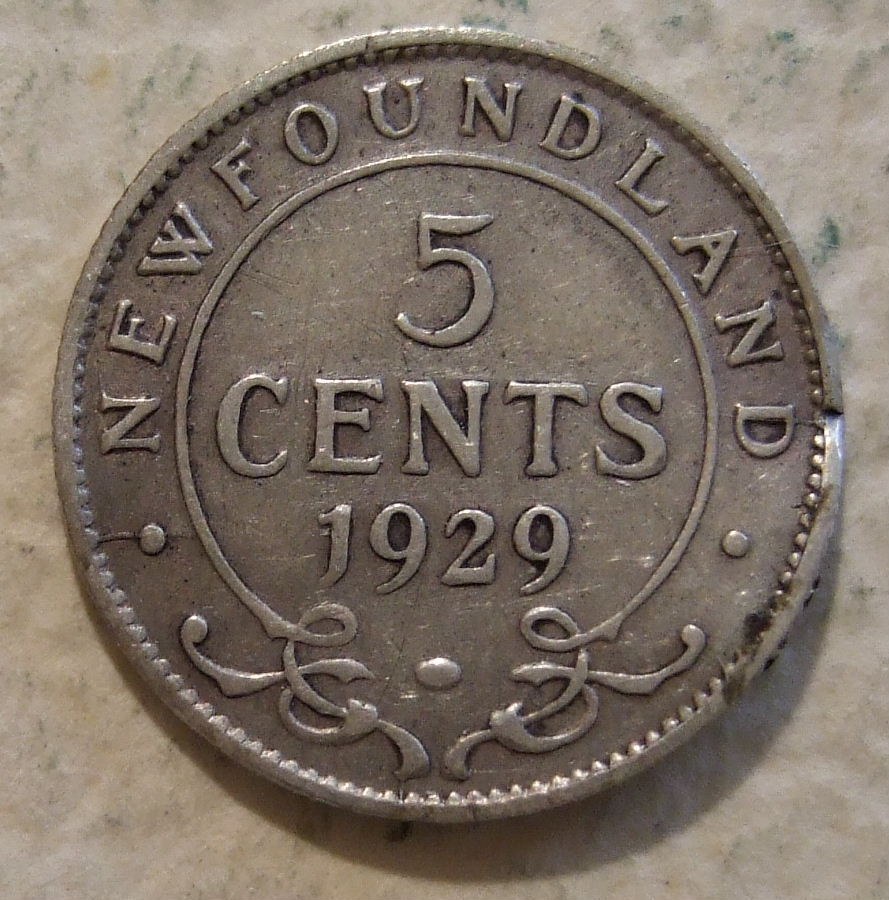
Begin with the reverse, which carries the type's signature layout: NEWFOUNDLAND arched around a central crown, the denomination 5 CENTS, the date, and ornamental leaf sprigs. Reading the country name in full is the quickest way to separate this piece from a similarly sized Canadian five-cent silver, which instead reads CANADA.
Turn to the portrait side and match the monarch to the date. A coin dated 1929 should show King George V with a Latin legend abbreviating GEORGIVS V. Earlier coins of the series show Victoria or Edward VII, and later ones George VI, so a portrait that does not match the date points to a misread year or a problem coin.
Cross-check the physical standard, because size and metal are decisive here. Expect sterling silver (.925), a weight of about 1.18 grams, a diameter near 15.5 mm, and a reeded edge. This is smaller than a U.S. dime; a coin that is noticeably larger, heavier, magnetic, or non-silver in tone is not this type. A jeweller's scale and calipers settle most questions.
Check for mint marks and beware look-alikes. Royal Mint (London) strikings usually bear no mark, while other facilities used across the series may show a small H (Heaton) or C (Ottawa). The nearest confusions are the contemporary Canadian and Nova Scotia-era small silver, and Newfoundland's own other silver denominations; confirm both the country name and the value to avoid mixing them up.
Finally, weigh authentication against the coin's likely value. Common circulated dates such as 1929 are rarely faked, so careful measurement usually suffices. For scarce dates, unusually sharp "uncirculated" coins, or any date that looks re-cut, examine the digits under magnification and seek a written opinion from a reputable dealer or grading service before relying on it.
Frequently asked questions
How do I tell a Newfoundland five cents from a Canadian one?
Read the reverse legend. Newfoundland spells out NEWFOUNDLAND around the crown, while the Canadian small silver five cents reads CANADA. Both are tiny silver coins of similar size.
What should a genuine coin weigh and measure?
About 1.18 grams of sterling silver (.925), roughly 15.5 mm in diameter, with a reeded edge. A magnetic response or a much heavier weight indicates it is not genuine.
Does the 1929 coin have a mint mark?
Typically none, as most Newfoundland five cents were struck at the Royal Mint in London. A small H or C on other issues in the series indicates the Heaton or Ottawa mint.
Do I need it professionally graded?
For a common circulated date like 1929, careful measurement is usually enough. For scarce dates or high-grade coins, have them authenticated by a third-party grading service.