
How to Identify the New Zealand Florin
Collector checks for the silver two-shilling florin: the kiwi reverse, denomination wording, size and metal, and how to tell it from its neighbours.
Read the full New Zealand Florin encyclopedia entry →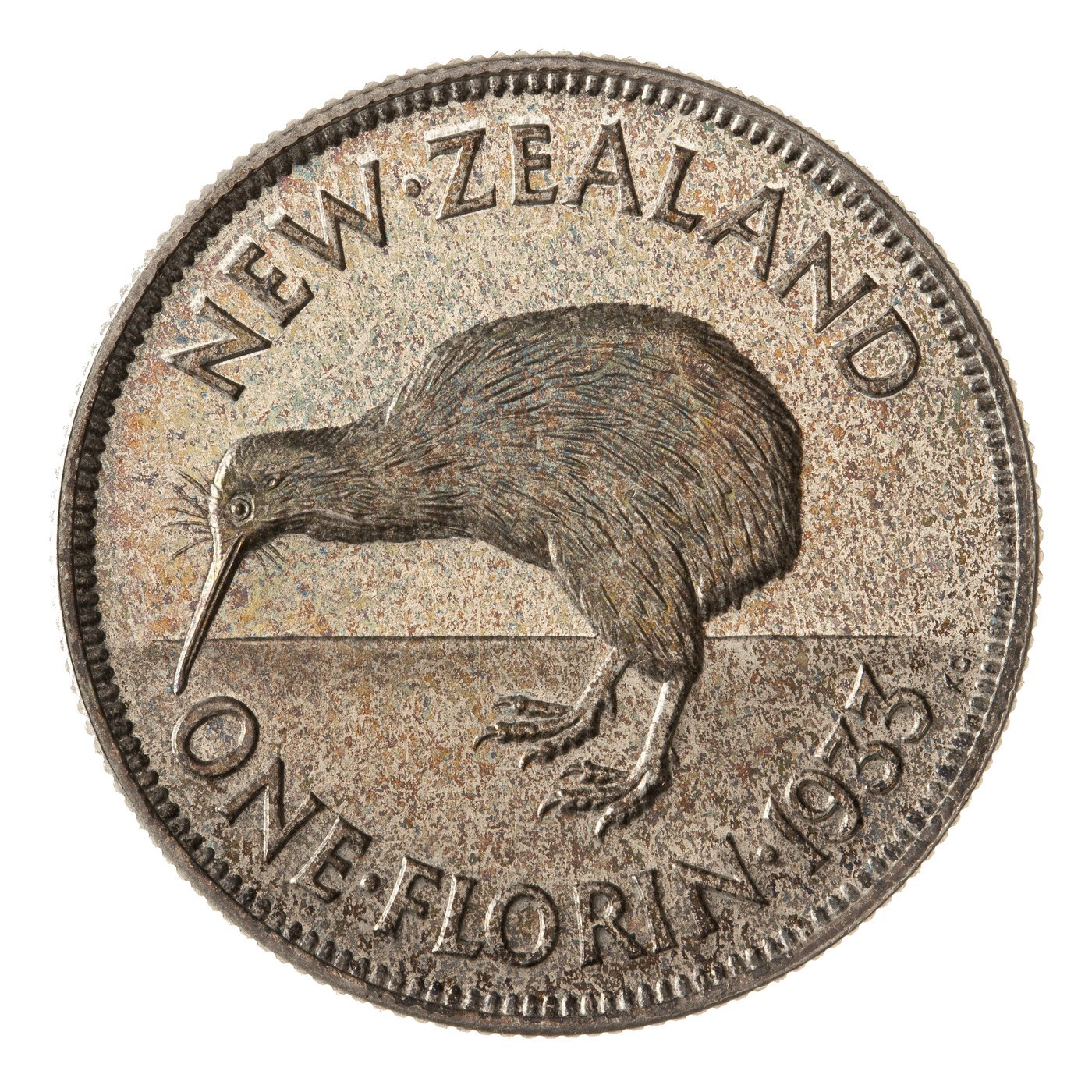
Start with the reverse, because it names the coin. A genuine florin of this type reads NEW ZEALAND ONE FLORIN with the date and shows a kiwi standing in the field. On this example the date is 1933, the first year of New Zealand's own coinage. The kiwi is unique to the florin, so if the reverse shows a Māori warrior, a bird other than a kiwi, or a heraldic shield, you are holding a different denomination.
Check the obverse for the monarch. A 1933 florin should carry the crowned effigy of King George V with Latin titles around the rim. The portrait changed with each reign, so a George VI or Queen Elizabeth II bust points to a later date in the series rather than to this coin. Matching the monarch to the date is a quick authenticity cross-check.
Measure the coin. The florin is about 28-29 mm in diameter and weighs roughly 11.3 grams, with a reeded edge, and 1933-1946 pieces are .500 silver. That size clearly separates it from the smaller shilling, sixpence, and threepence. Note that New Zealand silver of this era is .500 fine, not sterling, so do not expect the weight or feel of an older British sterling coin.
Mind the look-alikes. Within the New Zealand series each denomination carries a different reverse: kiwi for the florin, Māori warrior for the shilling, huia for the sixpence, arms for the half-crown, and crossed patu for the threepence. The kiwi plus ONE FLORIN together confirm the two-shilling piece. Also distinguish ordinary circulation strikes from proof or specimen strikes, which have mirror fields and sharper detail and are valued separately.
For authentication, weigh and measure any promising coin and inspect the date and legend under magnification for tooling or alteration. Silver is non-magnetic, so a magnetic response or a large weight deviation is a warning sign. Cleaning harms value, and desirable dates and grades attract fakes, so have a scarce date, a proof, or a high-grade coin verified by a reputable dealer or grading service before relying on it.
Frequently asked questions
How do I tell a florin from a shilling?
Look at the reverse image and legend. The florin reads ONE FLORIN and shows a kiwi; the shilling shows a Māori warrior and is smaller and lighter. The florin is the larger coin at about 28-29 mm and 11.3 grams.
Is my 1933 florin sterling silver?
No. New Zealand florins from 1933 to 1946 are .500 (50%) silver, not sterling. From 1947 the coin is cupro-nickel with no silver content.
What should a genuine florin weigh?
About 11.3 grams and roughly 28-29 mm across, with a reeded edge. Silver is non-magnetic, so a magnetic response or a large weight deviation suggests a problem.
Do I need professional authentication?
For common circulated dates, careful measurement is usually enough. For scarce dates, proofs, or high-grade coins, have the piece verified by a reputable dealer or third-party grading service.