
How to Identify the New Rochelle Half Dollar
A collector's checklist for confirming a 1938 New Rochelle half dollar — the calf obverse, fleur-de-lis reverse, silver specs, and authentication cautions.
Read the full New Rochelle Half Dollar encyclopedia entry →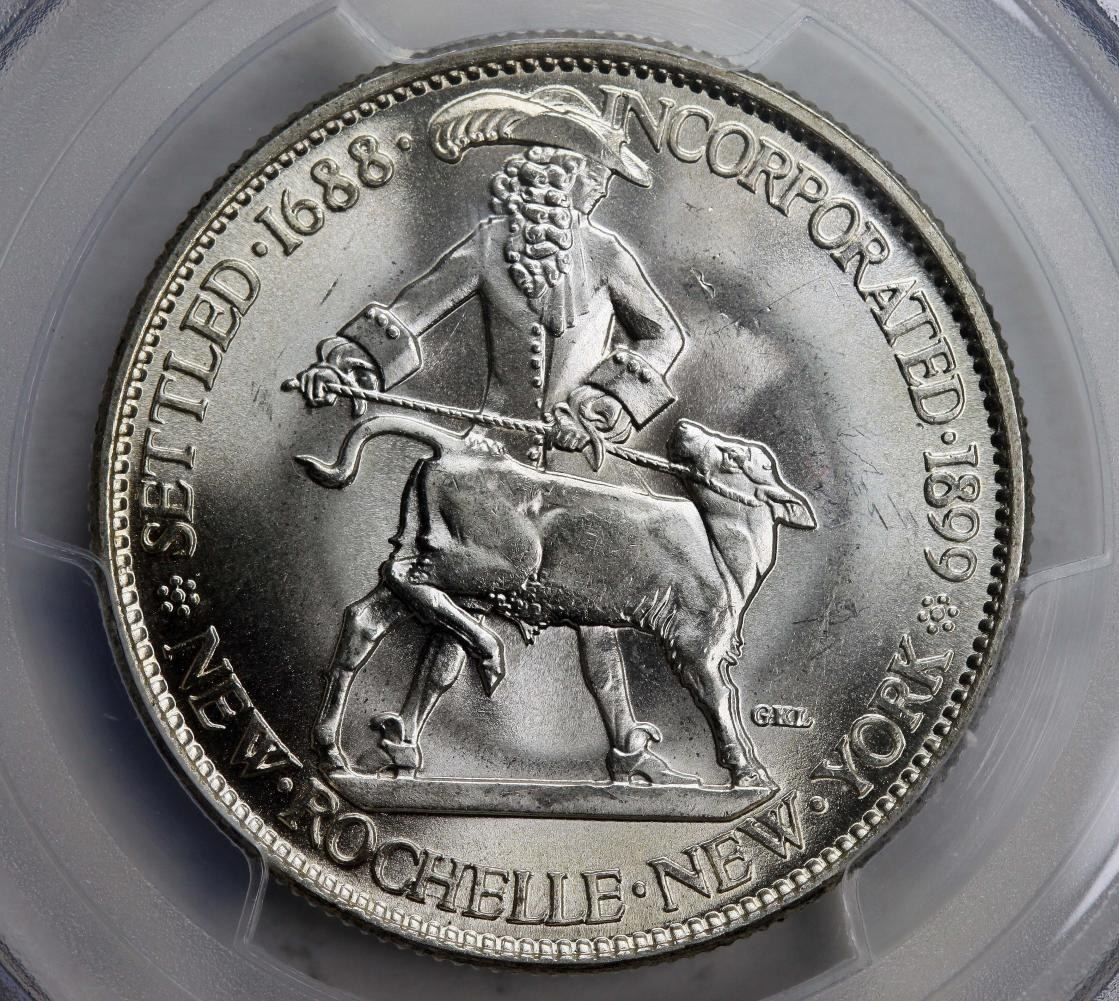
Start with the obverse scene and the dual dates. A genuine New Rochelle Half Dollar shows a standing figure leading a fatted calf, with the paired dates 1688 and 1938 marking the 250-year anniversary. This calf-and-figure motif is unlike any circulating coin and is the quickest way to separate the type from the Walking Liberty half dollar being struck at the same time, which shows a full striding Liberty figure.
Next, confirm the reverse. It should display a stylized fleur-de-lis drawn from New Rochelle's city seal, along with the statutory lettering and denomination. If a coin offered as this type shows a portrait, a memorial building, an eagle, or a horseback rider instead of the fleur-de-lis, it is not a New Rochelle half dollar — similar-sounding or misattributed listings sometimes mix it up with other commemoratives, so verify the actual design rather than the title.
Verify the physical specifications. The coin is a standard half dollar: roughly 30.6 mm in diameter, about 12.5 grams, struck in 90% silver with a reeded edge. A calibrated scale and calipers are the best tools here; a piece that is off in weight, diameter, or edge reeding for a silver half dollar is a warning sign.
Expect no mint mark and only the 1938 date. Every genuine example was struck at Philadelphia in 1938, so the absence of a mint mark is normal. Any New Rochelle half dollar carrying a mint mark, or a date other than 1938, should be treated as suspect.
Be cautious with authentication, since low-mintage commemoratives are targets for counterfeiting and for cleaning or artificial toning that can mask problems. Watch for mushy or doubled lettering, incorrect weight, tooling, or a color that does not match 90% silver. For any higher-value purchase, rely on reputable dealers and third-party grading (PCGS, NGC) rather than eye appeal alone.
Frequently asked questions
How do I tell it apart from a circulating 1938 half dollar?
The commemorative shows a figure leading a fatted calf on the obverse and a fleur-de-lis on the reverse, not the Walking Liberty design. Those New Rochelle-specific devices are unlike any regular-issue half dollar of the era.
What should a genuine example weigh and measure?
About 12.5 grams and roughly 30.6 mm in diameter, in 90% silver with a reeded edge. Figures that don't match those of a standard silver half dollar are a counterfeit warning sign.
Should the coin have a mint mark?
No. All were struck at Philadelphia in 1938 with no mint mark. A mint mark, or any date other than 1938, indicates a problem and warrants caution.
What are the key design elements to check?
Look for the man-and-calf obverse with the dates 1688 and 1938, and the fleur-de-lis reverse taken from the city seal. If either side shows a different design, the coin is not a genuine New Rochelle half dollar.