
How to Identify the Native American Dollar
A collector's walkthrough for the golden Native American Dollar: the Sacagawea obverse, the yearly reverse, edge lettering, and how to date the 2009 corn design.
Read the full Native American Dollar encyclopedia entry →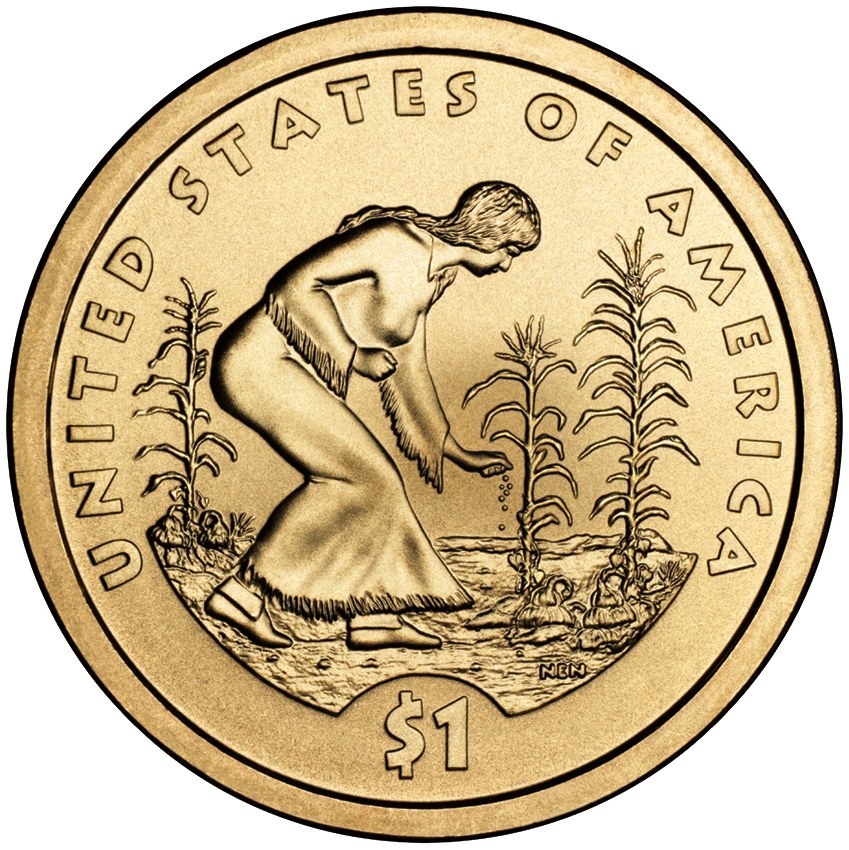
Begin with color and size. The Native American Dollar is a golden-toned coin about 26.5 mm across — larger than a quarter — struck in manganese brass with a smooth, plain edge. If your coin is silver-colored, reeded on the edge, or much smaller, it is not this type. The golden color comes from the alloy, not from any gold content.
Look at the obverse. It shows Sacagawea in three-quarter view carrying her infant son, with LIBERTY and IN GOD WE TRUST as inscriptions. This portrait is shared with the earlier Sacagawea Dollars (2000–2008), so the obverse alone does not tell you which series you have — you must check the reverse and the edge.
The reverse is the key to the year and theme. On the 2009 coin you will see three corn stalks together with the motto E PLURIBUS UNUM, reflecting the inaugural agriculture theme. Each year in the series has a different reverse, so the design identifies both the year's theme and helps date the coin. On coins dated 2009 and later, the year and mint mark are not on the faces at all — they are incused into the edge, so rotate the coin and read the rim lettering to confirm the date and mint (P, D, or S).
Watch for look-alikes and errors. The main look-alikes are the 2000–2008 Sacagawea Dollars (same obverse, but a soaring eagle reverse and date on the obverse) and the Presidential $1 Coins (a president's portrait, not Sacagawea). Among genuine Native American Dollars, the most collectible varieties are error coins such as those missing edge lettering entirely; if the edge is blank, examine it carefully and consider having it authenticated. As with any coin, do not clean it — cleaning harms both surface and value.
Frequently asked questions
How do I tell a Native American Dollar from a 2000–2008 Sacagawea Dollar?
Check the reverse and the date. The 2000–2008 coins have a soaring eagle reverse and the date on the obverse. Native American Dollars (2009 on) have a themed reverse — three corn stalks for 2009 — and the date on the edge.
The edge of my coin is blank — what does that mean?
On 2009-and-later coins the date and mint mark should be lettered on the edge. A completely blank edge can indicate a missing-edge-lettering error, which some collectors value. Have it examined before assuming it is an error.
Is this coin the same as the Presidential Dollar?
No. Presidential Dollars share the golden format and edge lettering but show a U.S. president on the obverse. The Native American Dollar always shows Sacagawea and her child.
Which mint made my coin?
Read the mint mark in the edge lettering: P for Philadelphia, D for Denver, and S for San Francisco (used for proof and collector issues). It appears alongside the date on the rim.