
How to Identify the Native American Dollar - Peratrovich
A collector's walkthrough for confirming the 2020 Peratrovich golden dollar: the Tlingit raven reverse, Sacagawea obverse, edge lettering, and metal.
Read the full Native American Dollar - Peratrovich encyclopedia entry →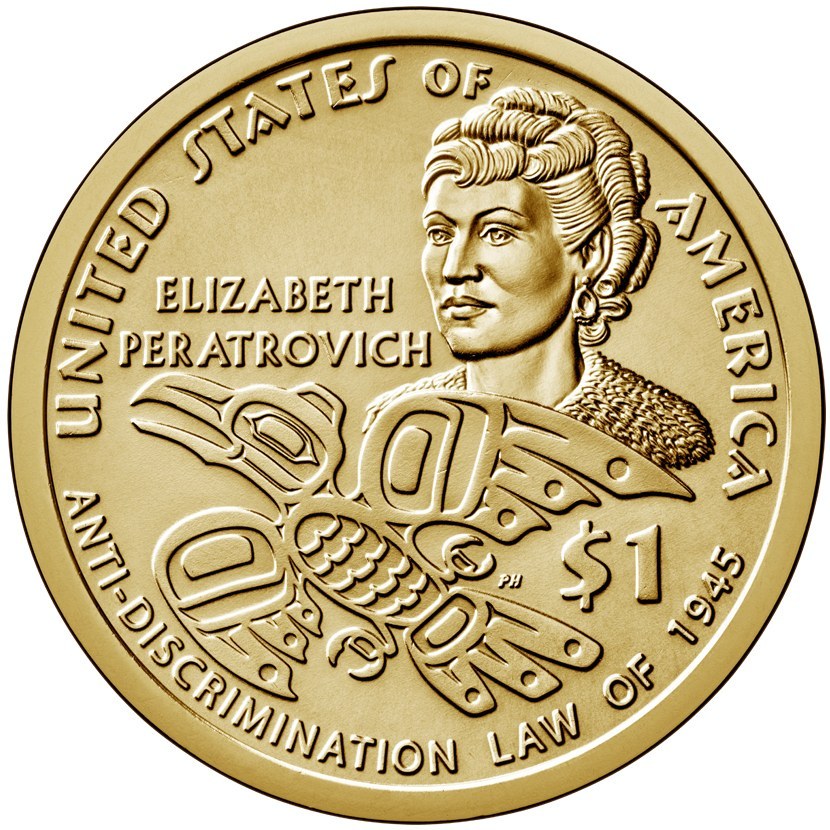
Start with the design side. A genuine 2020 issue shows Elizabeth Peratrovich in portrait beside a stylized Tlingit formline raven, with her name ELIZABETH PERATROVICH and the phrase ANTI-DISCRIMINATION LAW OF 1945 among the inscriptions, plus UNITED STATES OF AMERICA and $1. This single-year reverse is the surest way to separate the Peratrovich dollar from other years in the Native American series, each of which uses a different reverse.
Confirm the obverse. It should carry the constant Sacagawea design: a right-facing portrait of Sacagawea with her infant son on her back, and the inscriptions LIBERTY and IN GOD WE TRUST. Every Native American Dollar shares this obverse, so it confirms the series but not the year — the year comes from the reverse design and the edge.
Check the edge, because it does the work the faces usually do. The coin has a smooth, non-reeded edge with incused lettering that includes the date 2020, the mint mark, and E PLURIBUS UNUM. If you cannot find a date on either face, that is normal and expected for this series; look to the edge. A P or D mark indicates Philadelphia or Denver, and S indicates a San Francisco collector strike.
Verify the physical traits. The coin is manganese-brass clad with a warm golden color, about 26.5 mm across and roughly 8.1 g. It is noticeably larger and heavier than a quarter and has a plain edge, not a reeded one. The gold tone is from base-metal brass, not precious metal, so genuine examples should still feel like an ordinary modern coin and not attract a magnet strongly.
Be cautious with authentication claims. These are recent, abundant coins, so most examples need no professional grading. Reserve services such as PCGS or NGC for high-grade uncirculated or proof pieces, and be skeptical of ordinary circulated dollars marketed as rare simply for depicting Peratrovich. Artificially toned, cleaned, or novelty-plated coins can circulate; a plain golden coin with the correct edge lettering and weight is the baseline for a genuine piece.
Frequently asked questions
How do I tell the Peratrovich dollar from other golden dollars?
Look at the reverse. Only the 2020 issue shows Elizabeth Peratrovich with a Tlingit formline raven and the wording ANTI-DISCRIMINATION LAW OF 1945. Other years share the Sacagawea obverse but use different reverse designs.
Why is there no date on the front or back?
By design. The Native American Dollar series places the year, mint mark, and E PLURIBUS UNUM in incused lettering on the smooth edge, so you read them by turning the coin sideways.
Where is the mint mark?
On the edge, as part of the incused lettering. P is Philadelphia, D is Denver, and S is a San Francisco collector strike.
Is it worth getting graded or authenticated?
Usually not. These are common modern coins worth face value in circulated grades. Professional grading makes sense mainly for high-grade uncirculated coins, proofs, or a suspected genuine error.