
How to Identify the Napoleon 20 Franc Gold Coin
A guide to the classic French 20 franc gold pieces bearing Napoleonic portraits, covering the different bust types, reverse design, specifications, and fakes.
Read the full Napoleon 20 Franc Gold Coin encyclopedia entry →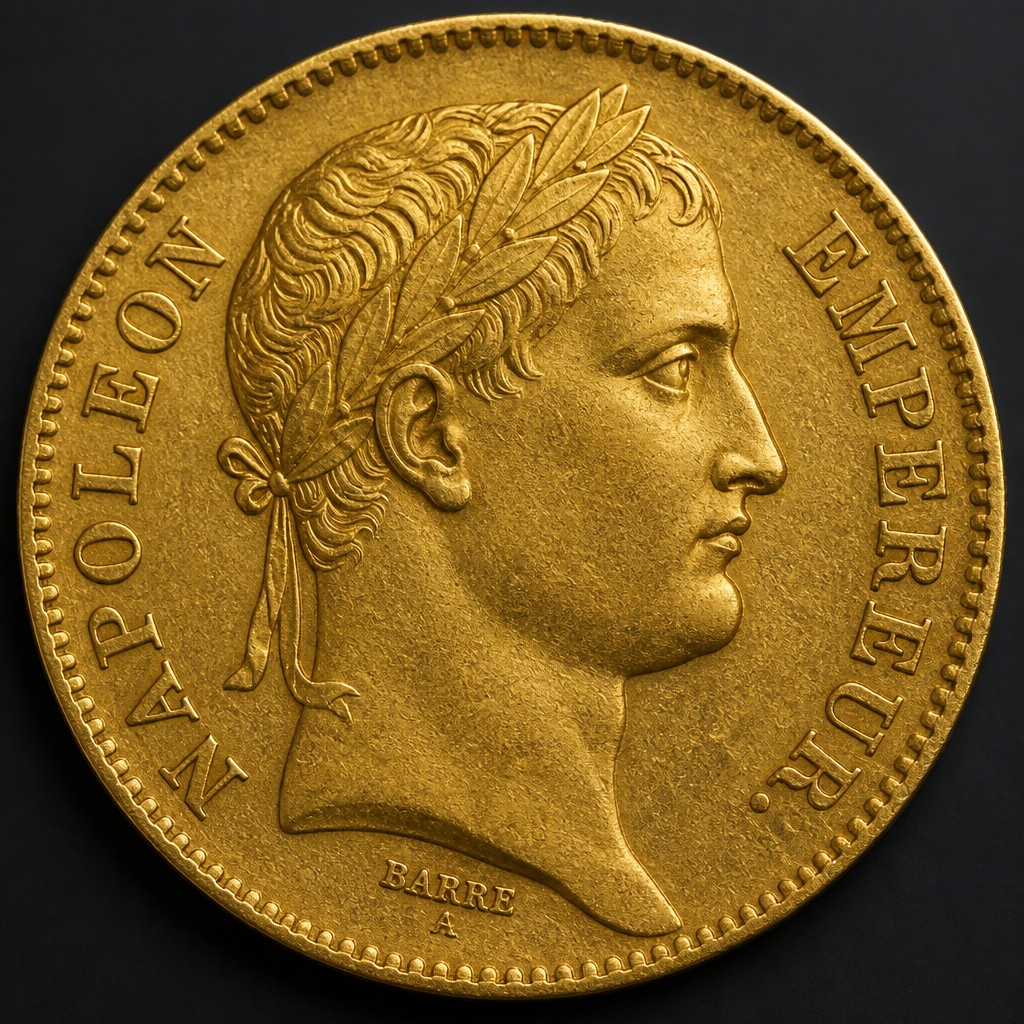
What Is the Coin
The "Napoleon" is the common nickname for French 20 franc gold coins struck under Napoleon I (as First Consul and later Emperor) and Napoleon III, spanning roughly 1803 to 1870, along with later official restrikes. The name is also loosely applied by dealers to other French 20 franc gold coins of the era, though strictly speaking a "true Napoleon" bears one of the Napoleonic portraits.
Obverse Design
Under Napoleon I, the obverse shows his bare or laureate head facing right, with legends such as "NAPOLEON EMPEREUR" (Empire period) or "BONAPARTE PREMIER CONSUL" (earlier Consulate issues). Under Napoleon III, two main portrait types exist: an early bare head (used roughly 1852-1860) and a later laureate head (used roughly 1861-1870), with the legend "NAPOLEON III EMPEREUR."
Reverse Design
The reverse typically displays the denomination "20 FRANCS," the date, and, depending on the exact type, a wreath or the French national arms. Empire-period coins often show an eagle motif or a simple wreath enclosing the value; Napoleon III issues usually show the value within a wreath with the date below.
Size, Weight, Metal & Edge
These coins are struck in .900 fine gold, weigh 6.45 g, and measure 21 mm in diameter, matching the Latin Monetary Union gold franc standard also used by several other European 20 franc gold coins. The edge is reeded on most issues.
Mint Marks and Where to Find Them
French coins of this era carry a small mint mark letter (commonly "A" for Paris) along with a privy mark unique to the mint director in office at the time, located near the date on the reverse. These small marks help pin down the exact minting period and are worth checking under magnification.
Telling It Apart From Similar Coins
Because "Napoleon" is used broadly, buyers should distinguish true Napoleonic-portrait coins from the later French 20 franc "Rooster" (Coq) type of 1899-1914, which shows a Marianne head rather than a Napoleon portrait, and from other 20 franc gold coins of the same era and standard issued by Switzerland, Belgium, or Italy. Comparing the obverse portrait and its inscription is the most reliable way to identify the correct type and ruler.
Grading and Condition at a Glance
Look at the high points of the portrait, such as the hair curls, laurel leaves, and cheek, for wear, since these flatten first with circulation. Original mint luster in the recessed areas around the lettering is a good sign of a lightly circulated or uncirculated example.
Authenticity Red Flags
Because 20 franc gold coins were struck in huge numbers and are frequently restruck or reproduced, weight and diameter that fall outside 6.45 g and 21 mm are a strong warning sign. Soft, mushy lettering, an incorrect edge reeding pattern, or a portrait that doesn't match the inscribed ruler's name are also signs of a later copy or fantasy piece rather than an original strike.
Frequently asked questions
Who is depicted on a 'Napoleon' 20 franc coin?
Either Napoleon I or Napoleon III, shown in one of several bare-head or laureate-head portrait styles, identified by the accompanying legend.
What is the coin's gold content?
It is .900 fine gold, weighing 6.45 g, meaning roughly 0.1867 troy ounces of pure gold.
Is every French 20 franc gold coin a 'Napoleon'?
No, dealers sometimes use the term loosely, but a true Napoleon shows a Napoleon I or Napoleon III portrait, not the later Rooster/Marianne design used from 1899-1914.
Where is the mint mark located?
Near the date on the reverse, typically a letter such as 'A' for the Paris mint, along with a small privy mark for the mint director.