
How to Identify the Mughal Quarter-Rupee
A collector's checklist for the Mughal silver quarter-rupee: reading the Persian legends, the Lahore mint, the Ilahi date, and size and authenticity.
Read the full Mughal Quarter-Rupee encyclopedia entry →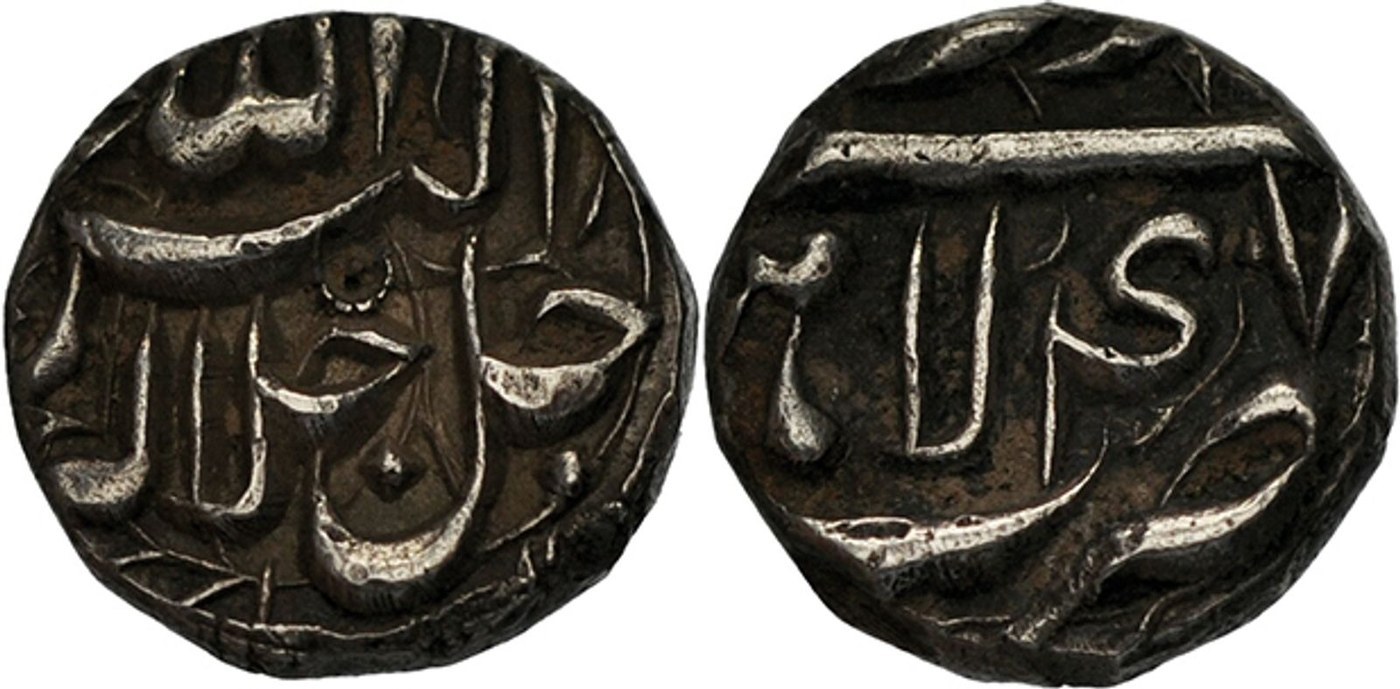
Begin with the overall design. A Mughal quarter-rupee is covered on both faces with Persian script inside a cartouche or panel, with no portrait, animal, or emblem. If you are holding a small silver coin whose only decoration is flowing Arabic-Persian calligraphy, you are almost certainly looking at Islamic-world coinage of this family rather than a Western or East Asian type.
Next, find the mint and date. Scan the legends for a mint name, on this coin Lahore, and for a date; here it is given in the Ilahi era as 47 (AD 1602-1603), written in Persian rather than Western numerals. Because the flan is small, the strike often captures only part of the full inscription, so rotate the coin and read whatever mint and year fragments survive. Learning to recognize a few mint names and Ilahi year forms is the single most useful identification skill for this series.
Check size, weight, and metal. The quarter-rupee is a small, thick, hand-struck silver piece, clearly lighter than a full rupee. Its outline is irregular and often slightly off-centre, which is normal for hammered coinage and not itself a sign of a problem. Weighing the coin and comparing it against published quarter-rupee standards is a quick sanity check on both denomination and authenticity.
Be aware of look-alikes. Many Mughal and later Indian silver fractions share the same all-inscription style across different mints, reigns, and eras, and half-rupees and rupees look similar apart from size. Do not assume a mint or date from the design alone; confirm them by actually reading the legends, since two coins that look alike at a glance can differ in mint, denomination, and year.
Finally, apply authentication caution. Watch for cast copies with soft, blurred script and seams on the edge, for tooled or re-engraved legends meant to fake a scarcer mint or date, and for modern souvenir strikes. Genuine hand-struck detail is crisp where the dies contacted the flan, even when the strike is incomplete. For better pieces, or where a specific mint-and-date combination matters, confirm the attribution against a specialist Mughal reference or with an expert.
Frequently asked questions
How do I read the date on a Mughal coin?
Look for a year written in Persian, not Western numerals. This coin uses the Ilahi era, where the number 47 corresponds to about AD 1602-1603. Some Mughal coins instead use the Hijri era, so note which calendar is present when attributing a piece.
How can I tell the quarter-rupee from a full rupee?
By size and weight. The quarter-rupee is markedly smaller and lighter and shows only part of the legend that a full rupee carries. Weighing the coin against published standards is the most reliable way to confirm the denomination.
Where do I find the mint name?
The mint name is part of the inscription, usually on the reverse; on this coin it reads Lahore. Because the flan is small, the mint name may be partly off the edge, so check the legend carefully and rotate the coin to read it.
How do I spot a fake or altered piece?
Cast fakes show soft, mushy script and edge seams, while altered coins may have re-engraved or tooled letters to imitate a scarcer mint or date. Genuine hammered strikes have crisp detail where the die met the flan; seek expert confirmation for higher-value attributions.