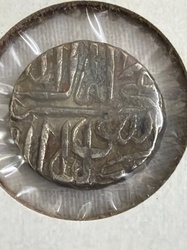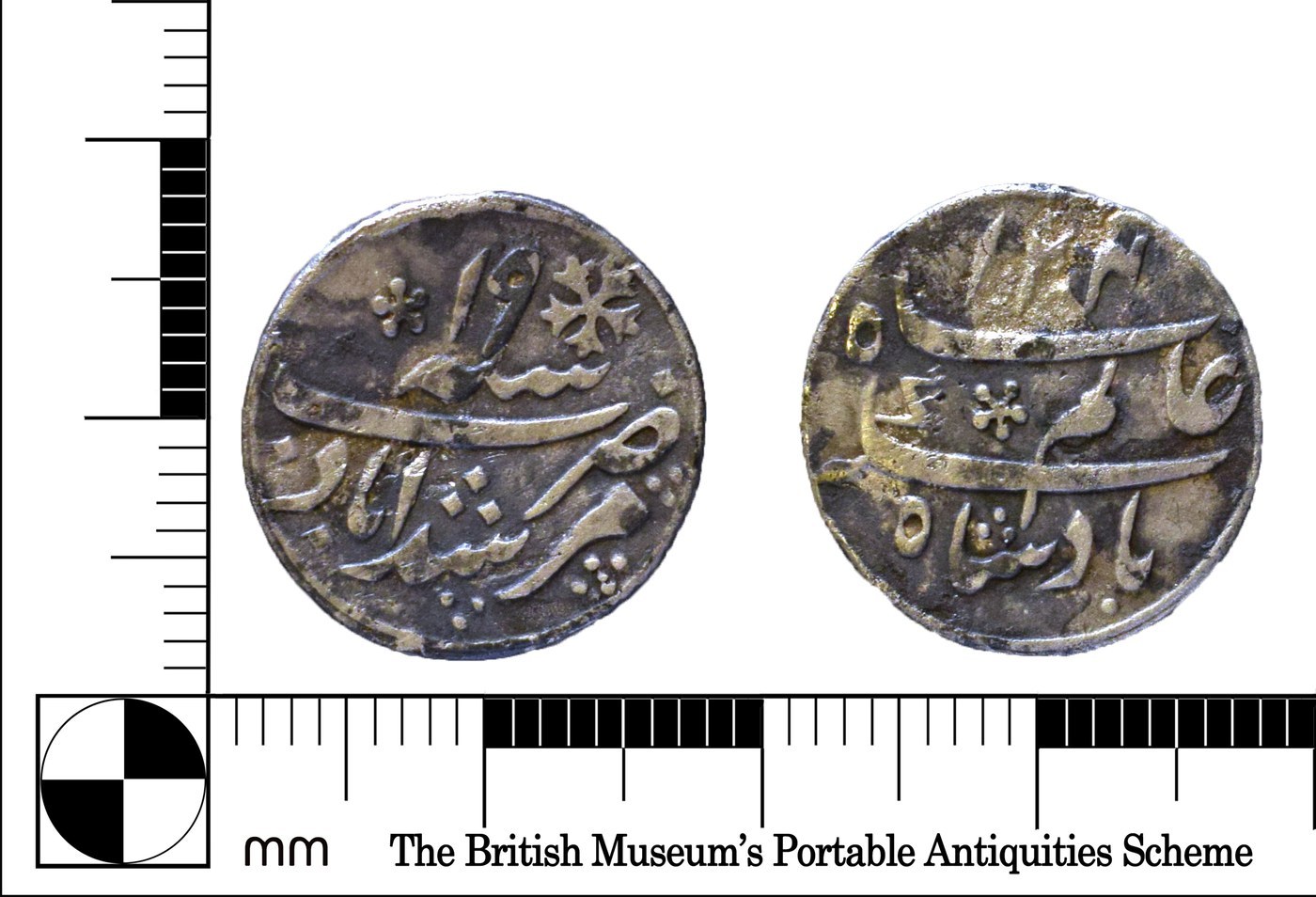
Mughal Islamic Rupee
A hand-struck silver rupee of the Mughal Empire, filled edge to edge with Persian and Arabic script naming the emperor, mint, and regnal year.
- Country
- India
- Denomination
- 1 Rupee
- Metal
- Silver
Got a coin like this?
Identify any coin from a photo, free.
Overview
The Mughal Islamic Rupee is a broad, hand-struck silver coin issued across the Mughal Empire, with the pieces in this group dated to roughly 1719-1758. It carries no portrait or figural image. Instead both faces are covered with Persian and Arabic calligraphy giving the ruling emperor's name and titles, the mint city, and the regnal (julus) year, in keeping with the aniconic tradition of Islamic coinage.
This span covers the long reign of Muhammad Shah (1719-1748) and the shorter reigns of his successors Ahmad Shah Bahadur (1748-1754) and Alamgir II (1754-1759), a period when central Mughal authority was fading even as the silver rupee remained the standard trade coin across much of the subcontinent. Rupees of this type were struck at many mints and survive in large numbers today.
Because the rupee was produced by hand at dozens of mints over many years, no two dies are identical and strikes vary widely in centering and completeness. Collectors value the series for its elegant calligraphy, its wide range of mint names, and its role as a workhorse silver coin of eighteenth-century India.
History & Background
The silver rupee (rupiya) was standardized under the Mughal emperor Akbar in the late sixteenth century, building on a coin introduced by Sher Shah Suri, and remained the empire's principal silver denomination for centuries. Earlier Mughal coins had carried the Islamic declaration of faith (the Kalima), but from the reign of Aurangzeb this sacred text was removed from circulating silver to avoid its being handled, and replaced with a Persian couplet and the emperor's regnal formula. The coins of 1719-1758 follow that later convention.
The year 1719 was itself turbulent, seeing several short-lived emperors before Muhammad Shah's accession, and the decades that followed were marked by weakening central control, the invasion of Nader Shah in 1739, and the rise of regional powers. Throughout, provincial and imperial mints continued striking rupees in the emperor's name, so coins of this period reflect a still-widely-circulated currency even as political power fragmented.
After this era the same Mughal rupee format was widely imitated: princely states, the Maratha confederacy, and the East India Company all struck coins in the style of, and often in the name of, the Mughal emperor. This continuity means genuine imperial issues of 1719-1758 sit at the head of a very large family of look-alike rupees produced well into the nineteenth century.
How to Identify
Look for a broad, relatively thin silver disc, typically around 11 to 11.7 grams and roughly 21 to 28 millimeters across, struck rather than cast. There is no bust, animal, or building. Both sides are wholly given over to flowing Persian nastaliq and Arabic script, usually arranged in horizontal lines with decorative flourishes, and the flan is often slightly irregular or off-center from hand striking.
The obverse generally carries the emperor's name and titles together with a couplet and the Hijri (AH) date, while the reverse names the mint city and states the regnal year using the standard formula ("zarb" for struck at, followed by the mint name, and "sanah ... julus" for the year of reign). Reading the mint name and ruler is the key to placing a specific coin; the dates are given in the Islamic calendar, so an AH date in the 1130s-1170s corresponds to this Gregorian span.
Because dies were cut individually and coins were struck by hand, expect weak or missing legends at the edges, doubling, and flan cracks. These are normal features of the type, not signs of damage, and a complete, well-centered strike showing the full mint name and date is comparatively desirable.
Value & Collectibility
Most Mughal silver rupees of 1719-1758 are relatively common and trade close to their silver value plus a modest collector premium, since large quantities were struck and many survive. Well-centered coins with a fully legible mint name, ruler, and date command more than worn or clipped examples with off-flan legends.
Value rises with scarcer mints, less common rulers such as Ahmad Shah Bahadur or Alamgir II, unusual regnal years, and exceptional strike or eye appeal. Because so many mints and dies exist, attribution to a specific mint and year can add meaningfully to a coin's interest and price.
As with any hand-struck silver, condition, completeness of the legends, and confident attribution drive value far more than mere age. Ranges vary widely with the market, so treat catalog or dealer references and recent comparable sales as your guide rather than any single fixed figure.
Frequently asked questions
Why doesn't this coin have a face or picture on it?
Mughal coinage follows the Islamic aniconic tradition, which avoids figural images on currency. Instead the design is entirely calligraphy naming the emperor, the mint, and the regnal year.
What do the inscriptions say?
The obverse typically gives the ruling emperor's name, titles, and a Persian couplet with the Hijri date, while the reverse names the mint city and the year of the reign. They are written in Persian and Arabic script.
Which rulers issued these rupees?
Coins dated 1719-1758 fall mainly under Muhammad Shah (1719-1748), Ahmad Shah Bahadur (1748-1754), and Alamgir II (1754-1759), plus the brief emperors of 1719.
Is a Mughal rupee valuable?
Most are common and trade near their silver content plus a small premium. Scarcer mints, rulers, and regnal years, along with strong strike and legibility, bring higher prices.
How much silver does it contain?
Mughal rupees were struck in high-purity silver at a standard weight of about 11.6 grams, though worn or clipped examples weigh less.
Mughal Islamic Rupee guides
In-depth guides for identifying, valuing, and collecting Mughal Islamic Rupee.
Mughal Islamic Rupee identified by the community
Real coins identified with Coin Identifier.