
How to Identify the Monroe Doctrine Centennial Half Dollar
A collector's checklist for confirming a 1923 Monroe Doctrine half dollar — the twin portraits, hemisphere reverse, mint mark, silver specs, and look-alikes.
Read the full Monroe Doctrine Centennial Half Dollar encyclopedia entry →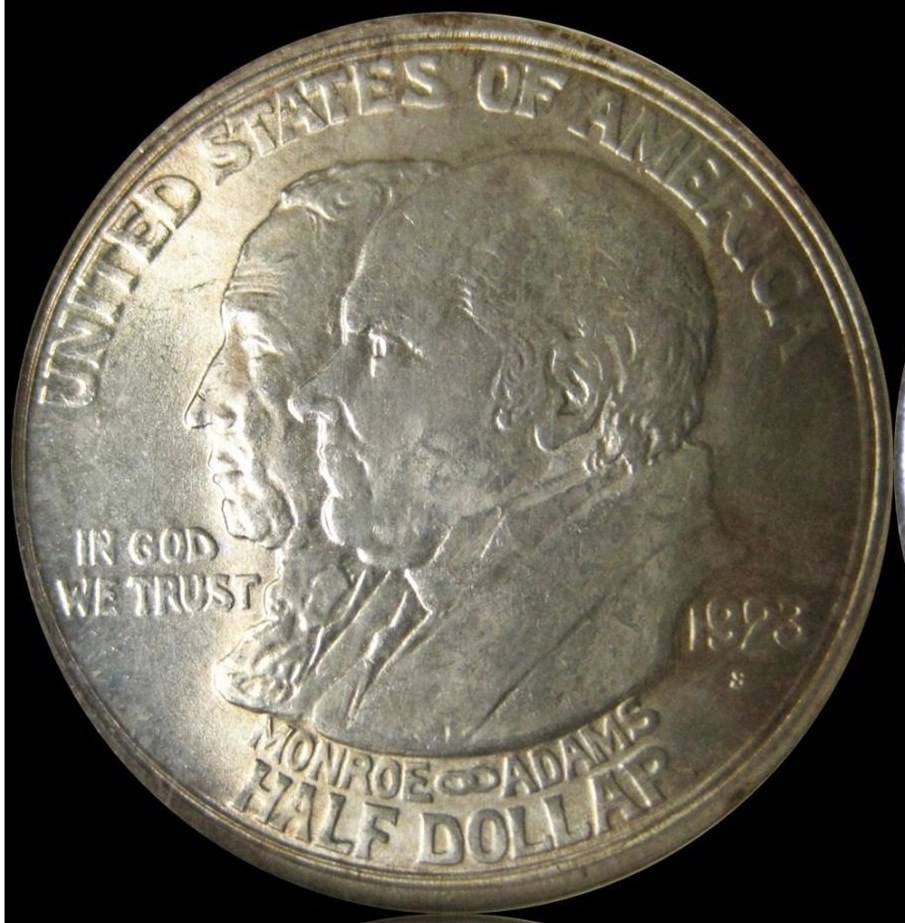
Start with the obverse portraits, the single most distinctive diagnostic. This coin uniquely shows two overlapping presidential heads — James Monroe in front, John Quincy Adams behind — both facing right in a jugate (conjoined) arrangement. If you see two profiles facing right rather than a single bust, you are looking at the Monroe Doctrine type. The photographed coin matches this.
Turn the coin over to confirm the reverse. Instead of an eagle, a genuine piece shows the Western Hemisphere with North and South America drawn as two draped allegorical women. This unusual map-like reverse, paired with the twin portraits, confirms the type beyond any single feature.
Check the date and mint mark. Every genuine example is dated 1923 and struck at San Francisco, so look for an "S" mint mark; any other date or a portrait of only one president is not this coin. Then verify the physical specifications: 90% silver, roughly 30.6 mm in diameter, about 12.5 grams, with a reeded edge — the same footprint as a regular silver half dollar. A calibrated scale and calipers help confirm it is silver and correctly sized.
Be aware of look-alikes and condition traps. Do not confuse it with other 1920s commemorative half dollars, which show different subjects; the twin-president obverse and hemisphere reverse are unique to this issue. Note also that the design is struck in low, slightly flat relief, so a soft or shallow appearance is normal for the type and is not by itself evidence of wear or of a counterfeit.
For higher-grade or higher-value examples, exercise authentication caution. Because circulated pieces are inexpensive, cleaned, altered, or artificially toned coins do appear. Confirm weight, diameter, and non-magnetic silver, look for crisp original surfaces, and rely on reputable third-party grading (PCGS, NGC) for any coin sold as uncirculated or gem, where the price gap makes verification worthwhile.
Frequently asked questions
How do I tell this from other 1920s commemorative half dollars?
Look for the two overlapping right-facing presidential profiles on the obverse and the Western Hemisphere shown as two female figures on the reverse. That combination is unique to the Monroe Doctrine type.
Where is the mint mark?
All genuine pieces were struck at San Francisco and carry an "S" mint mark. There is no Philadelphia or Denver version, so a coin without an S or with another date is not this issue.
Why does my coin look flat or weakly struck?
The type was produced in low relief, so a somewhat flat, shallow appearance is normal and does not necessarily indicate wear. Judge condition from high points and surface marks, ideally against graded examples.
What should it weigh and measure?
As a standard silver half dollar it is about 30.6 mm in diameter and roughly 12.5 grams, struck in 90% silver with a reeded edge. Figures far off these point to a problem coin or a fake.