
How to Identify the Mexican 8 Reales Pillar Dollar
A visual guide to the Mexico City 'pillar dollar,' explaining its crowned globes and Pillars of Hercules obverse, Spanish shield reverse, silver standard, and mint/assayer marks used to confirm its origin.
Read the full Mexican 8 Reales Pillar Dollar encyclopedia entry →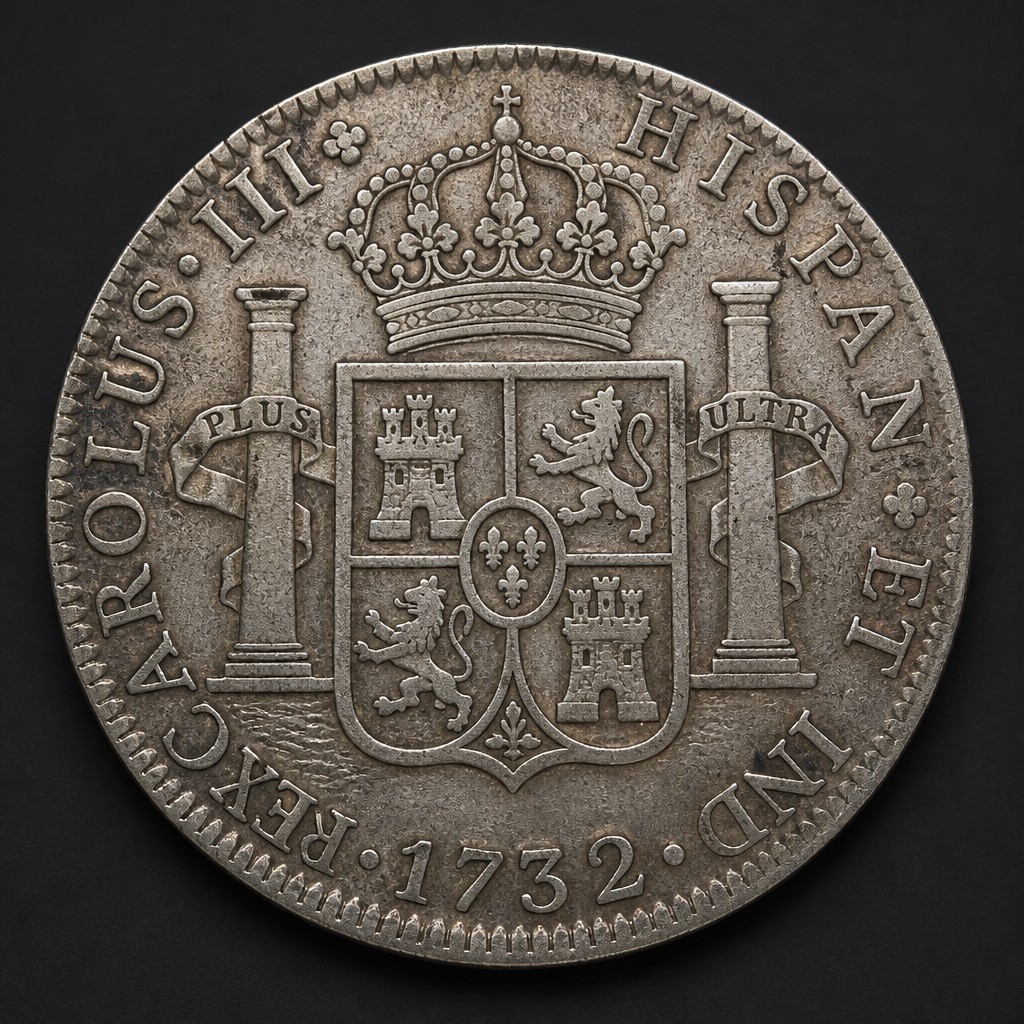
What This Coin Is
The pillar dollar refers to Spanish colonial 8 reales coins struck with the distinctive "Pillars of Hercules" design, produced at Mexico City and other New World mints roughly from the 1730s through the early 1770s, before being replaced by the portrait-bust style. It circulated so widely that it influenced the design of early United States currency.
Obverse Design
The obverse shows two crowned globes, representing the Old and New Worlds, set between two crowned pillars (the Pillars of Hercules) wrapped with a banner reading PLVS VLTRA ("further beyond"). Waves are shown at the base, and the Spanish monarch's name and titles run around the legend.
Reverse Design
The reverse displays the crowned Spanish royal shield, quartered with the arms of Castile and Leon, surrounded by a legend naming the mint and denomination.
Size, Weight, Metal, and Edge
Pillar dollars are large silver coins weighing about 27 grams, roughly 38–40mm in diameter, typically struck at .903 to .917 fine silver. Because many were produced on manually adjusted screw presses, the edge and centering can be somewhat irregular compared to later machine-struck coinage.
Mint Marks and Where to Find Them
Look for "Mo" in the legend, denoting the Mexico City mint, along with assayer's initials nearby confirming who certified the coin's silver content. The denomination "8" appears as part of the design as well. Other pillar dollars from mints like Lima or Potosí carry different mint abbreviations.
Telling It Apart From Similar Coins
Pillar dollars are often confused with the later "portrait dollars" that replaced them after about 1772, which show a bust of the reigning king instead of the globes-and-pillars design. They can also be confused with pillar-type coins from other Spanish colonial mints, distinguished mainly by the mint mark and assayer initials in the legend.
Judging Condition
Examine the sharpness of the crowns atop the pillars and globes, as well as the clarity of the shield's quartering on the reverse. Because these were hand-fed through screw presses, slightly off-center strikes are common even on higher-grade examples and are not necessarily a defect.
Authenticity Red Flags
Cast counterfeits typically show a seam line around the edge and slightly grainy or soft surface detail compared to genuine struck coins. Chop marks (small punched symbols from historical Asian trade use) are a normal and expected feature on genuinely circulated examples and do not indicate a fake, but a coin with the wrong weight, wrong diameter, or an implausible mint/assayer combination should be examined carefully.
Frequently asked questions
What does 'pillar dollar' mean?
It refers to Spanish colonial 8 reales coins featuring the Pillars of Hercules and crowned-globes design, struck mainly from the 1730s to early 1770s before the portrait-bust design replaced it.
How do I find the mint mark on a pillar dollar?
Look in the legend surrounding the shield on the reverse for a mint abbreviation such as 'Mo' for Mexico City, paired with the assayer's initials.
Why do some pillar dollars have small stamped marks on them?
These are chop marks added by merchants and bankers in Asian trade networks to verify the silver content, and are a normal sign of genuine historical circulation.
How is a pillar dollar different from a portrait 8 reales?
Pillar dollars show crowned globes and pillars on the obverse, while later portrait dollars (after about 1772) show a bust of the Spanish king instead.