
How to Identify the Metapontum Barley Ear Stater
A practical guide to spotting Metapontum's silver stater by its signature single ear of barley, the incuse or relief reverse, and the META city inscription.
Read the full Metapontum Barley Ear Stater encyclopedia entry →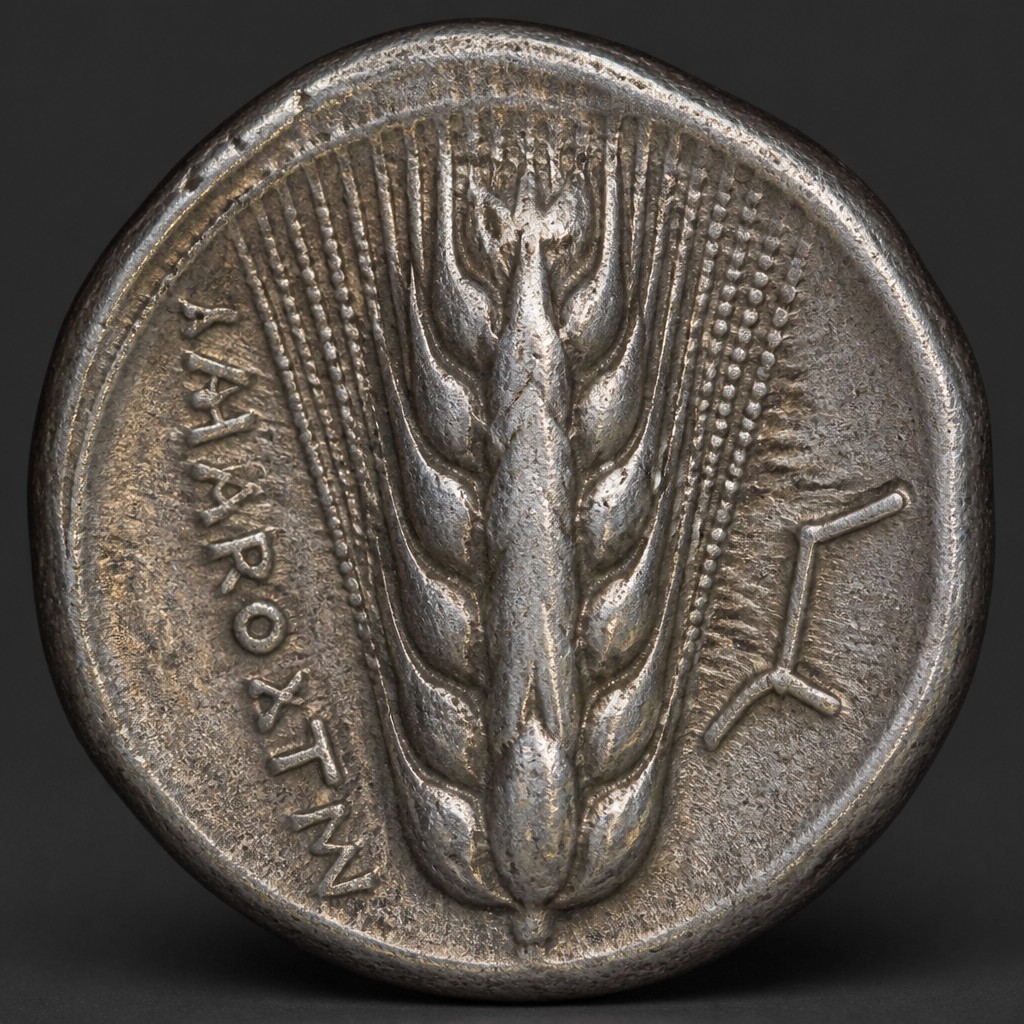
What It Is
Metapontum was a Greek colony in Lucania, southern Italy, whose economy depended on grain farming. Its silver coinage, struck from roughly the mid-6th century BC into the 3rd century BC, is famous for depicting a single ear of barley, an emblem of the city's agricultural wealth, on nearly every issue across three centuries.
Obverse
The obverse shows a single upright ear of barley (bearded grain) filling the field, sometimes with a small symbol, letter, or tiny figure added beside the stalk in later issues. On the earliest coins the design is rendered in bold relief with minimal additional detail.
Reverse
On the earliest "incuse" coins (roughly 550-470 BC), the reverse repeats the barley ear as a mirror-image incuse (sunken) impression rather than a raised design, a technique shared with other early South Italian mints. From the later 5th century onward, the reverse instead carries its own raised design, most often a head of Demeter, an ear of barley, or another local emblem, always accompanied by the city name.
Inscriptions
The city's name appears as META or the fuller ΜΕΤΑΠΟΝΤΙΝΩΝ, usually running vertically along the barley stalk or arched around the reverse field, depending on the period.
Size, Weight, and Metal
Metapontum's staters are silver, struck on the Achaean (South Italian) standard at roughly 7.8-8 grams, with a broad, thin flan on the early incuse issues and a more compact flan on later coins.
Identifying the Mint and Style
Because the barley ear was Metapontum's constant emblem, the mint is identified by the design itself combined with the META inscription. Small control symbols or magistrate initials added near the stalk on later issues can help date a specific coin more precisely.
Telling It Apart From Similar Coins
The incuse barley-ear type can be confused with other early South Italian incuse coinages, such as Sybaris' bull or Kroton's tripod, but the barley ear itself is unmistakable once compared side by side. Later relief-style staters with a barley ear obverse are sometimes confused with other grain-themed issues from nearby Italiote cities, so the META legend is the most reliable check.
Authenticity Red Flags
Cast fakes of the thin, broad incuse staters often show a grainy or pitted surface and a slightly warped, non-planar flan, since the thin fabric is hard to reproduce by casting. Weak or garbled lettering, incorrect weight, and a reverse incuse that does not precisely mirror the obverse relief are also signs of a modern reproduction rather than an ancient strike.
Frequently asked questions
Why does Metapontum's coinage always show a barley ear?
Barley was the basis of the city's agricultural economy, and the grain ear became its consistent civic emblem for roughly three centuries.
What is the 'incuse' technique seen on early Metapontum staters?
It is a manufacturing method where the reverse die produced a sunken, mirror-image version of the obverse design instead of an independent raised image, used by several early South Italian mints.
How heavy is a genuine Metapontum stater?
Roughly 7.8 to 8 grams of silver, struck on the Achaean weight standard used across South Italy.
How can I tell an incuse stater is genuine rather than cast?
Check that the reverse incuse precisely mirrors the obverse relief with sharp, clean lines; cast copies tend to show a grainy surface and a warped, uneven flan.