How to Identify the Mercury Dime
A step-by-step look at the winged Liberty head, the fasces reverse, the silver size and reeded edge, mint-mark placement, and look-alikes to rule out.
Read the full Mercury Dime encyclopedia entry →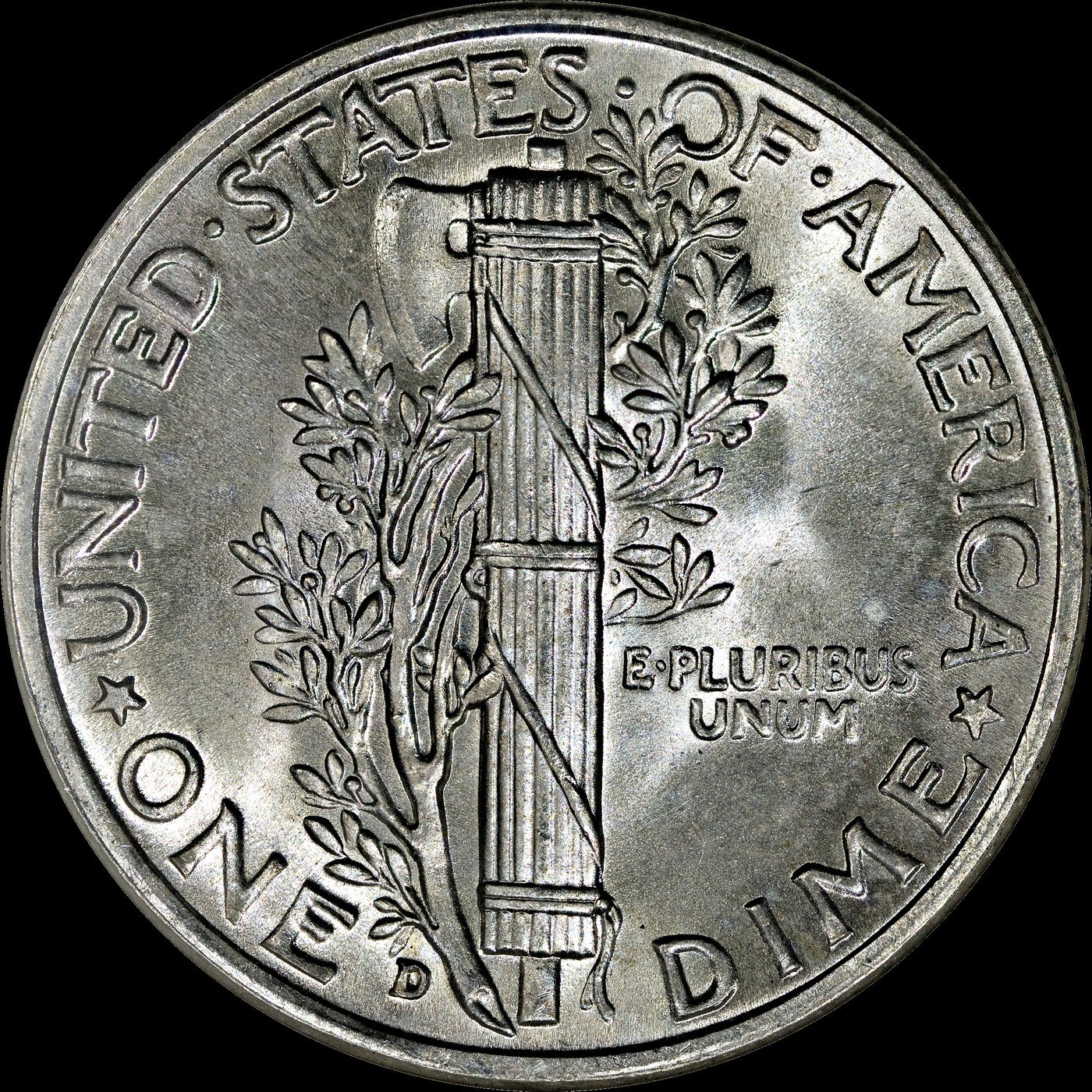
Start With the Obverse
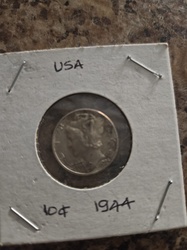
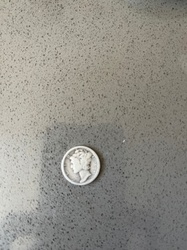
Look for a left-facing head of Liberty wearing a snug winged cap. "LIBERTY" arcs around the top rim, "IN GOD WE TRUST" sits in the lower left field, and the four-digit date is at the lower right — our example reads 1943. The wings emerge from the cap near Liberty's ear, which is the detail that earned the coin its "Mercury" nickname even though the subject is Liberty.
Check the Reverse Fasces
The reverse shows a vertical fasces: a bundle of rods bound by horizontal bands around an axe, crossed diagonally by an olive branch. Around it read "UNITED STATES OF AMERICA," "E PLURIBUS UNUM," and the denomination "ONE DIME." The two horizontal bands at the center of the fasces are worth a close look — when fully separated and sharp they mark a premium "Full Bands" strike.
Confirm Size, Metal, and Edge
The Mercury Dime is 90% silver: about 17.9 mm in diameter, roughly 2.5 grams, with a reeded (grooved) edge and a bright silver-gray color. It is the smallest of the common circulating U.S. coins of its era. A genuine example rings with the tone of silver and shows fine reeding on the edge; a plain edge or a copper-colored core would point to a fake or a different coin.
Find the Mint Mark
Turn to the reverse and look to the left of the fasces near its base, between the rods and the rim. A small "D" indicates Denver and an "S" indicates San Francisco; no mint mark means Philadelphia. The pictured coin shows a "D" for Denver. Date and mint mark together identify the specific issue and strongly affect value — for example, the scarce 1916-D versus common wartime dates like 1943 and 1943-D.
Watch for Look-Alikes and Altered Coins
Don't confuse this coin with the earlier Barber dime (a right-facing Liberty head in a cap band) or the later Roosevelt dime that replaced it in 1946 (a bust of Franklin D. Roosevelt). Because key issues are valuable, be cautious with the 1916-D and the 1942/1 overdates: added or altered mint marks and tooled dates are known. For any coin that appears scarce or high-grade, rely on a reputable third-party grading service to confirm the date, mint mark, and authenticity.
Frequently asked questions
How do I tell a Mercury Dime from a Roosevelt dime?
The Mercury Dime shows a winged Liberty head and a fasces on the reverse; the Roosevelt dime that followed in 1946 shows a profile of Franklin D. Roosevelt and a torch flanked by branches. Both are the same size, but the designs are entirely different.
Is a 1943 Mercury Dime made of silver like earlier dates?
Yes. The dime stayed 90% silver throughout World War II. Only the five-cent nickel changed alloy during the war, so a 1943 dime is standard silver.
Where do I look for the mint mark, and does it matter?
On the reverse, to the left of the base of the fasces. A "D" (Denver) or "S" (San Francisco) identifies a branch-mint coin; no mark means Philadelphia. It matters greatly, since some dates are far scarcer from one mint than another.
Should I clean a Mercury Dime to see it better?
No. Cleaning leaves hairline scratches and dulls the surface, lowering value to collectors. Examine it under good light and magnification instead, and leave any conservation to professionals.
Mercury Dime identified by the community
Recent Mercury Dime coins identified with Coin Identifier.