
How to Identify the Mende Dionysos on Donkey Tetradrachm
A silver tetradrachm of Mende in Chalcidice showing Dionysos riding a donkey, one of the most whimsical and recognizable designs in classical Greek coinage.
Read the full Mende Dionysos on Donkey Tetradrachm encyclopedia entry →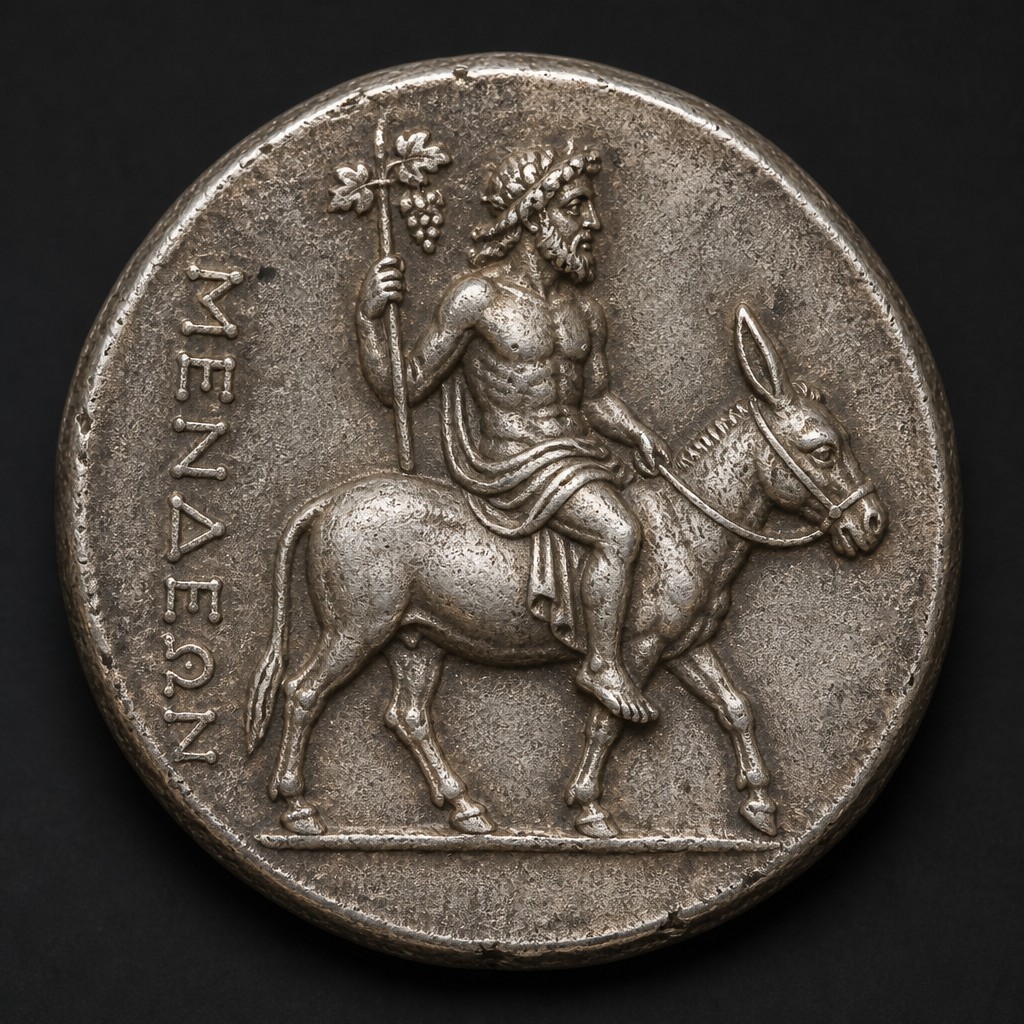
What the Coin Is
Mende was a wine-producing city on the Chalcidice peninsula of northern Greece, and its coinage celebrated the local cult of Dionysos, god of wine. Silver tetradrachms were struck there mainly in the fifth century BC, and the type is prized today for its lively, almost comic imagery.
Obverse Design
The obverse shows Dionysos, nude or loosely draped, reclining sideways on the back of a donkey (ass) that is often shown in an animated, springing pose. The god usually holds a kantharos (a two-handled wine cup) or a thyrsus, and a small bird such as a crow or raven sometimes appears in the field behind him. A dotted border frames the scene. Fine early examples show real depth to the modeling of both figures; later or provincial dies flatten the donkey's legs and the god's drapery.
Reverse Design
The reverse is dominated by a grapevine with clusters of grapes and curling tendrils, set within a shallow incuse square that is characteristic of archaic and early classical Greek coinage. An amphora (wine jar) sometimes sits within or beside the vine on certain issues. Traces of the city's name, usually abbreviated as some form of the ethnic MENDAION, can appear around or within the incuse field, though legends are often partial or off-flan.
Size, Weight, and Metal
These are silver tetradrachms struck on a standard close to the Attic weight, with full pieces weighing in the general range of 16 to 17.5 grams. The flan is typically thick and slightly irregular, a hallmark of hand-struck ancient coinage, and the edge is plain with no reeding or lettering.
Where to Look for Mint Signatures
Mende did not use separate mint marks the way later Roman coins did. Instead, look for the partial ethnic legend near the vine reverse and small control letters or symbols occasionally tucked into the field. Die variations in the pose of the donkey and the placement of the bird are the main tools specialists use to sort issues by date.
Telling It Apart from Similar Coins
Several other Thraco-Macedonian cities issued coins with animal and rider themes, but the combination of a reclining god, a donkey, and a vine reverse is unique to Mende. Coins of nearby Aineia or Terone use different animal motifs (such as horses or goats), and no other city pairs Dionysos with a donkey in this reclining posture, making this type fairly easy to distinguish once you know the design.
Judging Condition at a Glance
Because the design covers most of the flan, wear first shows on the highest points: the donkey's back and haunches, Dionysos's torso, and the grape clusters on the reverse. Sharp, well-centered strikes with a full incuse square and clear vine detail command the most attention from collectors, while off-center or heavily worn examples lose much of the charm of the design.
Authenticity Red Flags
Modern fantasy pieces and casts sometimes circulate with an exaggerated or cartoonish donkey pose that doesn't match known archaic die styles. Look for a soft, mushy surface texture (a sign of casting rather than striking), seams around the edge, or a donkey and rider that look too symmetrical and clean compared to the naturally irregular archaic Greek style. Genuine ancient silver also tends to show a specific gray or lightly toned patina rather than a uniform bright white surface.
Frequently asked questions
What makes the Mende tetradrachm's design so unusual?
It shows Dionysos casually reclining on a donkey rather than standing or in a chariot, an informal and playful composition rarely seen elsewhere in Greek coinage.
What metal and denomination is this coin?
It is a silver tetradrachm, roughly 16-17.5 grams, struck on a weight standard close to the Attic system used across much of the Greek world.
Does the coin have a visible mint mark?
There is no separate mint mark; instead look for the partial city ethnic near the vine on the reverse and small control symbols in the field.
How can I tell a genuine example from a modern copy?
Genuine strikes show natural die wear, an irregular flan, and toned silver surfaces, while fakes often look too symmetrical, feel soft or waxy from casting, or show a visible seam.