
How to Identify the McKinley Memorial Gold Dollar
A collector's checklist for confirming a genuine 1916–1917 McKinley gold dollar — portrait, memorial reverse, tiny size, gold content, and fakes to watch for.
Read the full McKinley Memorial Gold Dollar encyclopedia entry →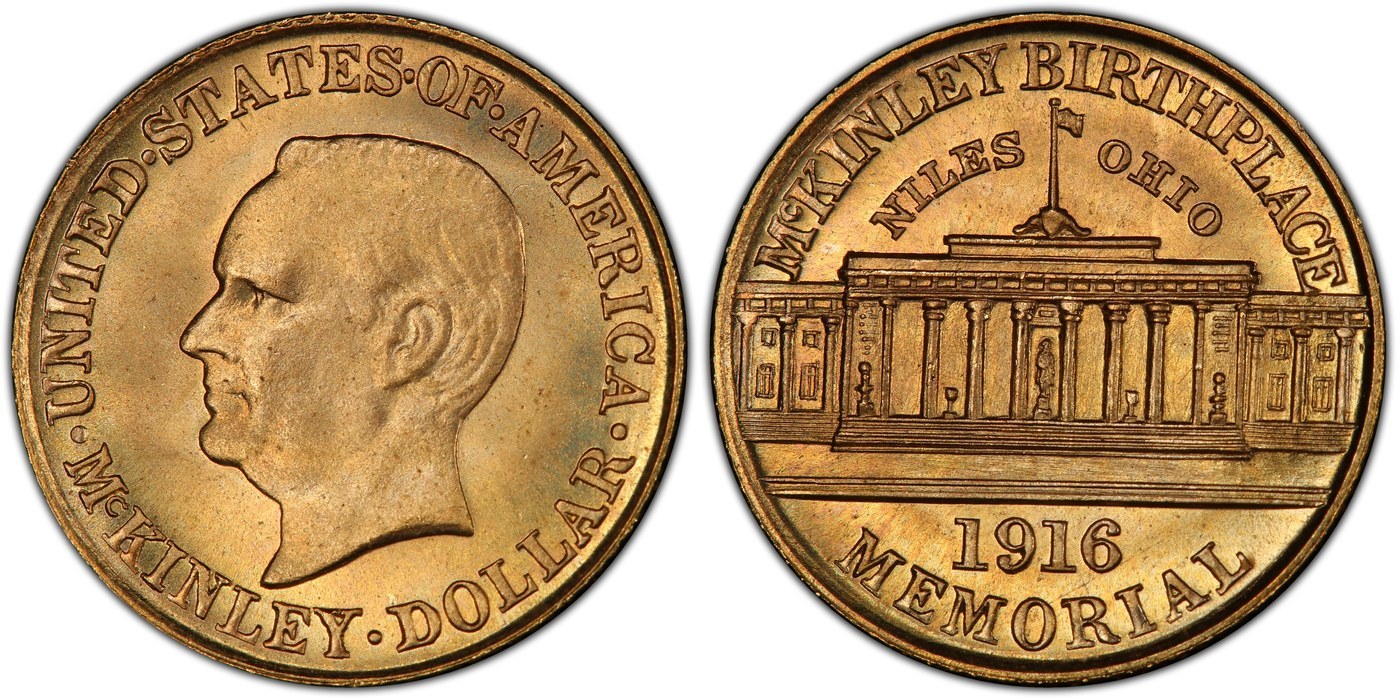
Begin with the inscriptions, because they are unique to this type. The obverse must read UNITED STATES OF AMERICA and MCKINLEY DOLLAR around a bare-headed portrait of William McKinley facing left. The reverse must show the McKinley Birthplace Memorial building with the legend MCKINLEY BIRTHPLACE MEMORIAL and the place name NILES O. OHIO, together with the date. Reading NILES, OHIO on the reverse is a strong, distinctive confirmation.
Next, judge the size and metal. This is a very small coin, about 15 mm across — the same tiny diameter as the classic U.S. gold dollar — and it is struck in .900 fine gold with a rich yellow color. If a supposed McKinley dollar is the size of a nickel or larger, or if the metal looks pale, brassy, or shows wear through to a base-metal core, it is not a genuine gold dollar. A jeweler's scale and calipers help here, since the correct small diameter and light gold weight are hard to fake convincingly.
Check the date to place the coin within the two-year series: genuine pieces are dated 1916 or 1917. These were struck at Philadelphia and carry no distinguishing mint mark, so do not expect a D or S; a McKinley dollar bearing a mint mark or an out-of-range date should be treated with suspicion.
Be alert to look-alikes and imitations. Small gold commemoratives have long attracted counterfeits, cast copies, and gold-plated or jewelry-mounted pieces; solder marks, a bent or filed edge, mushy or grainy detail, and any magnetic response are warning signs. The type is sometimes confused with other early gold dollar commemoratives, so always verify that both the McKinley portrait and the Niles memorial reverse are present together.
For any purchase of consequence, rely on third-party authentication rather than eye appeal alone. Coins certified by PCGS or NGC have been checked for authenticity and grade, and buying from an established dealer greatly reduces the risk of acquiring a cleaned, repaired, or outright counterfeit example.
Frequently asked questions
How big is a genuine McKinley gold dollar?
It is tiny — about 15 mm in diameter, the same small size as the old circulating U.S. gold dollar. Its small format and light weight in .900 fine gold are key identity checks.
Should my McKinley dollar have a mint mark?
No. These were struck at the Philadelphia Mint and carry no mint mark. A McKinley dollar showing a D or S mint mark, or a date other than 1916 or 1917, should be viewed with caution.
How can I tell it apart from other gold dollar commemoratives?
Confirm both sides: the left-facing McKinley portrait with MCKINLEY DOLLAR on the obverse and the memorial building with MCKINLEY BIRTHPLACE MEMORIAL and NILES O. OHIO on the reverse. That specific pairing is unique to this type.
How do I know my coin is authentic and not gold-plated?
Check the small correct diameter, the solid warm gold color with no base metal showing through, and the absence of solder or mount marks. For valuable pieces, rely on PCGS or NGC certification or a trusted dealer.