
How to Identify the Maundy Money Twopence
A collector's checklist for confirming a tiny silver twopence: read the crowned II reverse, the monarch's portrait, size, weight, and telltale look-alikes.
Read the full Maundy Money Twopence encyclopedia entry →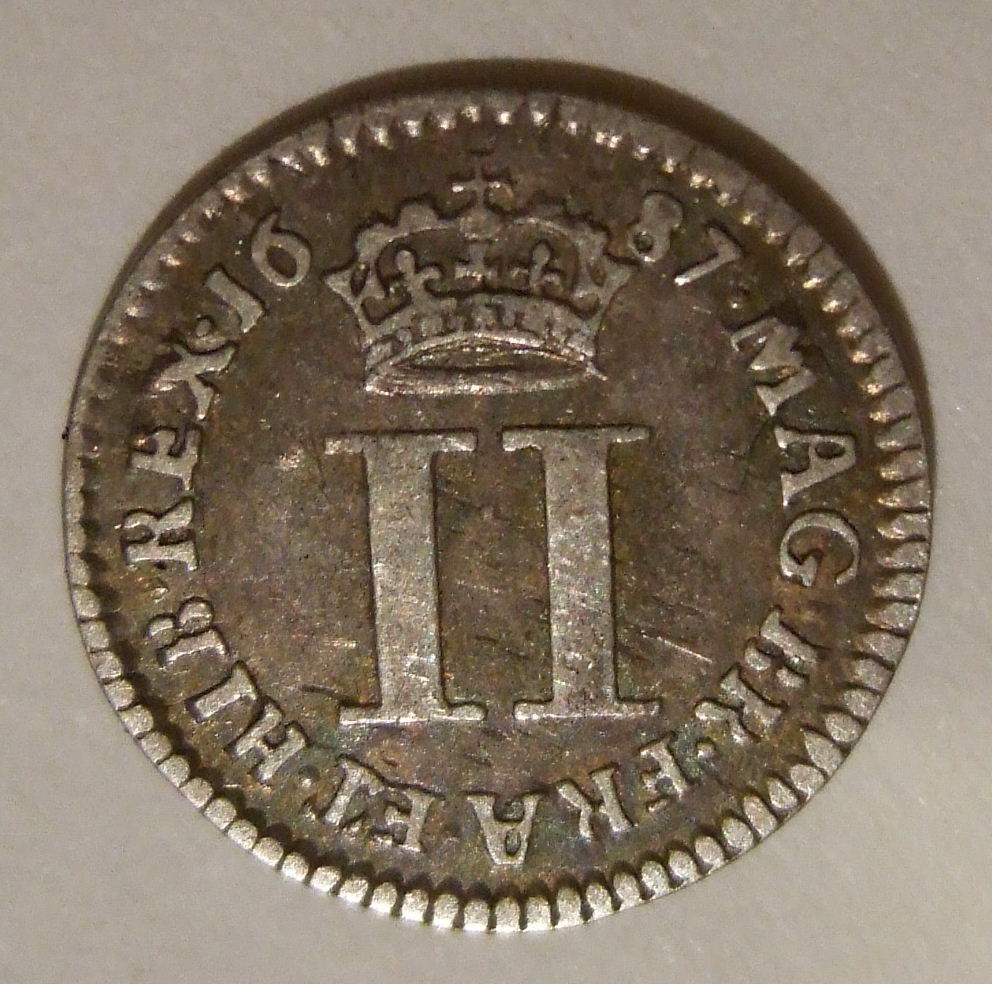
Start with the reverse, because it settles the denomination immediately. The Maundy twopence shows a crown above the Roman numeral II. If you see I, III, or IV instead, you have a different coin from the same silver family (penny, threepence, or fourpence). The legend around the numeral carries the royal titles and the date — on this coin, 1687.
Next, read the obverse portrait and legend. The bust is a profile of the reigning monarch; on this example it is James II, named in the Latin obverse inscription. Matching the portrait and the date to a known monarch is the key attribution step, since the same crowned-II reverse type was used across many reigns. James II coins date only from his 1685–1688 reign, so a legible portrait plus the 1687 date narrows it precisely.
Confirm the physical clues. A silver twopence of this period is minute — roughly a centimetre across and about a gram — with a milled (machine-struck) look: even edges and cleaner relief than hammered coins. The metal should be sterling silver, showing gray toning rather than the copper or brassy tone of base-metal fakes. Weigh it if you can; a piece far heavier or lighter than expected is a warning sign.
Watch for look-alikes and traps. Later Maundy twopences of other monarchs share the identical crowned-II reverse, so never attribute by the reverse alone. Also beware small silver threepences and other tiny denominations that can be confused at a glance, mounted or ex-jewelry pieces with solder or holes, and modern replicas. For a coin this old and small, a cautious approach and, when value warrants, third-party authentication or expert opinion are wise before buying or selling.
Frequently asked questions
What is the single most reliable identifier?
The crowned Roman numeral II on the reverse. It marks the two-pence value and separates the coin from the I, III, and IV pieces of the same series.
How do I attribute it to the right king or queen?
Read the obverse portrait and Latin legend together with the reverse date. Here the profile and inscription identify James II, and the reverse date is 1687.
How can I tell a genuine coin from a cast copy?
Genuine pieces are milled sterling silver with crisp, even detail and correct tiny size and weight. Soft mushy relief, seams, wrong color, or off weight suggest a cast or plated fake.
Does cleaning or a mount hurt the coin?
Yes. Harsh cleaning, mounting holes, solder marks, and bent flans all reduce collector value. Original toning and undamaged surfaces are strongly preferred.