
How to Identify the Massachusetts Willow Tree Shilling
The earliest and rarest of the Massachusetts 'tree' shillings, struck around 1652, identified by a stylized willow tree on the obverse and NEW ENGLAND AN DOM legend around the denomination on the reverse.
Read the full Massachusetts Willow Tree Shilling encyclopedia entry →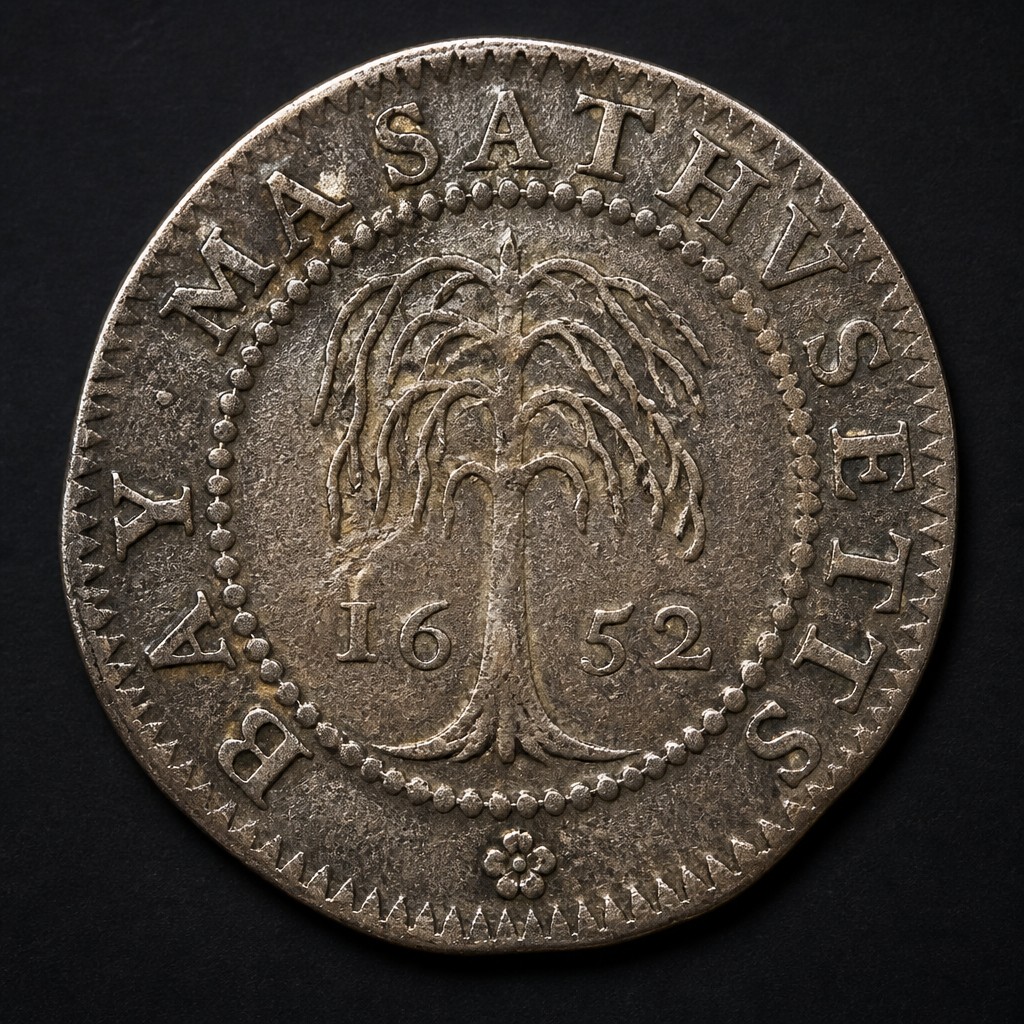
What It Is
The Willow Tree Shilling was struck by the Massachusetts Bay Colony beginning around 1652 (the date frozen on all these tree coinage issues regardless of actual striking year, to avoid English royal objection to colonial coinage), making it the first in a series of tree-themed shillings that continued with the later Oak Tree and Pine Tree designs. It is the scarcest and most primitively struck of the three tree types.
Obverse Design
The obverse shows a crude, thin-branched tree resembling a willow, with the legend "MASATHVSETS IN" arranged around the design in somewhat irregular lettering, reflecting the hand-cut dies used by the colonial mint.
Reverse Design
The reverse carries the legend "NEW ENGLAND AN DOM" around a central "XII" denoting the value of twelve pence (one shilling), with the date 1652 below, though again this date does not necessarily reflect the actual year of striking for every example.
Size, Weight, and Metal
Struck in silver, the Willow Tree Shilling is small and irregular, generally around 25-28mm across (hand-struck coins vary more in shape than machine-made pieces), weighing close to 4.3 grams to match the intended silver shilling standard of the period. The edge is plain, without reeding.
Mint Marks
There is no separate mint mark system since all examples came from the single Boston mint operated under John Hull; identification instead relies on the specific crude tree style and die characteristics that distinguish genuine Willow Tree dies from the later, more refined Oak and Pine Tree types.
Telling It Apart From Similar Coins
The Willow Tree design is notably cruder and thinner-branched than the later Oak Tree shilling (which shows a fuller, rounder tree canopy) or the Pine Tree shilling (which shows a more angular, distinctly pine-shaped tree). Because genuine Willow Tree shillings are extremely scarce, careful comparison of the tree style and lettering against known authentic examples is essential, and given the coin's rarity and value, expert numismatic authentication is strongly advised before assuming any example is genuine.
Judging Condition at a Glance
Given how few genuine examples survive and how crudely all of them were struck even when new, "high grade" is a relative term for this issue: look for legible legends and reasonably centered striking as the main positive indicators, since even mint-state examples show the natural roughness of early hand-struck colonial silver.
Authenticity Red Flags
Because genuine Willow Tree Shillings are rare and valuable, this is one of the most heavily counterfeited and reproduced colonial coin types, including deceptive cast copies sold as curiosities or souvenirs. Any potential example should be weighed and measured carefully against known genuine specimens, and because the stakes of misattribution are high, verification by a recognized numismatic grading service or specialist is strongly recommended rather than relying on visual inspection alone.
Frequently asked questions
Why do all these coins say 1652 even though they were struck over many years?
The Massachusetts mint kept the date frozen at 1652 across its tree coinage series, likely to avoid drawing attention from English authorities who objected to colonial minting.
How can I tell a Willow Tree shilling from an Oak Tree or Pine Tree shilling?
The Willow Tree design is the crudest, showing a thin, sparse tree, while the Oak Tree has a fuller rounded canopy and the Pine Tree shows a more distinct, angular pine shape.
What denomination does XII represent on the reverse?
It denotes twelve pence, equal to one shilling, the coin's face value.
Is this a common coin to find?
No, the Willow Tree Shilling is the rarest of the Massachusetts tree shillings, and any claimed example warrants careful, expert verification given how often it has been reproduced.