
How to Identify the Massachusetts Oak Tree Shilling
A colonial silver shilling struck by the Massachusetts Bay Colony in the 1660s, identified by a rounded, full-canopy oak tree on the obverse and the frozen 1652 date on the reverse.
Read the full Massachusetts Oak Tree Shilling encyclopedia entry →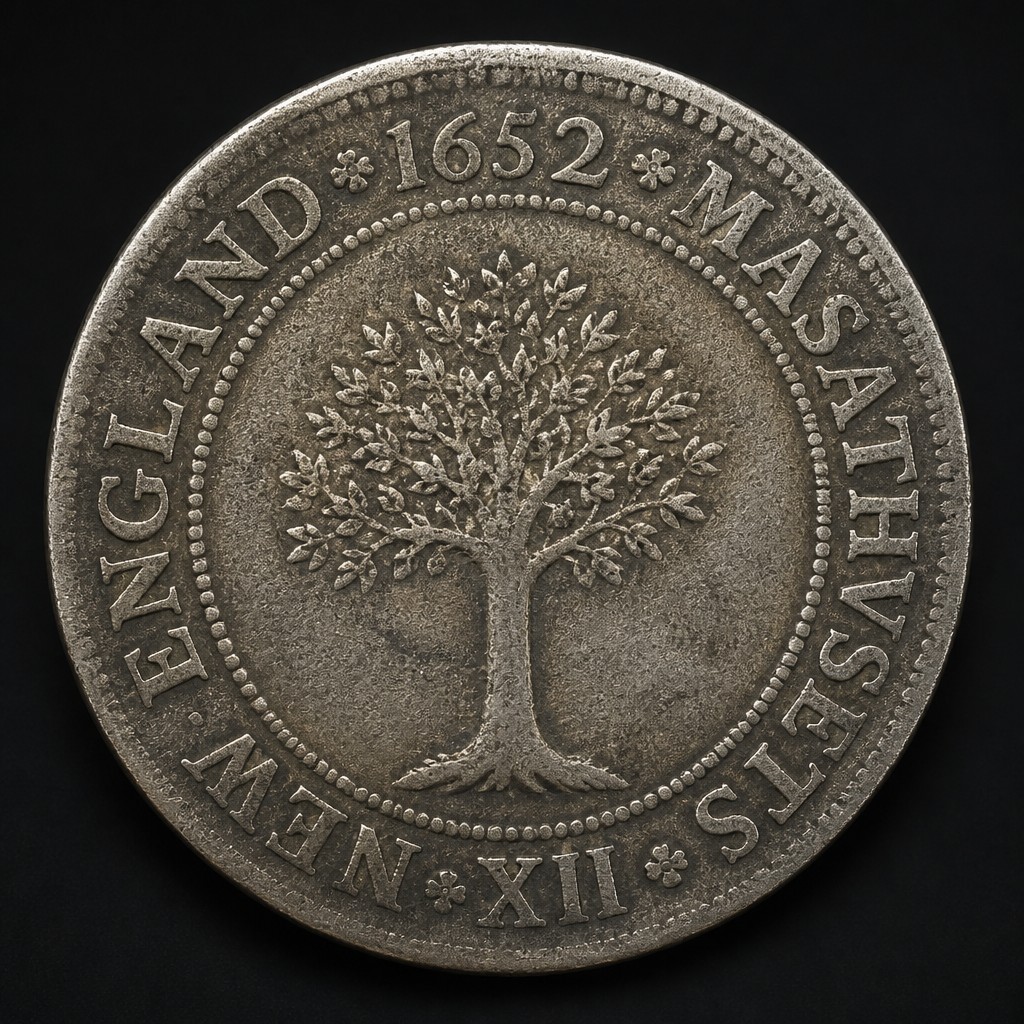
What It Is
The Oak Tree Shilling was struck by the Massachusetts Bay Colony mint in Boston beginning in the early 1660s, succeeding the earlier Willow Tree design and preceding the later Pine Tree series. Like the other tree coinage, all examples bear the fixed date of 1652 regardless of actual production year.
Obverse Design
The obverse shows a tree with a rounder, fuller canopy of branches compared to the sparse Willow Tree design, intended to represent an oak. The legend "MASATHVSETS IN" surrounds the tree, with lettering style varying somewhat across different die pairs used during production.
Reverse Design
The reverse displays the legend "NEW ENGLAND AN DOM" around a central denomination mark, most commonly "XII" for a full shilling (twelve pence), though the same basic tree design was also used for smaller denominations including sixpence and threepence, distinguished by their respective Roman numerals. The date 1652 appears below the central numeral.
Size, Weight, and Metal
Struck in silver, the shilling denomination is roughly 25-27mm in diameter and weighs approximately 4.3 grams, in line with the period's silver shilling weight standard; smaller denominations scale down proportionally in both size and weight. The edge is plain.
Mint Marks
All Oak Tree coinage came from the single Boston mint, so there is no separate mint mark system; instead, numismatists distinguish different die varieties by small variations in the tree's branch pattern, lettering style, and the specific rosette or punctuation marks used in the legends.
Telling It Apart From Similar Coins
Compared to the Willow Tree Shilling, the Oak Tree's canopy is noticeably fuller and rounder, making the two types distinguishable at a glance once you know what to look for. Compared to the later Pine Tree Shilling, the Oak Tree's branches are less angular and pointed than the pine's more distinctly conifer-shaped silhouette. Checking the denomination numeral (III, VI, or XII) also confirms whether a given piece is a threepence, sixpence, or full shilling.
Judging Condition at a Glance
As with all Massachusetts tree coinage, these are hand-struck coins with naturally irregular shapes and centering, so grading focuses on how much of the tree design and legend remain legible rather than expecting machine-like uniformity. Well-preserved examples show distinct individual branches and full, readable legends, while worn examples may have a flattened central tree and partially illegible lettering near the rim.
Authenticity Red Flags
Because Massachusetts tree coinage carries strong collector demand, cast counterfeits and deceptive reproductions are common in the market. Genuine pieces show the sharp, slightly irregular flow lines typical of hand-struck silver rather than the softer, grainier texture of a cast copy, and weight should closely match the expected standard for the claimed denomination. Given the value and historical importance of authentic examples, professional numismatic authentication is recommended before relying on visual inspection alone.
Frequently asked questions
Why does this coin have a fixed 1652 date despite being struck later?
Massachusetts continued using the 1652 date across its tree coinage series for years to avoid provoking English objections to colonial coin production.
How do I distinguish an Oak Tree Shilling from a Willow Tree or Pine Tree Shilling?
The Oak Tree shows a fuller, rounder tree canopy compared to the sparse Willow Tree design and the more angular, pointed Pine Tree design.
What do the Roman numerals on the reverse mean?
They indicate the denomination: XII for a shilling (twelve pence), VI for sixpence, and III for threepence, all using a similar overall tree design.
Where were Oak Tree Shillings minted?
All examples came from a single mint in Boston operated under the Massachusetts Bay Colony's authority.