
How to Identify the Manlius Vulso Æ Sextans
A collector's guide to confirming this Roman Republican bronze sextans by its capped head, prow reverse, two-pellet value mark, and moneyer's signature.
Read the full Manlius Vulso Æ Sextans encyclopedia entry →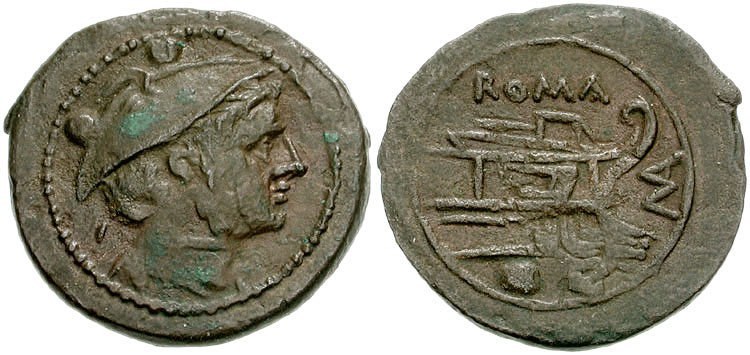
Begin with the overall format, because it places the coin instantly: a small bronze with a god's or hero's head facing right on one side and the prow of a galley on the other, with ROMA below the prow. That head-and-prow design is the hallmark of Roman Republican struck bronze. On this example the obverse head wears a peaked cap — read here as a Phrygian or conical cap — so note the cap shape and the direction the head faces (right).
Next, fix the denomination from the value marks rather than the size, since 2nd-century bronze weights vary. A sextans is normally marked with two pellets (••) for its worth of two unciae. Count the pellets: one means uncia, two means sextans, three quadrans, four triens. Two pellets, together with the head-and-prow type, confirm you have a sextans.
Then hunt for the moneyer's signature. The attribution to Manlius Vulso rests on an added name, monogram, or symbol placed near the prow or in the obverse field. This mark is what separates a signed Vulso issue from the many anonymous prow bronzes; if you cannot find any moneyer's mark, the coin may be an anonymous issue rather than this specific type.
Check the physical characteristics. Expect a struck bronze roughly 15-23 mm across and a few grams in weight, with a brown, green, or earthen patina. The metal should be a copper-alloy bronze, not silver-white or brassy-yellow, and it should not be magnetic. Wide variation in size is normal for the period and is not, by itself, a sign of a fake.
Finally, weigh the look-alikes and authentication cautions. The greatest risk is confusing the denomination — miscounting pellets — or mistaking an anonymous prow bronze for the signed Vulso issue, so verify both the value marks and the moneyer's mark. Ancient bronzes are also faked by casting: watch for a seam on the edge, a grainy or bubbled surface, and unusually soft, mushy detail. Genuine struck coins show sharper relief and a hard, stable patina. For an attribution that carries a premium, compare against a standard reference for Republican bronze and, where value warrants, seek a specialist opinion.
Frequently asked questions
What confirms this is a sextans and not another fraction?
The value marks. A sextans normally carries two pellets in the field with the prow, for its worth of two unciae. Count the pellets — two indicates a sextans, distinct from the one-pellet uncia or three-pellet quadrans.
Where is the moneyer's mark on the coin?
Look for an added name, monogram, or symbol near the prow or in the obverse field. That mark ties the coin to Manlius Vulso and distinguishes it from the many anonymous prow bronzes of the Republic.
What size and metal should a genuine example be?
It is a struck copper-alloy bronze, generally about 15-23 mm and a few grams, with a brown, green, or earthen patina. It should not look silver or brassy and should not be magnetic; size varies with the period's falling weight standard.
How can I spot a cast fake?
Casts often show a seam around the edge, a grainy or bubbled surface, and soft, blurry detail. Genuine struck coins have crisper relief and a hard, stable patina. When in doubt, compare to reference images and consult a specialist.