
How to Identify the Magnentius Double Centenionalis
A large bronze coin from the usurper Magnentius, notable for one of the earliest large Christian Chi-Rho symbols to appear on Roman coinage.
Read the full Magnentius Double Centenionalis encyclopedia entry →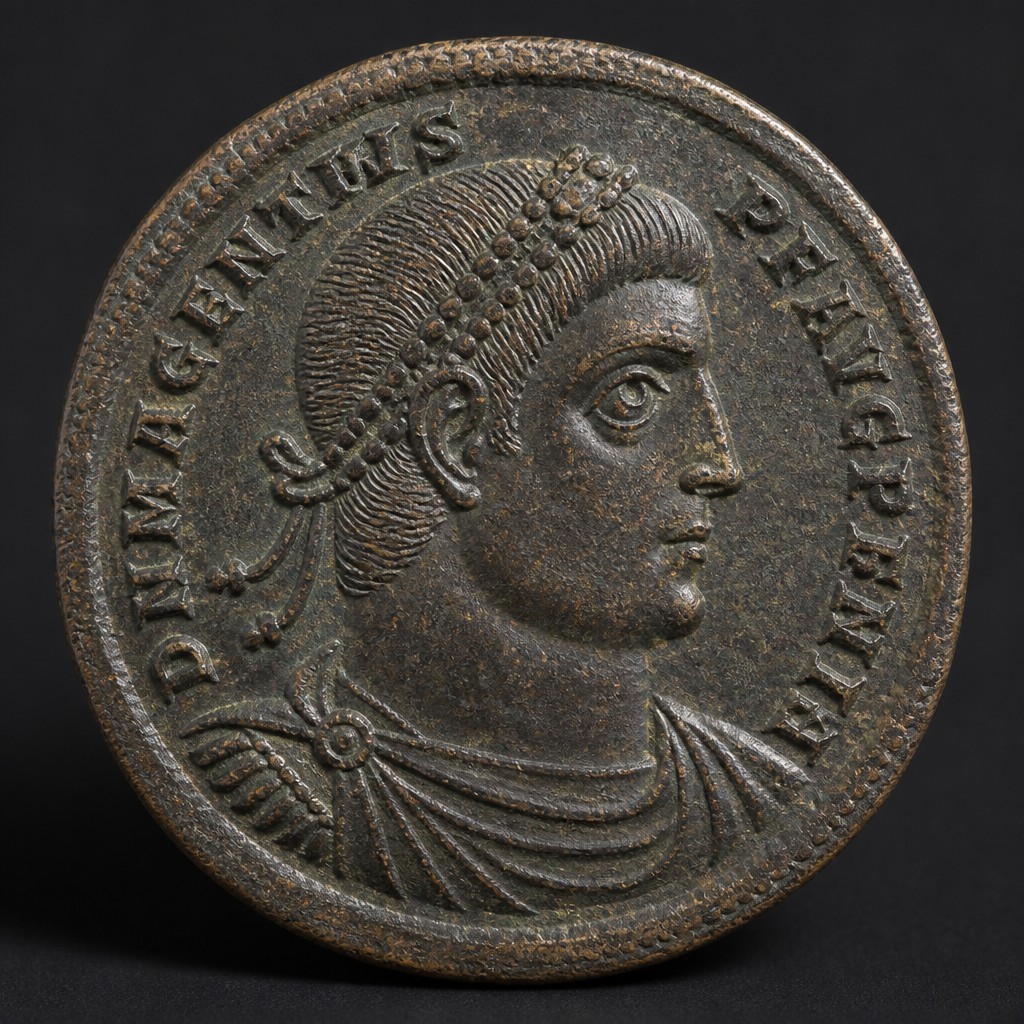
What This Coin Is
This large bronze coin was struck in the name of Magnentius, a military commander who seized power in the western Roman Empire in 350 AD and ruled for several years before his defeat by Constantius II. His coinage is historically notable for prominently featuring Christian symbolism at an unusually early date and large scale for Roman coins.
Obverse Design & Inscriptions
The obverse shows a bare-headed or draped-and-cuirassed bust of Magnentius facing right. The legend reads D N MAGNENTIVS P F AVG, following the standard imperial titulature format of "Our Lord, Pious, Fortunate, Augustus."
Reverse Design & Inscriptions
The signature reverse of this issue features a large Chi-Rho (the Christogram formed from the first two Greek letters of "Christ," Χ and Ρ) at the center, flanked by the Greek letters alpha and omega hanging from the crossbar. The surrounding legend reads SALVS DD NN AVG ET CAES ("the salvation/well-being of our lords the Augustus and Caesar"), referring jointly to Magnentius and his junior colleague.
Size, Weight, Metal, and Edge
This is one of the larger bronze denominations of the mid-4th century, generally measuring around 24-28mm in diameter and weighing roughly 6-8 grams. The edge is plain, as struck.
Mint Marks and Where to Find Them
The exergue carries the mint mark, with abbreviations such as AMB (Amiens), TR (Trier), LVG (Lyon), or ARL (Arles) common, since Magnentius controlled mints across Gaul, Britain, and parts of Italy and Spain during his revolt.
Telling It Apart From Similar Coins
The large, centrally placed Chi-Rho flanked by alpha and omega is unique to this issue among 4th-century Roman coinage and is not easily confused with anything else once recognized; earlier and later coins occasionally use a small Christogram as a subsidiary field symbol, but never as the dominant reverse design at this scale. The obverse name MAGNENTIVS also clearly separates it from contemporary issues of Constantius II or Decentius, Magnentius's Caesar, whose coins share a similar style but a different name and titulature.
Judging Condition at a Glance
Because of the large, open design, even moderately worn examples often show a clear Chi-Rho outline. Higher-grade coins display sharp serifs on the alpha and omega, a fully legible legend, and crisp portrait features; more worn pieces may show a smoothed or partially flattened Christogram while remaining identifiable.
Authenticity Red Flags
Given the historical significance of the design, this type has attracted some modern reproductions. Look out for coins with an unnaturally smooth, low-relief Chi-Rho lacking the sharp angular strokes of a genuine die strike, a visible casting seam, or a surface texture that looks sandy or grainy rather than showing natural metal flow lines. Genuine examples, even when worn, retain crisp geometric edges on the Chi-Rho where the design was struck rather than molded.
Frequently asked questions
Why is the Chi-Rho symbol significant on this coin?
It is one of the earliest and largest uses of the Christian Chi-Rho monogram as a dominant reverse design on Roman coinage, reflecting the growing visibility of Christianity in official imagery.
Who was Magnentius?
He was a military officer who usurped imperial power in the western Roman Empire in 350 AD, ruling for several years before being defeated by the legitimate emperor Constantius II.
What do the alpha and omega letters mean?
They reference a biblical phrase describing God as "the beginning and the end," reinforcing the Christian symbolism paired with the central Chi-Rho.
How can I tell this apart from a coin of Decentius?
Check the obverse legend; Decentius, Magnentius's junior colleague, is named separately on his own coins even though the style and Chi-Rho reverse are similar.