
How to Identify the Lydian Croeseid (Croesus Stater)
A guide to one of the earliest true coins in history, the Lydian gold and silver stater issued under King Croesus, covering its lion-and-bull design and specifications.
Read the full Lydian Croeseid (Croesus Stater) encyclopedia entry →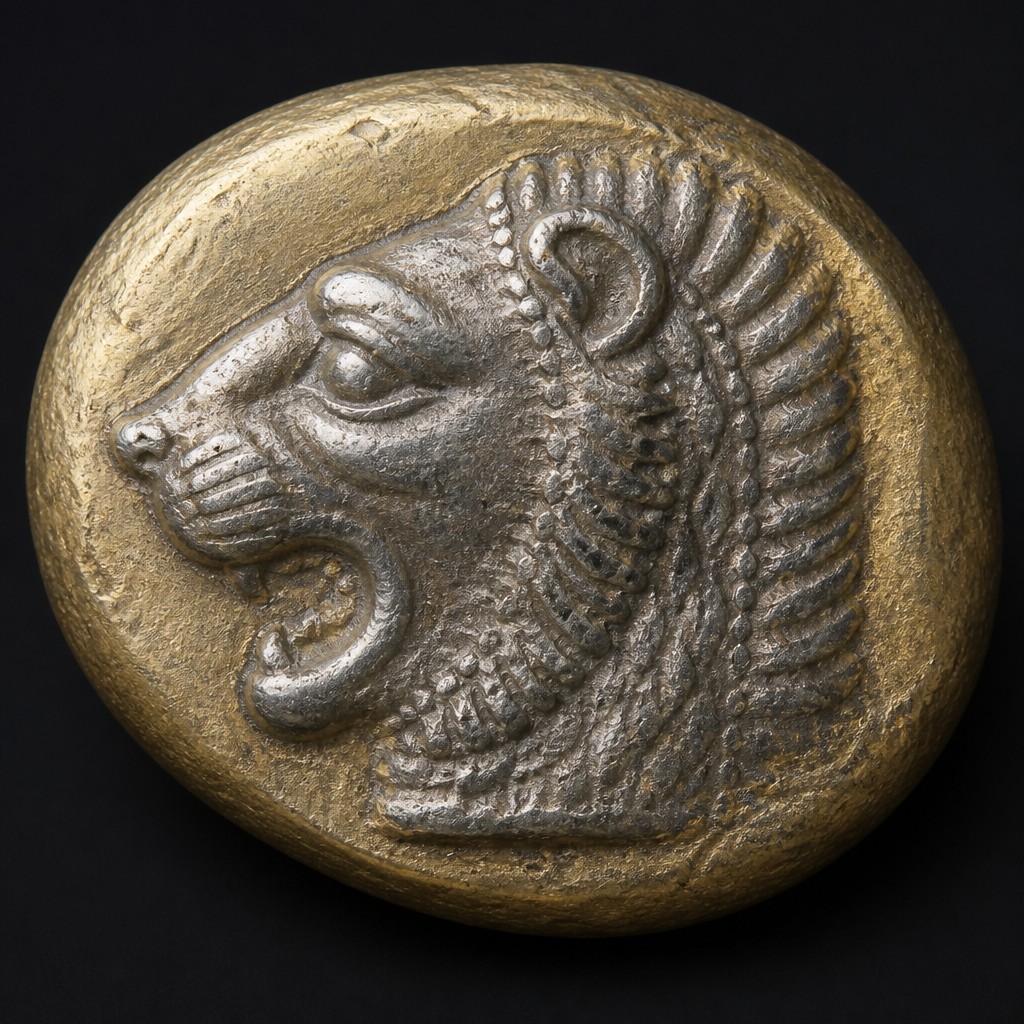
What Is the Coin
The Croeseid is a coin type struck in the Kingdom of Lydia (in present-day western Turkey) under King Croesus, around the mid-6th century BC. It is historically significant as one of the first coinages struck in separately refined pure gold and pure silver, at a fixed value ratio between the two metals, following earlier Lydian electrum coinage.
Obverse Design
The obverse shows the confronted foreparts of a lion (facing right) and a bull (facing left), with the lion's forepart typically dominant and detailed, often with a sunburst or wart-like nodule above its brow. There is no lettering, since inscriptions had not yet been introduced onto coinage at this time.
Reverse Design
The reverse carries no pictorial design; instead it shows two (sometimes three) incuse punch marks of roughly square or rectangular shape, a hallmark of the earliest struck coinage before two-sided die engraving became standard.
Size, Weight, Metal & Edge
Croeseids were struck in two metals: gold staters weighing approximately 8.05 g, and silver staters weighing approximately 10.7 g, reflecting a fixed gold-to-silver value ratio set by the Lydian state. There is no edge design in the modern sense, as these are hand-struck, irregularly shaped flans (blanks) rather than machine-milled coins.
"Mint Marks" and Identifying Features
Because these coins predate any lettering or mint mark system, there is no inscription to check. Authenticity and attribution rely instead on the style of the lion-and-bull dies, the size and depth of the incuse punches, and the weight standard matching known Lydian issues.
Telling It Apart From Similar Coins
Croeseids should not be confused with earlier Lydian electrum coins (a naturally occurring gold-silver alloy), which predate Croesus and lack the refined single-metal composition of true Croeseids. They are also distinct from later Persian gold darics and silver sigloi, which replaced the Lydian lion-and-bull design with a kneeling archer motif after the Persian conquest of Lydia.
Grading and Condition at a Glance
Given their age, most surviving examples show some flan irregularity, off-center striking, or edge cracking from the ancient minting process; this is normal and not necessarily a defect. Sharpness of the lion's mane and bull's horn details, along with a well-centered strike showing both incuse punches clearly, are what collectors look for in a well-preserved example.
Authenticity Red Flags
Because ancient coins of this importance are targets for forgery, uniform, "too-perfect" surfaces without natural die wear, incorrect weight for the claimed metal, or overly sharp, modern-looking design elements are causes for caution. A flan that is perfectly round and flat, rather than the slightly irregular, lumpy shape typical of hand-struck ancient blanks, is also a common tell on later copies. Given the specialized nature of ancient coin authentication, provenance and expert examination are especially important for this type.
Frequently asked questions
Why is the Croeseid historically important?
It is among the earliest coinages struck in separately refined pure gold and pure silver at a fixed exchange ratio, a major step in the development of coined money.
What is depicted on the obverse?
The confronted foreparts of a lion and a bull, with no lettering since inscriptions had not yet appeared on coinage.
What is on the reverse?
Two or three incuse punch marks rather than a pictorial design, typical of the earliest struck coins.
How is a Croeseid different from Persian darics?
Darics came later, after the Persian conquest of Lydia, and replaced the lion-and-bull design with an archer motif.