
How to Identify the Ludwigs-Eisenbahn Nürnberg-Fürth 150 Pfennig
Identify this 1921 Notgeld piece by its ornamental fountain monument, the Nürnberg-Fürth legend, the plain 150 Pfennig reverse and its light zinc-iron fabric.
Read the full Ludwigs-Eisenbahn Nürnberg-Fürth 150 Pfennig encyclopedia entry →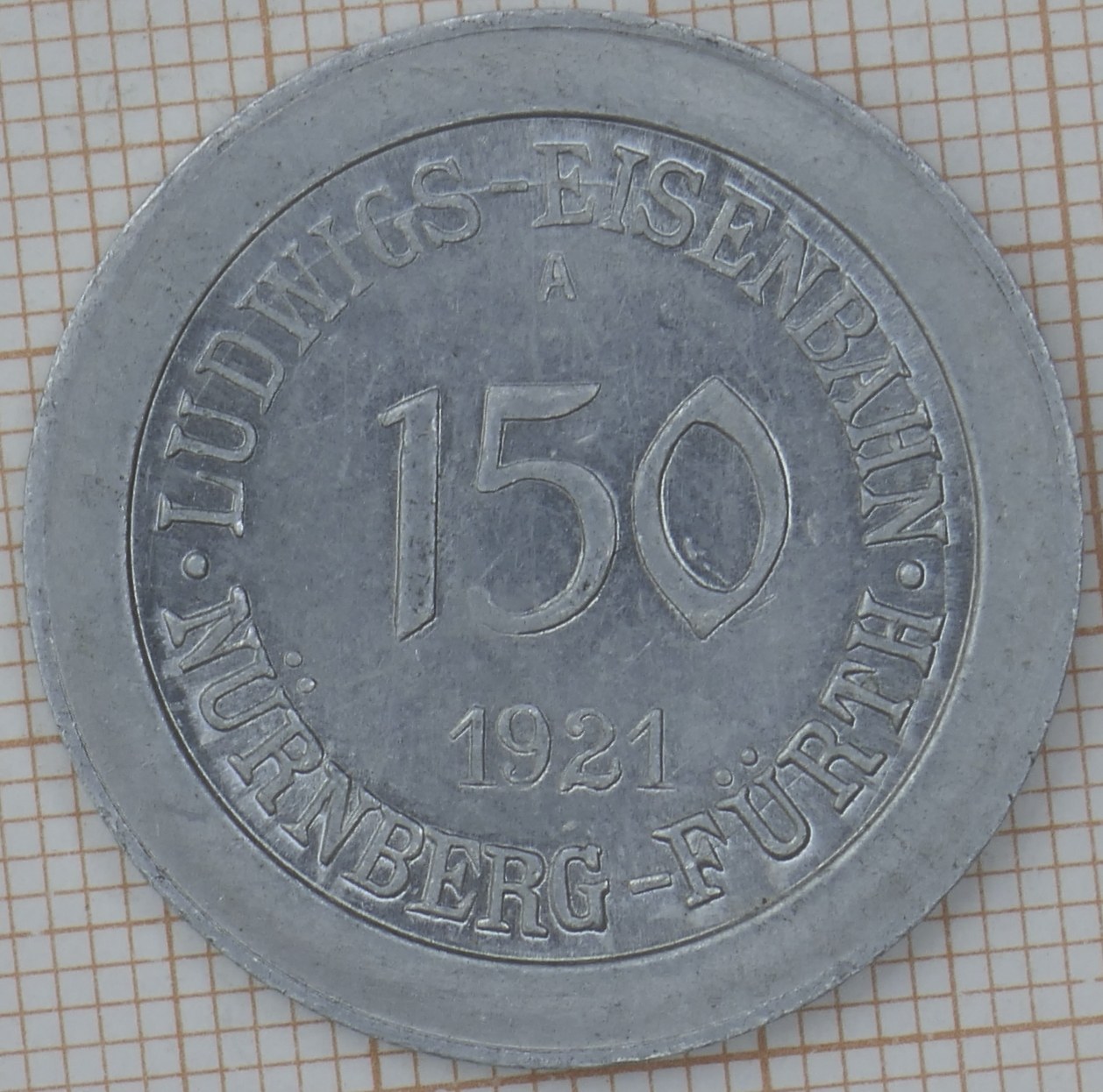
Start with the fountain motif. The obverse's defining feature is an ornamental monument — a decorative fountain (Kunstbrunnen) shown as a civic landmark. Read the surrounding legend for the words Nürnberg-Fürth and the reference to the Ludwigs-Eisenbahn; matching the motif to that legend is the surest way to attribute the piece.
Read the reverse and date. The reverse is deliberately plain: look for a single denomination marking of 150 Pfennig and the year 1921. Notgeld reverses emphasise the value over decoration, so a spare, text-only reverse is normal and expected here.
Check size, metal and fabric. This is a small base-metal token in zinc-iron, so it will feel light for its size and may show grey toning, spotting or corrosion. Weigh and measure it and compare against catalogue specifications for the type. A magnet may react to the iron content — useful for distinguishing base-metal Notgeld from silver or other coins.
Watch for look-alikes. Countless German towns and firms issued Notgeld in 1920–1923, many with landmark or monument designs and round denominations, so a similar-looking token from another city is easy to confuse at a glance. Confirm the Nürnberg-Fürth / Ludwigs-Eisenbahn legend, the 150 Pfennig value and the 1921 date together before settling on this type. The unusual 150-Pfennig denomination itself is a helpful diagnostic.
Authenticate with catalogues. Because Notgeld is catalogued in detail by issuer and denomination, the best check is to match your piece against published listings for Nürnberg-Fürth emergency money. Be cautious of modern reproductions and cleaned or artificially toned surfaces, and judge condition honestly, since corrosion and wear strongly affect both attribution and value.
Frequently asked questions
What is the single most distinctive feature?
The ornamental fountain (Kunstbrunnen) monument on the obverse, combined with a Nürnberg-Fürth / Ludwigs-Eisenbahn legend. Together with the 150 Pfennig value and 1921 date, these confirm the type.
How do I know it is a base-metal token and not a silver coin?
It is struck in zinc-iron, so it is light for its size and may show grey toning or corrosion; the iron content can react to a magnet. Weigh and measure it against catalogue specifications rather than judging by colour alone.
Why is the denomination 150 Pfennig unusual?
Standard coins came in values like 1, 2, 5 or 10 Pfennig, so an odd figure such as 150 Pfennig points to locally issued emergency money (Notgeld) rather than official national coinage, and is a useful identification clue.
How can I confirm the attribution?
Match the piece against published catalogues of German Notgeld, which list issues by city and denomination. Verify the Nürnberg-Fürth legend, the 150 Pfennig value and the 1921 date, and watch for modern reproductions.