
How to Identify the Lower Canada Bank Penny Token
Practical checks for an 1837 Lower Canada Habitant penny: the habitant obverse, crowned arms reverse, metal and size, plus cautions on varieties and fakes.
Read the full Lower Canada Bank Penny Token encyclopedia entry →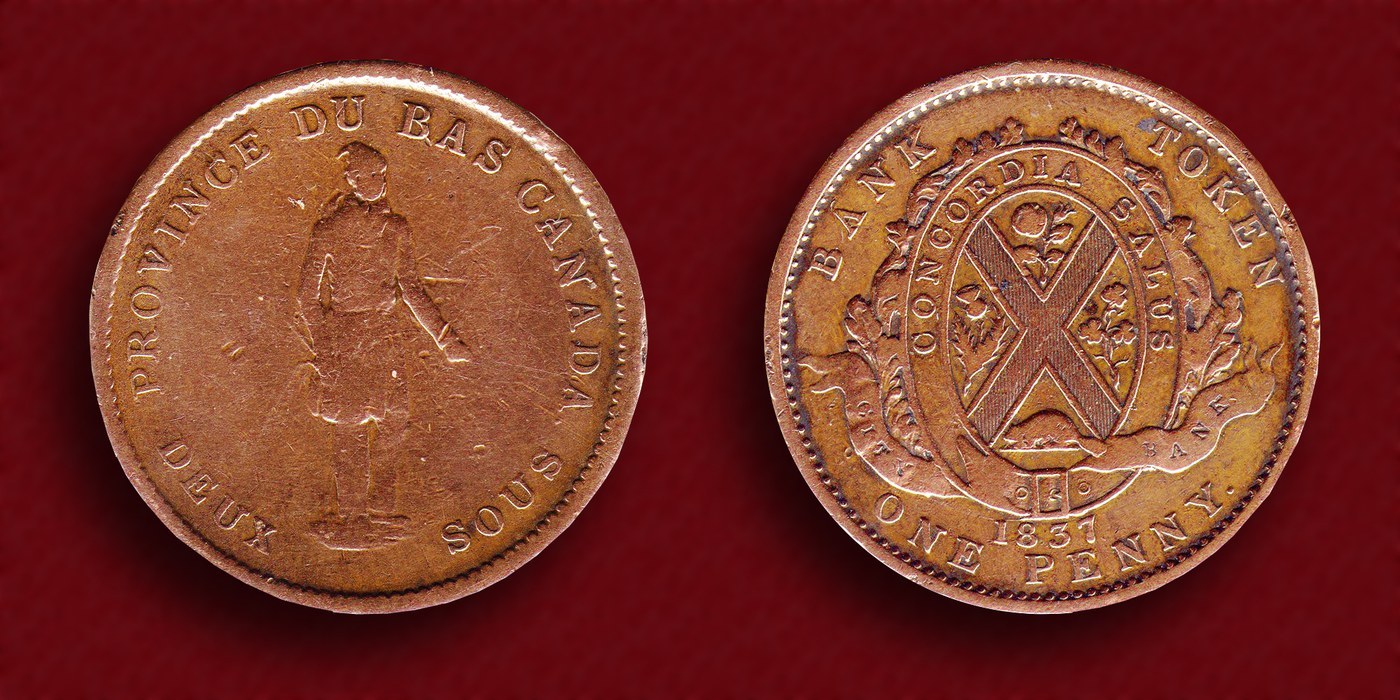
Start with the obverse figure and legend. You are looking for a standing habitant — a French-Canadian farmer figure — surrounded by the French inscription PROVINCE DU BAS CANADA. This obverse is the signature of the 1837 Lower Canada bank tokens, so a clear standing figure with that legend is your first confirmation that you have a Habitant-type piece rather than an unrelated colonial token.
Turn to the reverse and study the arms. The design shows an ornate heraldic shield topped by a crown and crest, with the surrounding legend naming the issuing bank and stating the denomination and the date 1837. Read this legend carefully with a loupe: the bank name and the exact denomination wording (the penny is the "Deux Sous" value) are what distinguish one issue in the series from another.
Cross-check the physical traits. The token should be copper — brown to reddish-brown and non-magnetic — and penny-sized, clearly larger and heavier than the matching "Un Sou" half-penny. A caliper, a small scale, and a magnet quickly separate a genuine copper penny token from a smaller half-penny, a plated imitation, or a magnetic base-metal fake.
Mind the varieties and look-alikes. Multiple Lower Canada banks used closely related versions of the habitant-and-arms design in 1837, and numerous minor die differences exist, so the general appearance alone does not identify a specific bank or variety. Related but distinct series — such as the "Bouquet" sous and other Canadian bank tokens — share the era and the copper format but differ in their devices, so match the full legend rather than the overall style.
Authenticate before relying on any conclusion. Examine the legends and date under magnification for tooling or casting seams, weigh the piece against expected standards, and for anything you suspect is a scarcer bank, an unusual variety, or a high grade, get a written opinion from a Canadian-token or pre-Confederation specialist instead of attributing it from the design alone.
Frequently asked questions
How do I know I have the penny and not the half-penny?
The penny is the larger, heavier "Deux Sous" value, while the half-penny is the smaller "Un Sou." Check the reverse denomination wording and compare diameter and weight; the two are otherwise very similar in design.
Does the coat of arms tell me which bank issued it?
Not on its own. Several banks used closely related crowned-arms reverses in 1837. You need to read the full reverse legend, including the bank name, to attribute the specific issue.
Is the metal a reliable clue?
Yes as a cross-check. Genuine tokens are copper, which is brown to reddish and non-magnetic. A magnetic or oddly bright, plated piece is more likely a reproduction than an original 1837 token.
Should I have the token authenticated?
For common, clearly circulated pieces careful measurement is usually enough. For anything that looks like a scarcer bank, a better variety, or a high grade, have it reviewed by a Canadian-token specialist.