
How to Identify the Louisiana Purchase Exposition Dollar (Jefferson)
A collector's checklist for confirming the Jefferson Louisiana Purchase gold dollar — portrait, legend, tiny gold-dollar format, and how to tell it from the McKinley type.
Read the full Louisiana Purchase Exposition Dollar (Jefferson) encyclopedia entry →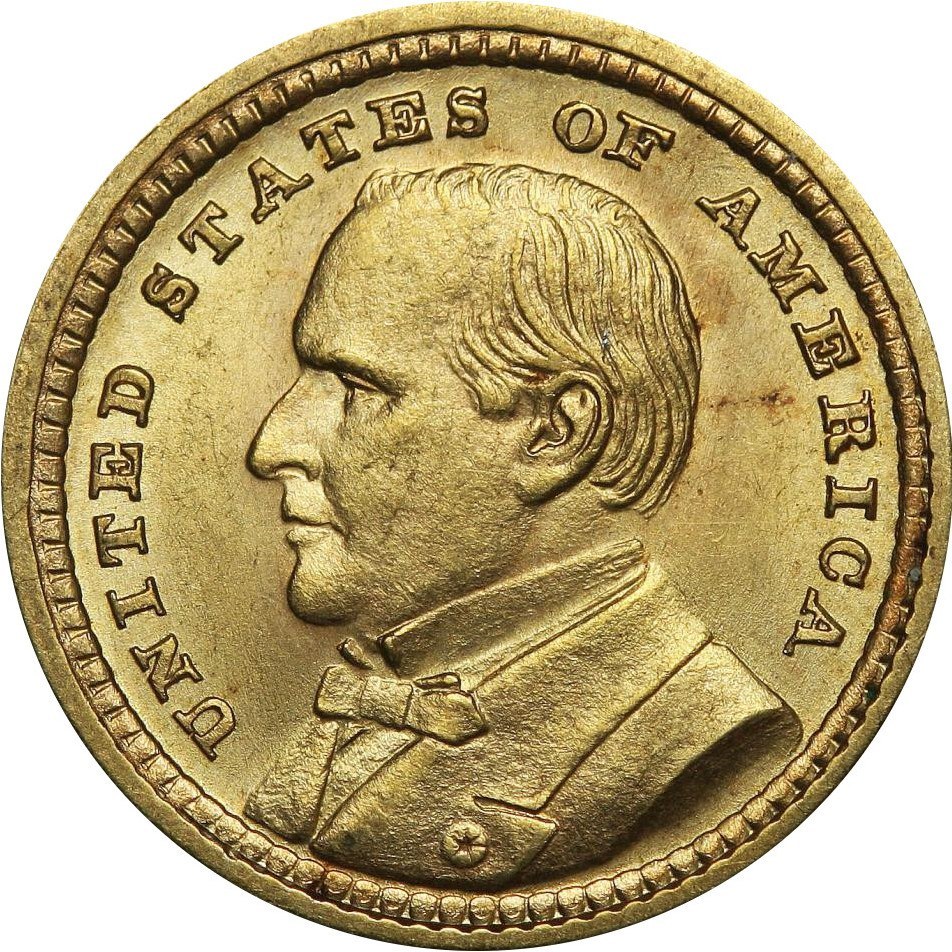
Begin with the portrait, because that is what separates this coin from its twin. The Jefferson variety shows Thomas Jefferson in a left-facing profile, ringed by the legend UNITED STATES OF AMERICA. The companion Louisiana Purchase gold dollar carries President William McKinley instead. If the face is not Jefferson's, you are holding the McKinley type, not this one.
Confirm the commemorative context. The issue honors the 1803 Louisiana Purchase and the 1904 Louisiana Purchase Exposition in St. Louis, and the reverse of the series names that exposition. The pairing of a presidential profile with the Louisiana Purchase theme is the signature of these coins, so read both the portrait and the surrounding legends together.
Check the physical format, which is distinctive. This is a gold dollar — a very small coin only about 15 mm in diameter, noticeably smaller than a U.S. one-cent piece, struck in .900 fine gold and weighing well under two grams. The warm, rich yellow of genuine gold and the diminutive size are strong confirmations; a coin that is the wrong diameter, too heavy, or a pale color for its size should be questioned.
Do not look for a mint mark. These commemoratives were struck at the Philadelphia Mint and carry no mint mark, so the absence of one is normal and not a warning sign. The meaningful variable is the portrait variety, not a mint letter.
Apply the usual authentication cautions for small gold commemoratives. Because the coins are valuable and easy to fake or alter, watch for casting seams, soft or mushy detail, added or re-engraved portraits, and incorrect weight or diameter. Cleaning and jewelry use are common, since some pieces were mounted; look for solder traces, filed edges, or a scrubbed surface. For any significant purchase, rely on examples certified by a major grading service (PCGS or NGC) rather than on eye appeal alone.
Frequently asked questions
How do I tell the Jefferson variety from the McKinley variety?
Look at the obverse portrait. This coin shows Thomas Jefferson in left-facing profile; the other 1903 Louisiana Purchase gold dollar shows President William McKinley. The portrait is the only way to tell the two apart at a glance.
How big is the coin and what is it made of?
It is a gold dollar, roughly 15 mm in diameter and light in weight, struck in .900 fine gold. Its small size and warm gold color are key identifying traits.
Should my coin have a mint mark?
No. It was produced at the Philadelphia Mint and carries no mint mark, so a missing mint mark is expected and not a sign of a problem.
How can I be sure a valuable example is genuine?
Verify the correct small diameter, light weight, and rich gold color, and check for casting seams, altered detail, or mounting damage. For higher-value coins, buy pieces certified by PCGS or NGC.