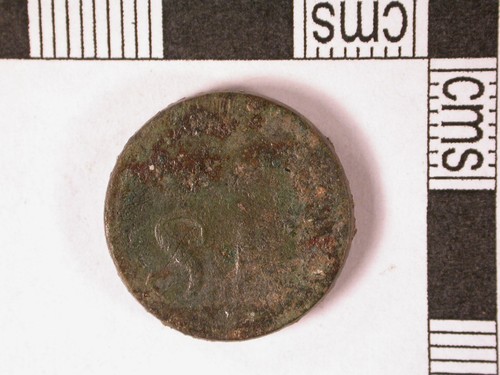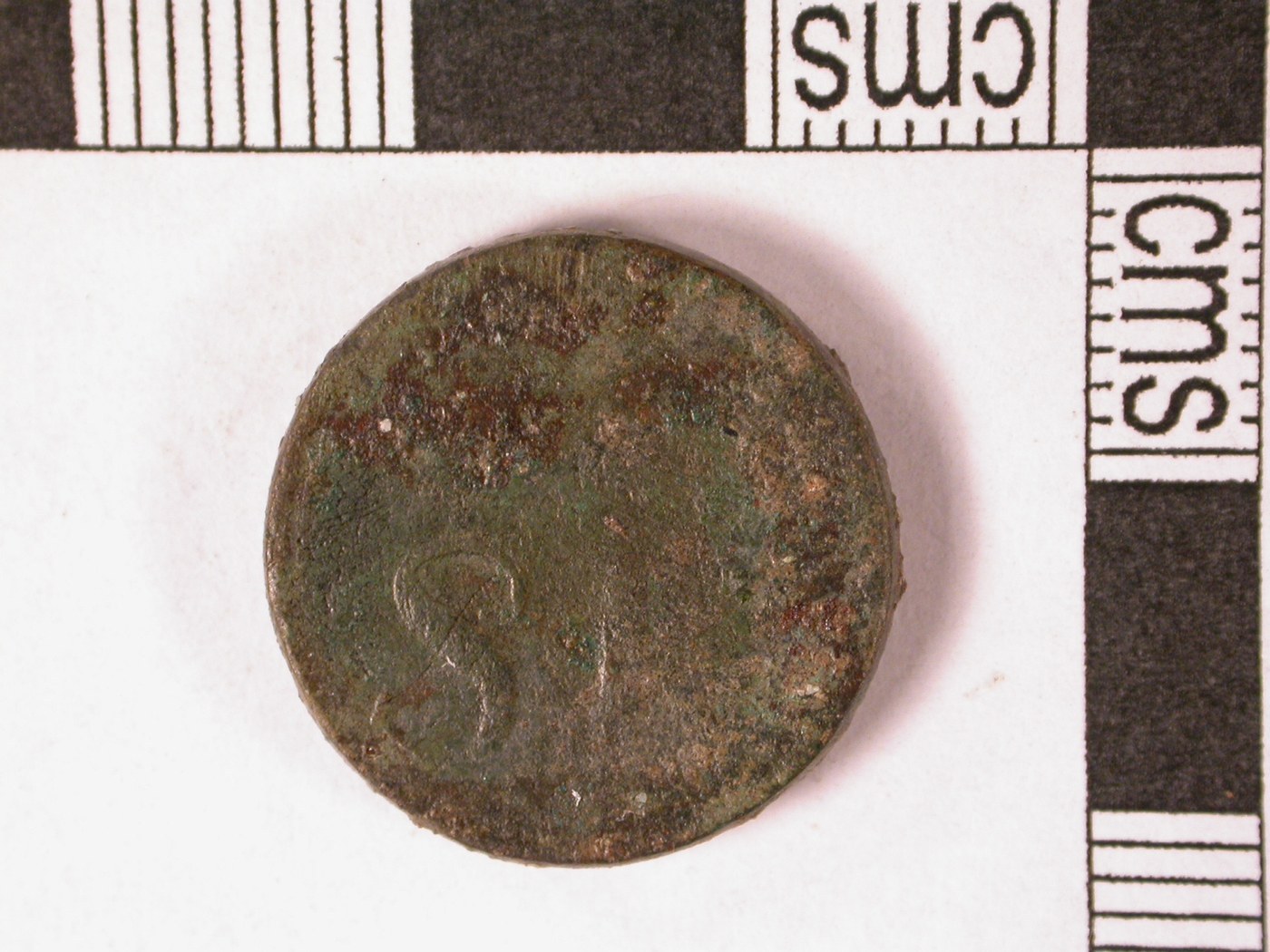
Louis d'Or Coin Weight
A French bronze monetary weight (poids monétaire) made to check the weight of a gold Louis d'Or, not a coin itself but a money-changer's balance weight.
- Country
- France
- Denomination
- Coin Weight
- Metal
- Bronze
Got a coin like this?
Identify any coin from a photo, free.
Overview
The Louis d'Or Coin Weight is not a coin but a monetary weight—a small, dense bronze piece calibrated to match the exact mass of a French gold Louis d'Or. Money changers, merchants and bankers set such a weight in one pan of a balance and the suspect gold coin in the other; a coin that was clipped, worn or counterfeit would fail to balance and could be rejected.
This example is a worn bronze disc, photographed here as an archival object beside a metric scale to record its diameter. Its surfaces carry the muted brown-to-olive patina typical of long-handled bronze, and the design—once a stamped device and legend identifying which coin it verified—is softened by age and use.
Because it verified rather than spent value, a coin weight belongs to the world of the assayer's balance box rather than the purse. Its worn profile and utilitarian form reflect a working tool, not a decorative or circulating piece.
History & Background
The gold Louis d'Or was France's principal gold coin from the reign of Louis XIII in 1640 until the Revolution swept away the monarchy's coinage in the 1790s. Across that century and a half its official weight was fixed by royal edict, and any variation invited fraud—so a parallel trade in poids monétaires, monetary weights, grew up alongside the coins themselves.
These weights were produced by licensed adjusters and balance-makers, often working under royal or municipal authority, and were sold in fitted cases together with a small folding balance. A single box might hold weights for the Louis d'Or and its multiples and fractions, as well as for foreign gold such as the Spanish pistole or the Portuguese moidore that circulated in French commerce.
Because the Louis d'Or was re-tariffed and its weight standard revised several times during the 17th and 18th centuries, coin weights were made in matching series over many decades. Precise attribution of a single worn piece to a maker or exact year is often difficult, which is why a broad historical dating is more honest than a specific one.
How to Identify
Identify a Louis d'Or coin weight first by what it is not: it has no denomination or year in the manner of a coin, no reeded edge, and no evidence of having been struck as currency. It is a plain, fairly thick bronze disc whose weight, not its face, was the point.
Look for a stamped or engraved device—historically a fleur-de-lis, a crown, a monarch's initial, or a small effigy—together with a short legend or abbreviation indicating the coin it represents. On heavily circulated pieces like this one the design is worn to a faint outline. The metal is bronze or brass rather than gold; a genuine coin weight is a base-metal proxy, never precious.
Confirm identity with the balance: a Louis d'Or weight should sit close to the historical mass of the gold coin it checked (a Louis d'Or was on the order of several grams of gold, varying by issue). Diameter is usually a little larger than the coin so the piece is easy to handle. Photographing it against a metric scale, as here, is the standard way to document size for reference.
Value & Collectibility
As historical horology-adjacent numismatic tools, French coin weights are collected in their own right, and value turns on legibility, maker, completeness and condition rather than on any bullion content—the bronze is worth little as metal. A clearly stamped weight naming the Louis d'Or, with crisp device and legend, is more desirable than a worn, anonymous disc.
Worn single weights such as this one are generally modest, affordable items, valued as tangible relics of the pre-Revolution money trade. Prices rise sharply for weights that retain their original fitted case and matching balance, for signed pieces by known adjusters, and for complete graded sets covering multiple denominations.
Because condition and attribution vary so widely, compare any specific piece to recent dealer listings and specialist auction results for French poids monétaires rather than assuming a fixed figure. Authentic surfaces and an untampered patina add materially to the appeal.
Frequently asked questions
Is a Louis d'Or coin weight actually money?
No. It is a bronze monetary weight, a tool used with a balance to check whether a gold Louis d'Or coin had its correct weight. It was never legal tender and has no face value of its own.
Why is it made of bronze instead of gold?
The weight only needed to match the mass of the gold coin, not contain gold. Base metals like bronze or brass were durable, cheap and stable, making them ideal for a reusable reference weight.
What was the Louis d'Or?
The Louis d'Or was France's main gold coin from 1640 to the 1790s, named for the kings Louis who issued it. Its official weight was fixed by edict, which is exactly what these weights were made to verify.
Can I date my coin weight precisely?
Usually only broadly. The Louis d'Or standard was revised several times over 150 years and matching weights were made throughout, so a worn, unsigned piece is best described by era rather than an exact year.
Louis d'Or Coin Weight guides
In-depth guides for identifying, valuing, and collecting Louis d'Or Coin Weight.