
How to Identify the Lincoln-Illinois Centennial Half Dollar
A 1918 silver commemorative marking Illinois's statehood centennial, easily spotted by its Lincoln portrait obverse and eagle-on-rock reverse based on the state seal.
Read the full Lincoln-Illinois Centennial Half Dollar encyclopedia entry →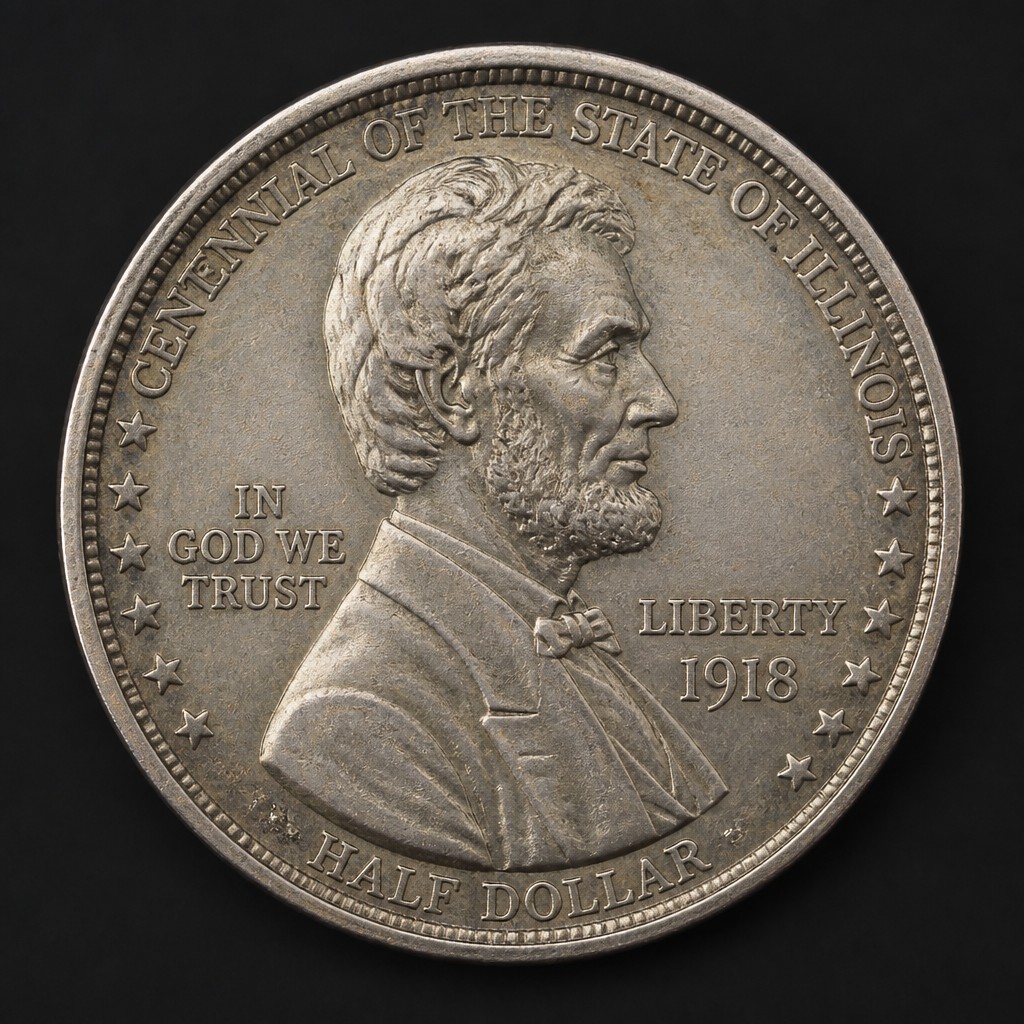
What This Coin Is
The Lincoln-Illinois Centennial Half Dollar was issued in 1918 to celebrate the 100th anniversary of Illinois statehood (1818-1918). It was the first U.S. commemorative coin to feature Abraham Lincoln and remains a single-year issue popular for its striking, well-executed design.
Obverse Design
The obverse shows a left-facing bust of Abraham Lincoln, adapted by engraver George T. Morgan from Augustus Saint-Gaudens's standing Lincoln statue. "UNITED STATES OF AMERICA" arcs along the upper rim, "HALF DOLLAR" appears below, and "IN GOD WE TRUST" is placed near Lincoln's shoulder. The portrait is notably deep and realistic compared to many commemoratives of the era.
Reverse Design
The reverse, designed by John R. Sinnock, reproduces the state seal of Illinois: an eagle with outstretched wings perched on a rock, holding a shield in its talons, with rays of sun behind it. The inscriptions "ILLINOIS CENTENNIAL 1818-1918" and "STATE SOVEREIGNTY NATIONAL UNION" (Illinois's state motto) encircle the design.
Size, Weight, Metal, and Edge
The coin follows standard classic commemorative half dollar specifications: 90% silver, 10% copper, approximately 12.5 grams, about 30.6mm in diameter, with a reeded edge.
Mint Marks and Where to Find Them
All Lincoln-Illinois halves were struck at the Philadelphia Mint and bear no mint mark. Because this is a one-mint, one-year issue, mint mark hunting is not part of identifying this coin.
Telling It Apart from Similar Coins
The Lincoln portrait is unique among commemoratives of this design style, so confusion with other coins is unlikely. Collectors should simply confirm the "ILLINOIS CENTENNIAL 1818-1918" wording and eagle-on-rock reverse match, since later Lincoln cents or medals sometimes get mistakenly compared to this larger silver half dollar.
Judging Condition at a Glance
On the obverse, check Lincoln's cheekbone, brow, and the fine strands of hair for flattening. On the reverse, examine the eagle's breast feathers and the top of the rock formation, which are the first areas to show wear. A coin with sharp feather separation and a fully detailed Lincoln portrait indicates minimal circulation.
Authenticity Red Flags
Genuine examples show crisp, well-defined lettering and a naturally frosty or lightly toned silver surface. Be cautious of coins with unusually soft or mushy detail (suggesting a cast copy), incorrect diameter or weight, or an edge without clean, evenly spaced reeding. Discoloration that looks painted on rather than naturally toned over decades is also worth scrutinizing closely.
Frequently asked questions
Where was the Lincoln-Illinois half dollar minted?
Exclusively at the Philadelphia Mint in 1918; it carries no mint mark.
What makes this coin historically notable?
It was the first U.S. commemorative coin to depict Abraham Lincoln, based on a Saint-Gaudens statue design.
Is the Lincoln-Illinois half a common commemorative to find?
It is considered a moderately available classic commemorative compared to some of the rarest issues, though well-preserved examples still command solid prices.
What's the easiest way to spot wear on this coin?
Check Lincoln's cheek and hair on the obverse and the eagle's breast feathers on the reverse, since these areas flatten first with circulation.
What metal composition should I expect?
Standard 90% silver, 10% copper composition typical of pre-1965 U.S. silver half dollars.