
How to Identify the Licinius Follis
A guide to identifying Licinius's follis (308-324 AD), covering its shrinking size through the late Tetrarchic reforms, the Jupiter reverse type, and how to spot his son's similar coins.
Read the full Licinius Follis encyclopedia entry →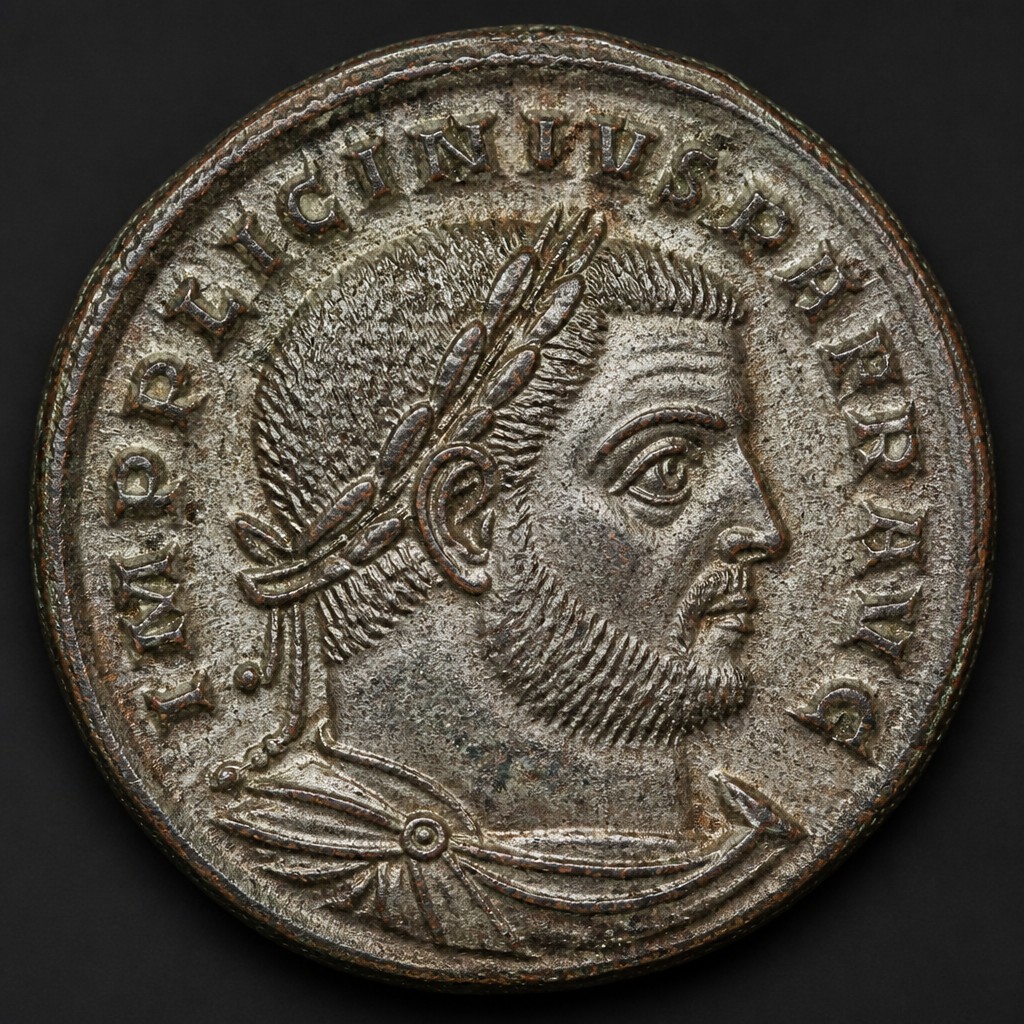
What Is the Licinius Follis?
Licinius rose to Augustus of the eastern empire in 308 and became Constantine the Great's main rival for sole rule, eventually defeated and executed in 324 after a prolonged civil war. His follis coinage spans the last phase of the Tetrarchic system into the early Constantinian era, and shows the denomination's continued reduction in size and weight over that period.
Obverse Design and Inscriptions
The obverse shows a laureate, and later laureate-and-cuirassed, bust right, with the legend IMP LICINIVS PF AVG or IMP C VAL LICINIVS PF AVG.
Reverse Design and Inscriptions
Early coins continue the GENIO POP ROM Genius type. From around 313 onward, the dominant type becomes IOVI CONSERVATORI, showing Jupiter standing with an eagle and a small Victory figure, reflecting Licinius's continued attachment to traditional pagan cult in contrast to Constantine's growing Christian associations. Later issues also use SOLI INVICTO COMITI.
Size, Weight, and Metal
By Licinius's reign the follis had shrunk considerably from Diocletian's original standard, typically measuring roughly 20-23mm and weighing about 3-4 grams, continuing the empire's gradual currency reduction.
Mint Marks and Where to Find Them
Coins were struck at numerous eastern mints, including Antioch, Nicomedia, Cyzicus, Heraclea, Siscia, and Thessalonica, with exergue city codes followed by officina letters or numerals.
Telling It Apart from Similar Coins
His son Licinius II, made Caesar in 317, shares a youthful portrait with the legend D N VAL LICINIVS NOB CAES or LICINIVS IVN NOB C, distinguishing him from his father's mature bust. Contemporary rival Constantine I's coinage from the same years is distinguished simply by the differing emperor name in the legend, though coins of both rulers circulated together before their final war.
Judging Condition at a Glance
Check the Jupiter figure's eagle and Victory attributes for detail on IOVI CONSERVATORI reverses, along with the usual portrait wear points on the obverse.
Authenticity Red Flags
Standard cautions against cast fakes and re-silvered surfaces apply, as with other late Tetrarchic-era folles. Also verify that the reverse type is consistent with the expected date range for the coin, since a GENIO POP ROM reverse paired with a portrait style typical of the later 313-324 period would be an inconsistency worth further scrutiny.
Frequently asked questions
What is the most common reverse type on Licinius's later coins?
IOVI CONSERVATORI, showing Jupiter standing with an eagle and a small Victory figure, which became dominant from around 313 onward.
How do I tell Licinius's coin apart from his son Licinius II's?
The son is shown with a youthful portrait and the legend D N VAL LICINIVS NOB CAES or LICINIVS IVN NOB C, distinct from his father's mature bust and senior AVG title.
Why is this follis smaller than Diocletian's original follis?
The denomination was progressively reduced in size and weight through ongoing currency reforms between Diocletian's introduction of the follis around 294 and Licinius's reign decades later.
How is Licinius's coinage related to Constantine's from the same period?
Both rulers issued similar-style folles simultaneously while they were rivals for power, and their coins are distinguished simply by the differing emperor name in the obverse legend.