
How to Identify the Liberty Head V Nickel
A guide to identifying the Liberty Head 'V' Nickel (1883-1913), covering its Liberty portrait, large Roman numeral reverse, the famous missing-CENTS variety, and mint mark placement.
Read the full Liberty Head V Nickel encyclopedia entry →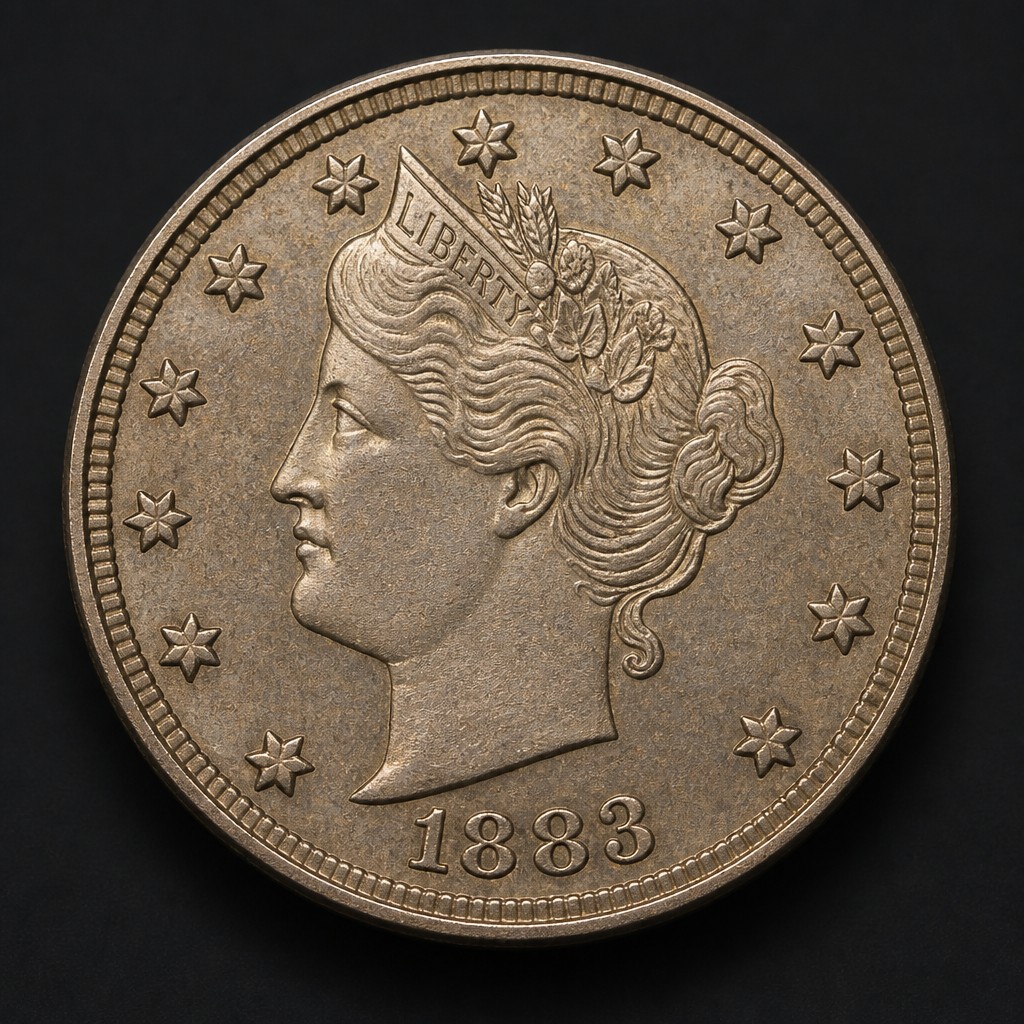
What It Is
The Liberty Head Nickel, often called the "V Nickel" for the large Roman numeral V on its reverse, was struck from 1883 to 1913. It was designed by Charles E. Barber and is best known for a minting oversight in its first year that created one of numismatics' most famous curiosities.
Obverse (Front) Design
Liberty faces left, wearing a coronet inscribed "LIBERTY," with a wreath of cotton, corn, wheat, and tobacco around her hair. Stars encircle the border, and the date sits at the bottom.
Reverse (Back) Design
The reverse is dominated by a large Roman numeral "V" inside a wreath, with "UNITED STATES OF AMERICA" and "E PLURIBUS UNUM" around the border. In early 1883, the coin's designers omitted the word "CENTS," assuming the Roman numeral made the denomination obvious. Some people gold-plated these "no CENTS" nickels and passed them off as five-dollar gold pieces, since the two coins are close in size; these deceptive pieces later earned the nickname "Racketeer Nickels." Later in 1883, the Mint added the word "CENTS" beneath the V to end the confusion, and this version continued through the end of the series.
Size, Weight, Metal, and Edge
The coin measures 21.2 mm in diameter and weighs 5.00 grams, struck in the same 75% copper, 25% nickel alloy used throughout the series' history. The edge is plain.
Mint Marks
For most of the series' run, from 1883 through 1911, every Liberty Head Nickel was struck at the Philadelphia Mint and carries no mint mark. Only in the final two years, 1912, did the Denver and San Francisco mints strike this design, placing a small "D" or "S" on the reverse just below the "V."
Telling It Apart from Similar Coins
The "no CENTS" 1883 variety is distinguished simply by the absence of the word "CENTS" below the V; the "with CENTS" version added that word later the same year, so both varieties share the 1883 date. Beyond that, the plain "CENTS" reverse is used for every date from 1883 through 1913. A tiny number of 1913-dated Liberty Head Nickels exist, but these were never an authorized regular issue; only five are known, and any coin offered as a genuine 1913 Liberty Head Nickel warrants extreme skepticism and professional authentication, since ordinary 1912 or altered coins are sometimes misrepresented as this rarity.
Judging Condition at a Glance
Wear shows first on Liberty's hair above the ear and along her cheek, and on the leaves of the wreath surrounding the V on the reverse. A coin with crisp, well-defined wreath leaves and clear hair strands is in notably better shape than one where these details have flattened.
Authenticity Notes
Beyond the 1913 rarity issue, watch for gold-plated "no CENTS" pieces still being sold as novelty items; these were plated decades ago and are not fraudulent in themselves, but should never be mistaken for genuine five-dollar gold coins. Reported mint marks on 1912 coins should be checked for correct positioning directly beneath the V and for consistent metal color, since applied mint marks are sometimes used to fake rarer combinations.
Frequently asked questions
What is the 'Racketeer Nickel'?
It refers to an 1883 'no CENTS' Liberty Head Nickel that was gold-plated by scammers and passed off as a five-dollar gold coin because of its similar size; it is not a separate official Mint issue.
How do I tell the two 1883 varieties apart?
The first 1883 nickels lack the word 'CENTS' below the large V on the reverse; later in the year, the Mint added 'CENTS' to prevent the coin from being confused with gold coinage.
Where is the mint mark on a Liberty Head Nickel?
It appears only on 1912-dated coins, as a small D or S positioned just below the V on the reverse; all other dates were struck in Philadelphia and carry no mint mark.
Is a 1913 Liberty Head Nickel real?
Only five genuine examples are known and none were an authorized Mint product; any coin presented as a 1913 Liberty Head Nickel should be treated with strong skepticism and referred to a professional grading service.