
How to Identify the Liberty Head Quarter Eagle ($2.50)
A small $2.50 gold coin struck from 1840 to 1907, identified by its coronet-style Liberty portrait and a shield-bearing eagle on the reverse.
Read the full Liberty Head Quarter Eagle ($2.50) encyclopedia entry →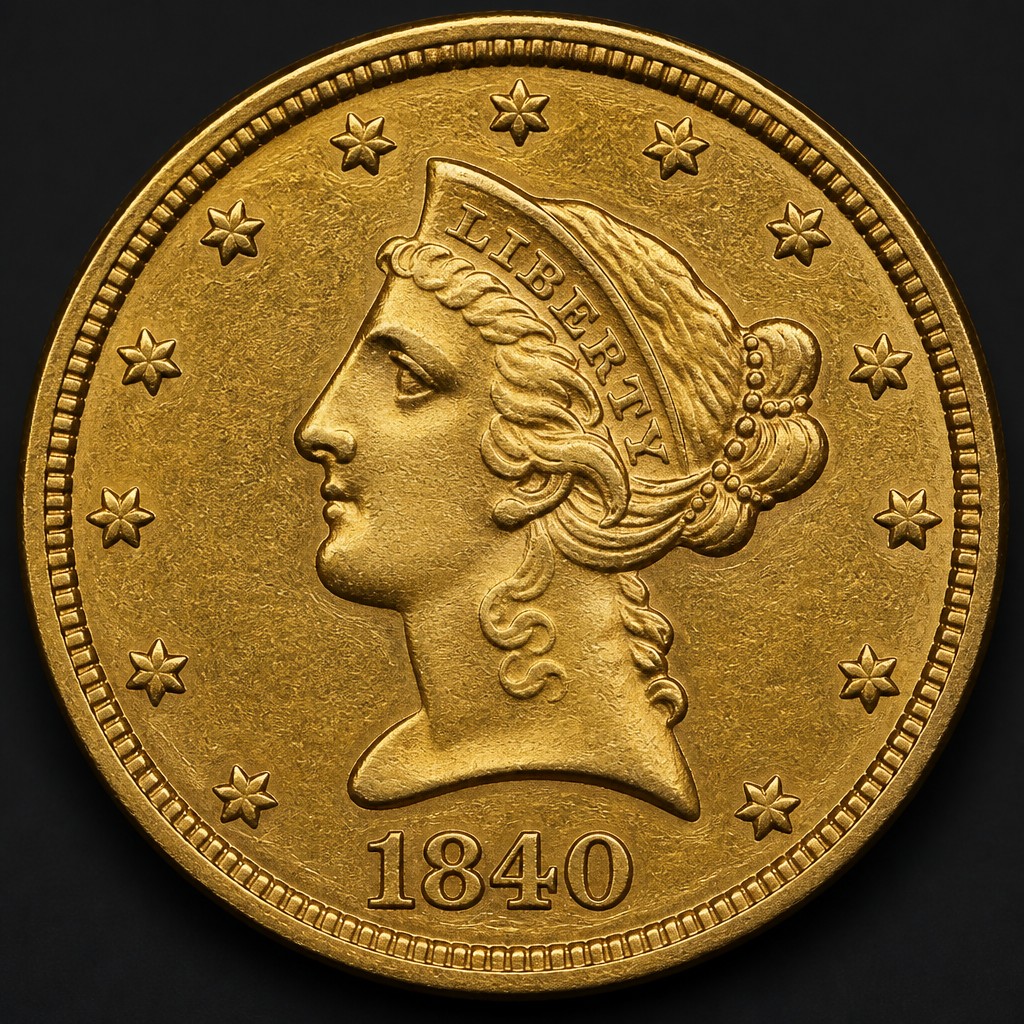
What It Is
The Liberty Head, or Coronet Head, quarter eagle is a $2.50 gold coin designed by Christian Gobrecht and struck from 1840 to 1907. It followed the earlier Classic Head quarter eagle and remained in production, essentially unchanged in design, for nearly seven decades.
Obverse Design
The obverse shows Liberty's head facing left wearing a coronet inscribed "LIBERTY." Stars surround the portrait, and the date appears below.
Reverse Design & Inscriptions
The reverse depicts an eagle with a shield on its breast, holding an olive branch and arrows in its talons. "UNITED STATES OF AMERICA" arches above, and "2 1/2 D." appears below the eagle. "IN GOD WE TRUST" was added above the eagle beginning in 1866.
Size, Weight, Metal, and Edge
The coin weighs 4.18 grams, is struck in .900 fine gold, measures 18 mm in diameter, and has a reeded edge — a small coin easily overlooked among pocket change of the era.
Mint Marks and Where to Find Them
The mint mark sits on the reverse, above "2 1/2 D." and below the eagle. Look for "C" (Charlotte), "D" (Dahlonega), "O" (New Orleans), or "S" (San Francisco); no mint mark indicates Philadelphia.
Telling It Apart From Similar Coins
As with other Liberty Head gold coins, the presence or absence of "IN GOD WE TRUST" above the eagle separates No Motto coins (before 1866) from With Motto coins (1866 onward). To tell this coin apart from the Indian Head quarter eagle introduced in 1908, look for the coronet portrait and standard raised relief here, versus a feathered headdress and incuse (recessed) design on the later type. It can also be confused at a glance with the earlier Classic Head quarter eagle (1834–1839), which lacks stars on the obverse in most years and has a plainer Liberty portrait without a coronet band reading "LIBERTY."
Judging Condition at a Glance
Examine Liberty's hair curls and coronet edge, and the eagle's wing tips and shield lines on the reverse, for the first signs of wear on an otherwise small, densely detailed coin.
Authenticity Red Flags
Because of its small size and gold content, weight and diameter checks are especially useful — deviations are easier to notice on a coin this compact. Inspect the mint mark closely for a clean, unaltered appearance; given the coin's low face value but genuine gold content, low-mintage branch-mint dates are sometimes targeted for added or altered mint marks, so compare against known genuine examples for that date and mint.
Frequently asked questions
Where is the mint mark located?
On the reverse, above the denomination '2 1/2 D.' and below the eagle.
How can I tell this from the Classic Head quarter eagle?
The Liberty Head type has a coronet inscribed 'LIBERTY' and stars around the portrait in most years, while the earlier Classic Head type has a plainer portrait with a simple headband and no coronet lettering.
How is this different from the Indian Head quarter eagle?
This coin uses a coronet-style Liberty in normal raised relief, while the Indian Head quarter eagle shows a feathered headdress in an incuse, recessed design.
Does every date have 'IN GOD WE TRUST'?
No, the motto only appears above the eagle on coins struck from 1866 onward.