
How to Identify the Liberty Head Half Eagle
Identify an 1838 $5 gold half eagle by its capped Liberty head ringed with stars, spread-winged eagle reverse, small heavy gold size, and "5 D." value.
Read the full Liberty Head Half Eagle encyclopedia entry →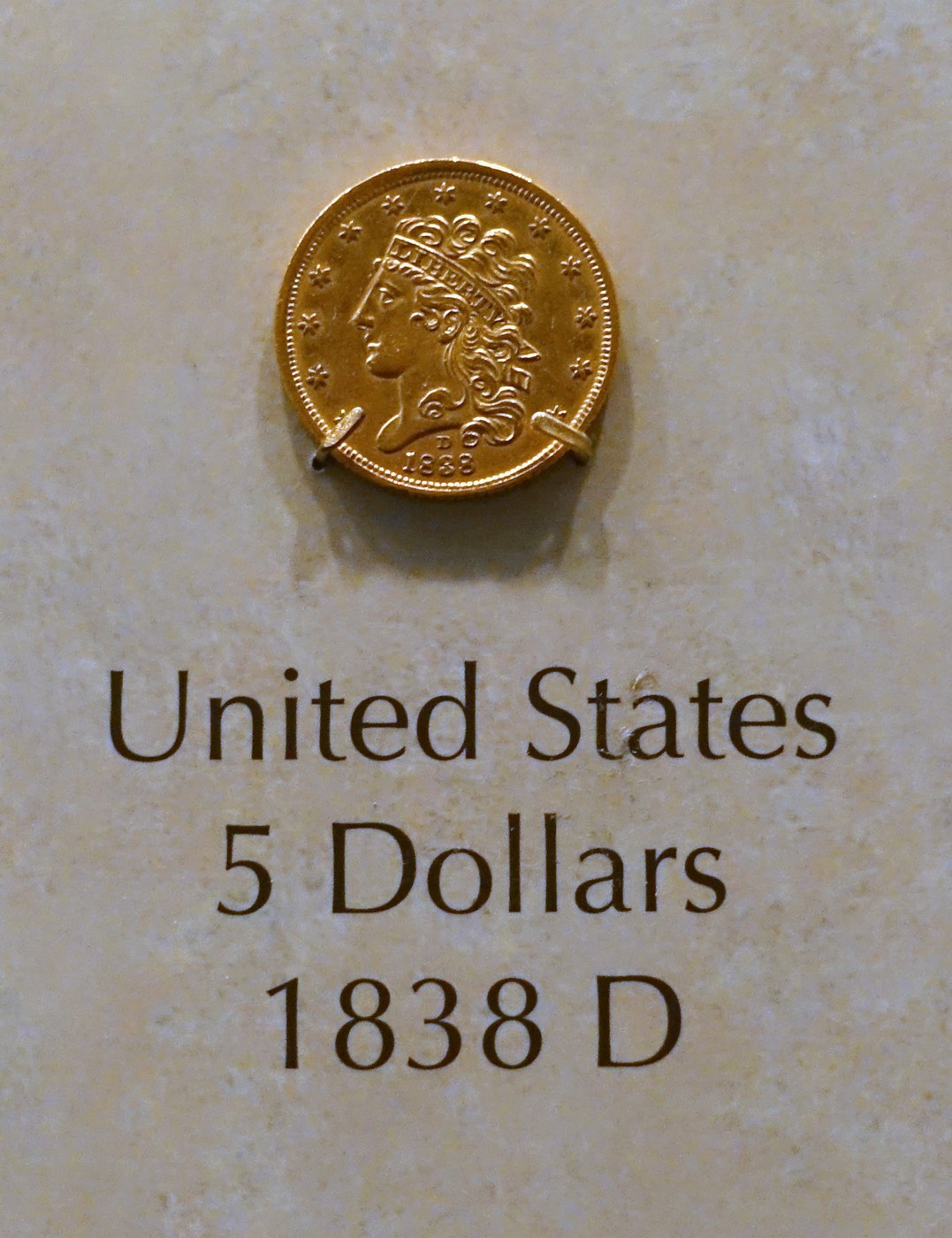
What It Is
The coin pictured is a United States half eagle—a five-dollar gold piece—dated 1838. That date places it in the Classic Head design, struck from 1834 to 1838, which shows a plain left-facing Liberty head rather than a coronet. Confirming the denomination and design phase first makes the rest of the identification straightforward.
Obverse (Front)
Look for Liberty facing left, her hair drawn back and held by a band lettered "LIBERTY," surrounded by thirteen stars with the four-digit date at the bottom. This plain, band-wearing portrait is the tell for the Classic Head type; the later Coronet half eagle instead shows Liberty wearing a distinct coronet with "LIBERTY" across it.
Reverse (Back)
The reverse shows an eagle with wings spread, a shield on its breast, holding an olive branch and arrows. "UNITED STATES OF AMERICA" arcs around the top and the denomination reads "5 D." below the eagle. On this type there is no "E PLURIBUS UNUM" motto—its absence helps separate the reduced-weight Classic Head coins from the earlier Capped Head half eagles.
Size, Metal, and Mint Marks
This is a small but dense coin: about 22.5 mm across and roughly 8.3 grams, struck in an alloy of about 90% gold, so it feels heavy for its size and shows a rich gold color. Philadelphia strikes have no mint mark. On the 1838 branch-mint coins, check the obverse just above the date for a small "C" (Charlotte) or "D" (Dahlonega)—unlike many later half eagles, the mark is on the front, not the reverse.
Look-Alikes and Cautions
Don't confuse the 1838 Classic Head with the 1839-and-later Coronet "Liberty Head" half eagle (coronet instead of a band) or with the earlier Capped Head half eagles (which carry the "E PLURIBUS UNUM" motto). Because these are valuable early gold coins, counterfeits, added mint marks, and altered dates exist—an added "C" or "D" can turn a common coin into an apparent rarity. Verify weight and diameter, be wary of cleaned, polished, or ex-jewelry pieces with solder or file marks, and have any potentially valuable example authenticated and graded by a reputable third-party service before buying or selling.
Frequently asked questions
How do I tell the Classic Head half eagle from the later Coronet Liberty Head?
On the 1834–1838 Classic Head, Liberty wears a plain band lettered "LIBERTY" across her hair. On the 1839–1908 Coronet type she wears a raised coronet inscribed "LIBERTY." The date on the coin also settles it—1838 is the Classic Head type.
Where should I look for a mint mark on an 1838 half eagle?
Check the obverse, just above the date. A "C" means Charlotte and a "D" means Dahlonega; Philadelphia coins have no mint mark. Later half eagles moved the mint mark to the reverse, so the obverse position is characteristic of the 1838 branch-mint issues.
How can I confirm it is genuine gold and not a copy?
A real coin should weigh about 8.3 grams and measure roughly 22.5 mm, with crisp original detail and no seams or casting bubbles. Given the coin's value and the existence of counterfeits and added mint marks, have questionable pieces examined by a professional grading service rather than relying on appearance alone.
Does a worn or cleaned example still have value?
Yes—as a gold coin it retains bullion value, and even circulated Classic Head half eagles carry collector premiums. However, cleaning, scratches, mount or solder marks, and damage significantly reduce the numismatic value, so originality matters.