
How to Identify the Liberty Head Half Eagle ($5)
Also known as the Coronet Head half eagle, this $5 gold coin was struck from 1839 to 1908 and is identified by Liberty's coronet portrait and a shield-bearing eagle reverse.
Read the full Liberty Head Half Eagle ($5) encyclopedia entry →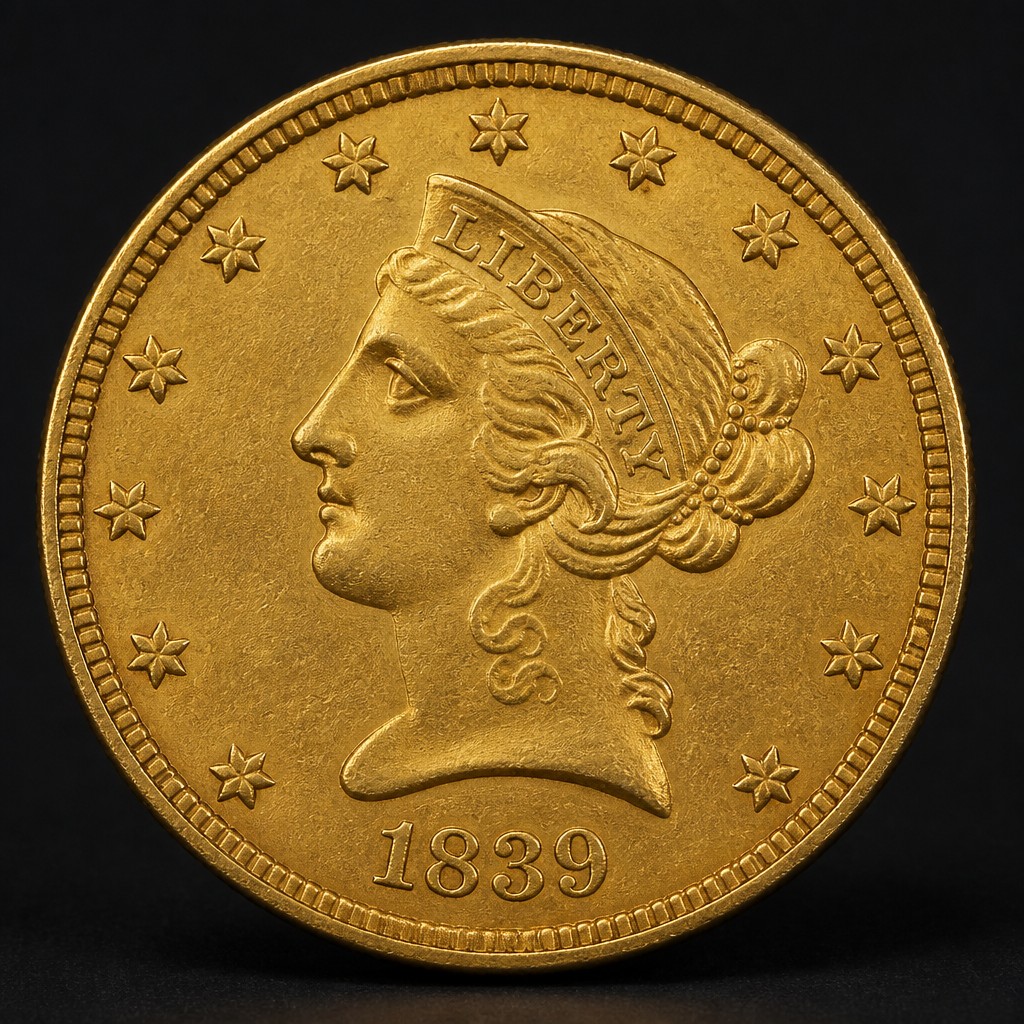
What It Is
The Liberty Head, or Coronet Head, half eagle is a $5 gold coin designed by Christian Gobrecht and produced from 1839 through 1908. It was struck at more branch mints than almost any other U.S. gold denomination, reflecting its role as a workhorse coin in commerce for nearly seventy years.
Obverse Design
The obverse shows Liberty's head facing left wearing a coronet inscribed "LIBERTY." Stars surround the portrait and the date sits below.
Reverse Design & Inscriptions
The reverse depicts an eagle with a shield on its breast, holding an olive branch and arrows. "UNITED STATES OF AMERICA" arches above, and the denomination reads "FIVE D." below the eagle on most issues. "IN GOD WE TRUST" was added above the eagle beginning in 1866.
Size, Weight, Metal, and Edge
The coin weighs 8.359 grams, is struck in .900 fine gold, measures 21.6 mm in diameter, and has a reeded edge.
Mint Marks and Where to Find Them
The mint mark is found on the reverse, above the denomination and below the eagle. Look for "C" (Charlotte), "D" (Dahlonega), "O" (New Orleans), "S" (San Francisco), or "CC" (Carson City); no mint mark indicates Philadelphia.
Telling It Apart From Similar Coins
As with the related $10 eagle, checking for "IN GOD WE TRUST" above the eagle quickly sorts a coin into the No Motto era (before 1866) or With Motto era (1866 onward). To distinguish this coin from the Indian Head half eagle that replaced it starting in 1908, look for the coronet-and-curls portrait and reeded edge here, versus a feathered war bonnet and incuse design on the later type.
Judging Condition at a Glance
Look at Liberty's hair curls near the coronet and the eagle's wing feathers and shield lines for the earliest signs of wear; these high points flatten before the open fields around them.
Authenticity Red Flags
Given its long production run across multiple Southern branch mints — some of which struck relatively low numbers of coins — verify that the mint mark's size, shape, and position match genuine examples for that specific mint and date. A mint mark with rough edges, unusual thickness, or evidence of having been added or altered is a warning sign, as is a weight or diameter that falls outside the coin's known specifications.
Frequently asked questions
Where is the mint mark on this coin?
On the reverse, above the denomination and below the eagle.
How do I know if it's a 'No Motto' or 'With Motto' variety?
Check above the eagle on the reverse; 'IN GOD WE TRUST' appears there only on coins from 1866 onward.
What is the difference between this and the Indian Head half eagle?
This coin shows a coronet-wearing Liberty in conventional raised relief with a reeded edge, while the Indian Head half eagle has a feathered headdress design struck incuse.
Which mint marks appear on this series?
C (Charlotte), D (Dahlonega), O (New Orleans), S (San Francisco), and CC (Carson City), plus no mark for Philadelphia.