
How to Identify the Liberty Head Eagle
Identify the Liberty Head Eagle by its coronet-crowned Liberty, shielded eagle, 'TEN D.' value, large 90% gold planchet, and reverse mint mark.
Read the full Liberty Head Eagle encyclopedia entry →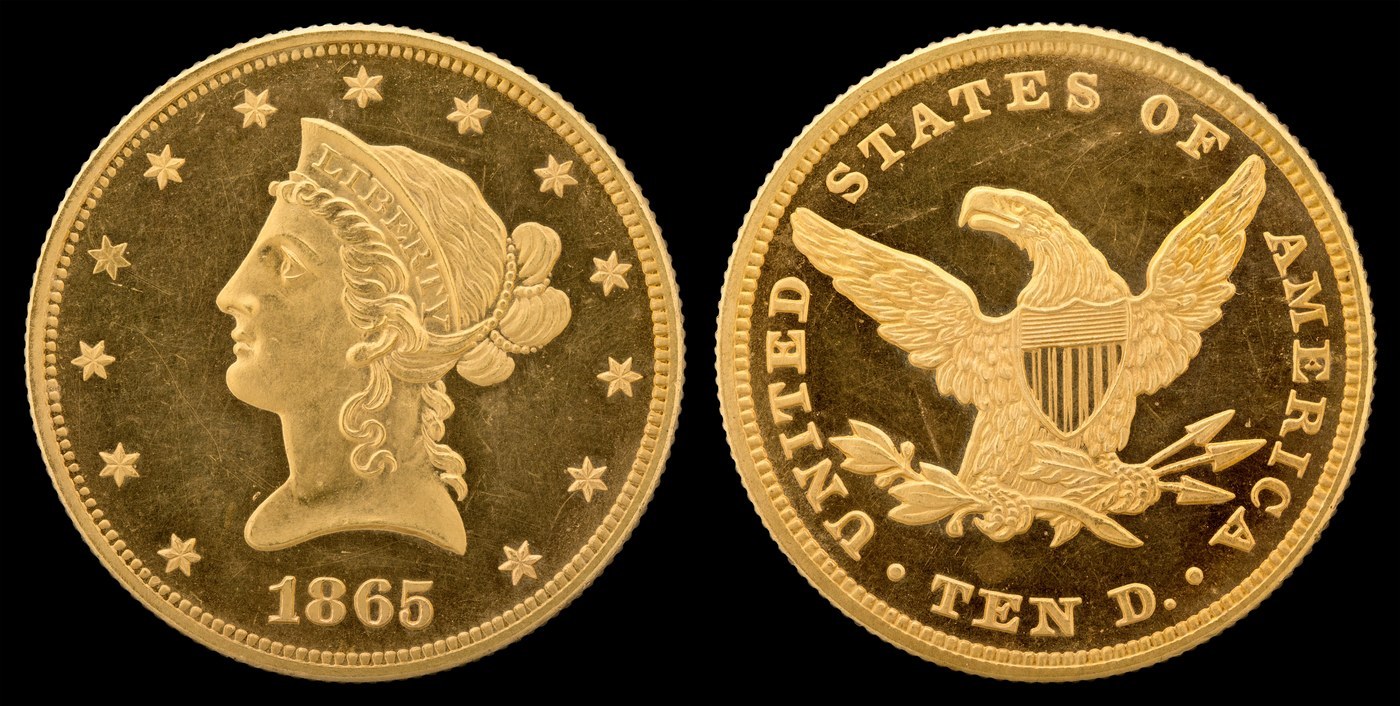
What It Is
The Liberty Head Eagle, also called the Coronet Head Eagle, is a U.S. ten-dollar gold coin struck from 1838 to 1907. Designed by Christian Gobrecht, it runs for seven decades, so the date and small design details are what pin down where a given coin—such as the 1839 example—falls in the series.
Obverse (Front)
Look for Liberty facing left wearing a coronet with the word "LIBERTY" across the band, her hair drawn back in a bun. Thirteen stars ring the border and the date sits at the bottom. This coronet portrait separates the type from the earlier Capped Head eagles and from the later Indian Head eagle that replaced it in 1907.
Reverse (Back)
The reverse shows an eagle with a Union shield on its breast, holding an olive branch and arrows. "UNITED STATES OF AMERICA" arcs across the top and "TEN D." marks the denomination at the bottom. The single most useful dating clue is the motto: coins from 1866 onward add "IN GOD WE TRUST" on a scroll above the eagle, while No Motto coins like the 1839 piece have clear space there.
Size, Metal, and Mint Marks
This is a large gold coin—about 27 mm across, roughly 16.7 grams, 90% gold with a copper balance, and a reeded edge. Check the reverse just below the eagle for a mint mark: O (New Orleans), S (San Francisco), CC (Carson City), or D (Denver). No mint mark means Philadelphia, which is correct for the 1839 issue.
Look-Alikes and Cautions
Don't confuse the ten-dollar eagle with the smaller half eagle ($5) or quarter eagle ($2.50), which share the coronet Liberty motif but are smaller and read "FIVE D." or "2 1/2 D."; the "TEN D." and larger size confirm an eagle. Because these are gold and some dates are scarce, counterfeits and altered mint marks or dates exist. Verify weight, diameter, and reeding against published specifications, watch for solder traces or filed edges from jewelry use, and have any scarce or high-value date authenticated by a reputable grading service before buying or selling.
Frequently asked questions
How do I tell a Liberty Head Eagle from a half eagle or quarter eagle?
All three use a coronet Liberty, but the eagle is the largest at about 27 mm and reads 'TEN D.' on the reverse; the half eagle reads 'FIVE D.' and the quarter eagle '2 1/2 D.' Size and denomination together identify the ten-dollar eagle.
How can I date an example like the 1839 coin?
Read the date under Liberty, then check for the reverse motto. 'No Motto' coins with no 'IN GOD WE TRUST' scroll run 1838-1866, which fits an 1839; the motto appears only from 1866 on.
What size and weight should it be?
About 27 mm in diameter and roughly 16.7 grams in 90% gold with a reeded edge. Meaningful deviation from those figures is a red flag for a fake or altered coin.
Should I have one authenticated?
For any scarce date, early issue, or high-grade coin—an early 1839 included—yes. Gold eagles are counterfeited and mint marks are sometimes altered, so third-party certification is wise before a transaction.