
How to Identify the Liberty Head Eagle ($10)
Also called the Coronet Head eagle, this $10 gold piece was minted from 1838 to 1907 and is identified by Liberty's coronet portrait and a shield-bearing eagle on the reverse.
Read the full Liberty Head Eagle ($10) encyclopedia entry →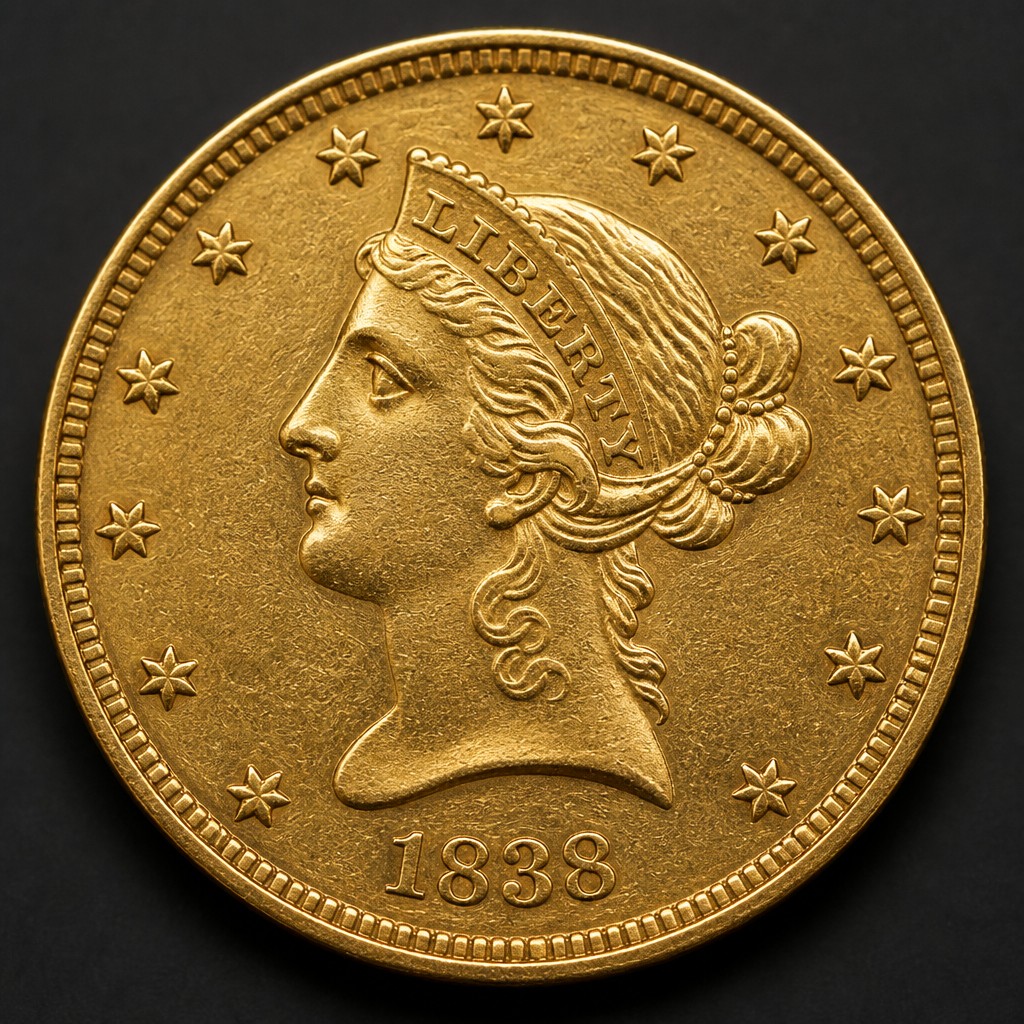
What It Is
The Liberty Head, or Coronet Head, eagle is a $10 gold coin designed by Christian Gobrecht and struck from 1838 through 1907, making it one of the longest-running gold coin designs in U.S. history. It circulated through the pre-Civil War expansion, the Civil War era, and into the early 20th century before being replaced by the Indian Head eagle.
Obverse Design
The obverse shows Liberty's head facing left, wearing a coronet inscribed with "LIBERTY." Stars surround the portrait and the date is below. Early issues from 1838–1839 show a slightly different head style and star arrangement than the more common design used from 1839 onward.
Reverse Design & Inscriptions
The reverse depicts an eagle with a shield across its breast, holding an olive branch and arrows in its talons. "UNITED STATES OF AMERICA" arches around the top, and the denomination appears below the eagle, reading "TEN D." on early issues and "TEN DOLLARS" spelled out on some later dates. Beginning in 1866, "IN GOD WE TRUST" was added on a ribbon above the eagle.
Size, Weight, Metal, and Edge
The coin weighs 16.718 grams, is struck in .900 fine gold, measures 27 mm in diameter, and has a reeded edge.
Mint Marks and Where to Find Them
The mint mark sits on the reverse just above the denomination, below the eagle. Coins may show "C" (Charlotte, gold coinage only, through 1861), "D" (Dahlonega, gold coinage only, through 1861 — not to be confused with the later Denver "D"), "O" (New Orleans), "S" (San Francisco), or "CC" (Carson City). No mint mark indicates Philadelphia.
Telling It Apart From Similar Coins
Compare the reverse motto to sort a coin into the "No Motto" era (1838–1866) or "With Motto" era (1866–1907) at a glance — if "IN GOD WE TRUST" appears above the eagle, the coin dates to 1866 or later. To distinguish this type from the Indian Head eagle that followed, look at the obverse portrait: a coronet and curled hair here versus a feathered war bonnet on the later design, along with a reeded edge instead of raised stars.
Judging Condition at a Glance
Check Liberty's hair curls and coronet point for flattening, along with the eagle's wing tips and shield lines on the reverse — these are the first areas to show wear.
Authenticity Red Flags
Given its gold content and long production run across many branch mints, confirm that the mint mark style, weight, and diameter are consistent with genuine examples. Watch for softened details, an incorrect edge, or a mint mark that appears added, filed, or repositioned, all of which suggest tampering aimed at creating a rarer branch-mint coin from a common one.
Frequently asked questions
How do I know if my coin is a 'With Motto' or 'No Motto' variety?
Check above the eagle on the reverse — if 'IN GOD WE TRUST' appears there, the coin dates from 1866 onward; if it's absent, the coin predates 1866.
Where is the mint mark located?
On the reverse, just above the denomination and below the eagle.
What does a 'D' mint mark mean on this coin?
On this series, 'D' refers to the Dahlonega, Georgia mint (active 1838–1861), not Denver, which did not strike gold coins until the 20th century.
How is this different from the Indian Head eagle?
This type shows Liberty wearing a coronet with a reeded edge, while the Indian Head eagle shows a feathered headdress and a starred edge.