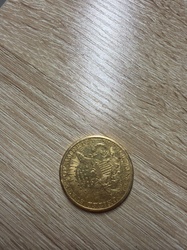
How to Identify the Liberty Head Double Eagle
Confirm a Liberty Head $20 gold by its coroneted Liberty head, heraldic shield eagle, large size, and by reading its motto and denomination to fix the type.
Read the full Liberty Head Double Eagle encyclopedia entry →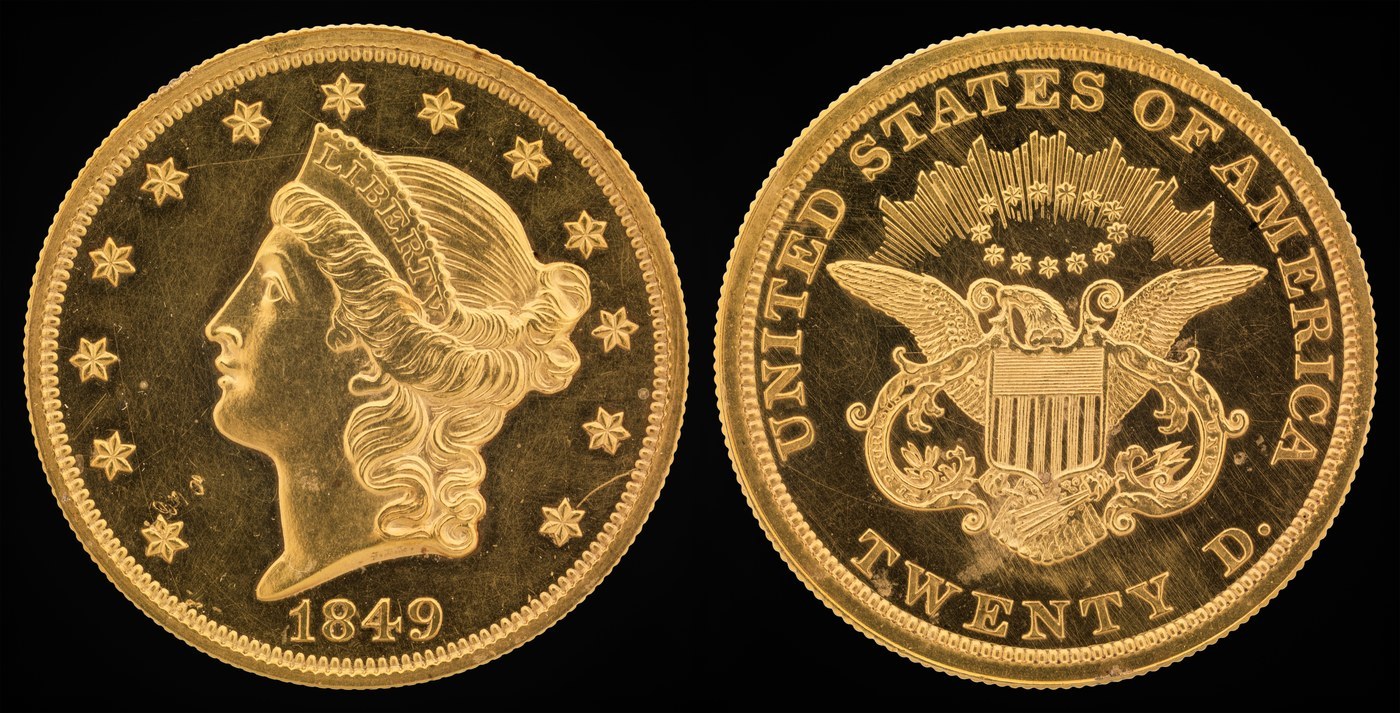
Start with the two designs, which identify the type at a glance. The obverse shows Liberty in left-facing profile wearing a coronet lettered LIBERTY, surrounded by thirteen stars with the date below. The reverse shows a heraldic eagle: wings spread, a striped shield across its breast, an olive branch and arrows in its talons, and rays with an oval of stars above the head. This formal coat-of-arms eagle is different from the naturalistic flying eagle on the later Saint-Gaudens double eagle.
Use the reverse lettering to pin down the variety, which matters for a coin like the 1869. If you see IN GOD WE TRUST on a ribbon within the star oval and the value reads TWENTY D., it is a Type 2 (1866–1876), matching an 1869 coin. No motto at all means Type 1 (1850–1866); a value spelled out as TWENTY DOLLARS means Type 3 (1877–1907). Reading the motto and denomination together, then checking the date, quickly confirms which of the three types you hold.
Check size, weight, and color. A genuine double eagle is about 34 mm across, weighs roughly 33.44 grams, and is struck in 90% gold with a reeded edge and a rich yellow-gold tone. It is a large, dense coin; a piece that is noticeably light, thin, off-diameter, or pale in color deserves scrutiny. A careful weight and diameter measurement is a useful first screen.
Locate the mint mark on the reverse, below the eagle and above the denomination, between the tail feathers and the value. No mint mark indicates Philadelphia; letters such as S (San Francisco), CC (Carson City), O (New Orleans), or D (Denver) indicate branch mints, though not every mint struck every year. For an 1869, expect either no mint mark or an S.
Be cautious with authentication. Because these are high-value gold coins, they are widely counterfeited, and genuine coins are sometimes altered — added or changed mint marks and re-engraved dates are used to imitate scarce issues. Cast or die-struck fakes may even use gold. Given the stakes, confirm any coin of real premium with a recognized third-party grading service rather than relying on appearance alone.
Frequently asked questions
How do I tell a Type 1, Type 2, and Type 3 apart?
Read the reverse. No motto and TWENTY D. is Type 1 (1850–1866); IN GOD WE TRUST added with TWENTY D. is Type 2 (1866–1876); and IN GOD WE TRUST with the value spelled TWENTY DOLLARS is Type 3 (1877–1907). An 1869 coin is a Type 2.
Where is the mint mark on a Liberty Head Double Eagle?
On the reverse, directly below the eagle and above the denomination, between the tail feathers and the value. No mint mark is Philadelphia; S, CC, O, or D indicate branch mints. Not all mints struck every date.
How can I distinguish this from a Saint-Gaudens double eagle?
The Liberty Head type has a profile Liberty head in a coronet and a heraldic shield eagle. The Saint-Gaudens type, which replaced it in 1907, shows a full-length striding Liberty on the obverse and a flying eagle on the reverse.
Is a weight check enough to prove authenticity?
It is a strong first screen — a genuine coin is about 33.44 grams, 34 mm, and 90% gold — but matching weight alone does not guarantee authenticity, since counterfeits can be made from gold. For any valuable piece, use a recognized third-party grading service.
Liberty Head Double Eagle identified by the community
Recent Liberty Head Double Eagle coins identified with Coin Identifier.