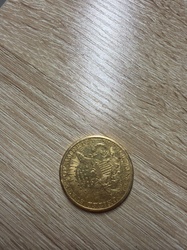
Liberty Head Double Eagle
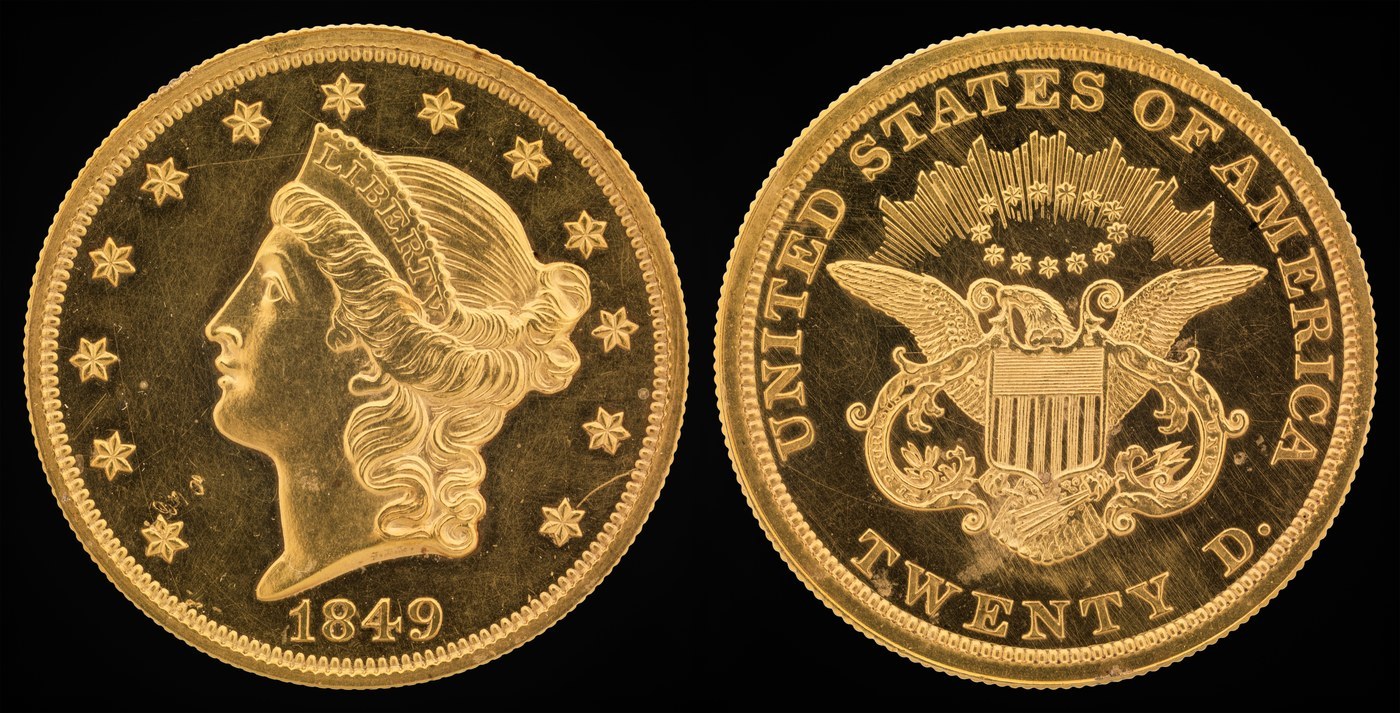
U.S. $20 gold coin struck 1850–1907, showing a coroneted Liberty head left and a heraldic eagle with shield; the 1869 is a with-motto Type 2.
- Country
- United States
- Denomination
- 20 dollars
- Metal
- Gold
Got a coin like this?
Identify any coin from a photo, free.
Overview
The Liberty Head Double Eagle is a United States twenty-dollar gold coin. Its obverse shows the head of Liberty facing left, her hair drawn back and gathered in a bun, wearing a coronet inscribed LIBERTY, encircled by thirteen stars with the date below. The reverse depicts a heraldic eagle with wings spread, a striped shield on its breast, an oval of stars and rays above the eagle's head, and the denomination and country legend around the rim.
The photographed coin is dated 1869. This places it in the middle 'Type 2' variety of the series, produced from 1866 to 1876, which carries the motto IN GOD WE TRUST on a scroll within the oval of stars on the reverse while still spelling the value as TWENTY D. The coin is struck in 90% gold, measures about 34 mm in diameter, weighs roughly 33.44 grams, has a reeded edge, and contains just under one troy ounce of pure gold (about 0.9675 oz).
History & Background
The double eagle was authorized in 1849 after the California Gold Rush flooded the country with bullion, creating demand for a large gold coin. Mint engraver James B. Longacre designed the piece; a single 1849 pattern exists, and regular production began in 1850. At twenty dollars, it was the highest-denomination U.S. coin struck for circulation and became a workhorse for storing and moving large sums of gold.
The series divides into three types. Type 1 (1850–1866) has no motto and reads TWENTY D. In 1866 the motto IN GOD WE TRUST was added above the eagle, creating Type 2 (1866–1876), the variety to which this 1869 coin belongs. In 1877 the reverse legend was changed to spell out TWENTY DOLLARS, producing Type 3 (1877–1907). The Liberty Head design ran until 1907, when it was replaced by Augustus Saint-Gaudens's new double eagle.
Liberty Head Double Eagles were struck at Philadelphia (no mint mark), San Francisco (S), New Orleans (O, early dates), Carson City (CC, from 1870), and later Denver (D). In 1869 the coin was produced at Philadelphia and San Francisco.
How to Identify
Confirm the type by both designs. The obverse Liberty head faces left, wears a beaded coronet lettered LIBERTY, and is ringed by thirteen stars with the date beneath. The reverse shows a heraldic eagle with a shield on its breast, wings spread, holding an olive branch and arrows, with rays and an oval of stars above — a formal, coat-of-arms style eagle rather than a naturalistic perched or flying bird.
The year narrows the variety. Because this coin is dated 1869, it is a Type 2 double eagle: look for IN GOD WE TRUST on a ribbon within the arc of stars above the eagle, combined with the value spelled TWENTY D. below. A coin with no motto is an earlier Type 1 (1866 or before); a coin reading TWENTY DOLLARS is a later Type 3 (1877 and after).
Size and metal are diagnostic. At about 34 mm and 33.44 grams in 90% gold with a reeded edge, this is a large, heavy coin with a deep yellow-gold color, noticeably weightier than a silver dollar of similar diameter. The mint mark, when present, sits on the reverse below the eagle, between the tail feathers and the denomination. An 1869 with no mint mark is a Philadelphia strike; an S below the eagle indicates San Francisco.
Value & Collectibility
Every Liberty Head Double Eagle contains nearly a full troy ounce of gold, so even a heavily worn example carries substantial intrinsic value that tracks the gold market. This bullion floor means these coins are almost always worth many hundreds of times their face value based on metal content alone.
Beyond melt, value depends heavily on date, mint, and condition. Common Philadelphia and San Francisco dates in circulated grades typically trade at a modest premium over their gold value, while scarce dates, early Carson City issues, and high-grade Mint State pieces can command significant collector premiums. The 1869, a Type 2 date, is a collectible mid-series issue whose price varies with grade and eye appeal.
Because double eagles are high-value gold coins, they are a frequent target for counterfeits and alterations, and prices swing with the gold market. Consult a current price guide or dealer rather than a fixed figure, and have any coin of real premium authenticated and graded by a recognized third-party service.
Frequently asked questions
How much gold is in a Liberty Head Double Eagle?
It is struck in 90% gold and weighs about 33.44 grams, containing roughly 0.9675 troy ounce of pure gold — just under a full ounce. That bullion content gives every example substantial intrinsic value tied to the gold market.
What makes the 1869 double eagle a 'Type 2'?
Type 2 coins (1866–1876) carry the motto IN GOD WE TRUST on a scroll within the oval of stars on the reverse while still spelling the value as TWENTY D. The 1869 falls in this range, distinguishing it from the no-motto Type 1 and the TWENTY DOLLARS Type 3.
Who designed the Liberty Head Double Eagle?
Mint engraver James B. Longacre designed both the coroneted Liberty head obverse and the heraldic eagle reverse. The type entered production in 1850 and continued through 1907.
Where is the mint mark on this coin?
On the reverse, below the eagle, between the tail feathers and the denomination. No mint mark means Philadelphia. For 1869, an S there indicates San Francisco; the coin was struck at those two mints that year.
Is this the same as the Saint-Gaudens double eagle?
No. The Saint-Gaudens double eagle, with a striding Liberty, replaced this design in 1907. The Liberty Head (Coronet) type shown here has a profile Liberty head and a heraldic shield eagle, and was struck from 1850 to 1907.
Liberty Head Double Eagle guides
In-depth guides for identifying, valuing, and collecting Liberty Head Double Eagle.
Liberty Head Double Eagle identified by the community
Real coins identified with Coin Identifier.