
How to Identify the Lewis and Clark Exposition Dollar
A collector's checklist for confirming a genuine 1904 or 1905 Lewis and Clark gold dollar — the two-portrait design, size, gold, and authentication cautions.
Read the full Lewis and Clark Exposition Dollar encyclopedia entry →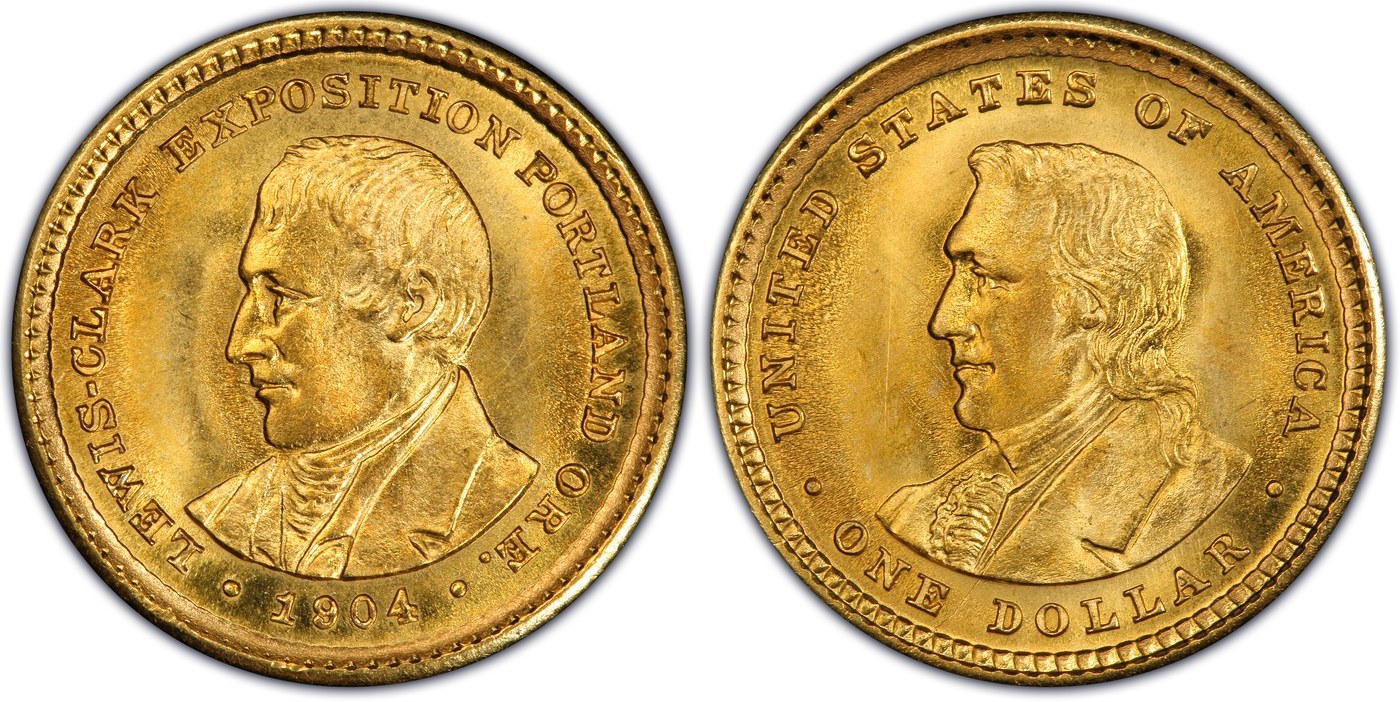
Begin with the design, which is unmistakable once you know it. This coin shows a facing profile portrait on each side rather than a portrait-and-reverse pairing: one face is Meriwether Lewis and the other is William Clark. If you see a bust on both sides of a small gold coin with a Lewis and Clark exposition legend, you are on the right track. Any coin with a seated figure, wreath, or building on the back is a different type.
Read the legends and dates. Genuine pieces name the Lewis and Clark Exposition and Portland, and carry centennial dates linked to the expedition (1804–1904 or 1805–1905). The coin's own date will be either 1904 or 1905, and that year is how collectors separate the two issues. Barber's lettering should be sharp and evenly spaced.
Confirm the physical specifications. This is a gold dollar, so it is small — about 15 mm in diameter and roughly 1.7 grams in .900 fine gold, with a warm yellow tone and a reeded edge. A "Lewis and Clark" piece that is the size of a quarter or larger, that is base-metal colored, or that is described as a medal or token is not this coin. Because it is a small, valuable gold type, use a scale and calipers rather than eyesight alone.
Mint marks are a quick filter: there are none. Every genuine strike came from Philadelphia, so a mint mark under the design would be a warning sign. Watch also for common look-alikes — souvenir medals, gold-plated copies, and modern fantasy pieces sometimes borrow the Lewis and Clark theme without being the authorized 1904–1905 gold dollar.
For authentication, treat any raw high-value example with care. Cast fakes, added mint marks, altered dates, and repaired or cleaned surfaces all appear in the market for early gold commemoratives. Verify weight and diameter, look for crisp original detail, and for any significant purchase rely on coins certified by PCGS or NGC rather than on appearance alone.
Frequently asked questions
How do I tell the 1904 from the 1905 issue?
Read the date on the coin. Both were struck at Philadelphia with the same two-portrait design, and the four-digit year — 1904 or 1905 — is what identifies which issue you have.
What size and weight should it be?
It is a standard gold dollar: about 15 mm in diameter and roughly 1.7 grams in .900 fine gold. A much larger or base-metal 'Lewis and Clark' piece is a medal or a copy, not this coin.
Should my coin have a mint mark?
No. All genuine examples were struck at Philadelphia with no mint mark. A mint mark on a Lewis and Clark dollar is a red flag that the coin may be altered or fake.
How can I be sure a pricey example is authentic?
Check weight and diameter, look for sharp original Barber detail with no seams or tooling, and buy examples certified by PCGS or NGC. Beware gold-plated copies and souvenir medals using the same theme.