
How to Identify the Kushan Gold Dinar
An ancient gold coin of the Kushan Empire modeled on the Roman aureus, identified by its standing-king obverse and deity reverse in Bactrian script.
Read the full Kushan Gold Dinar encyclopedia entry →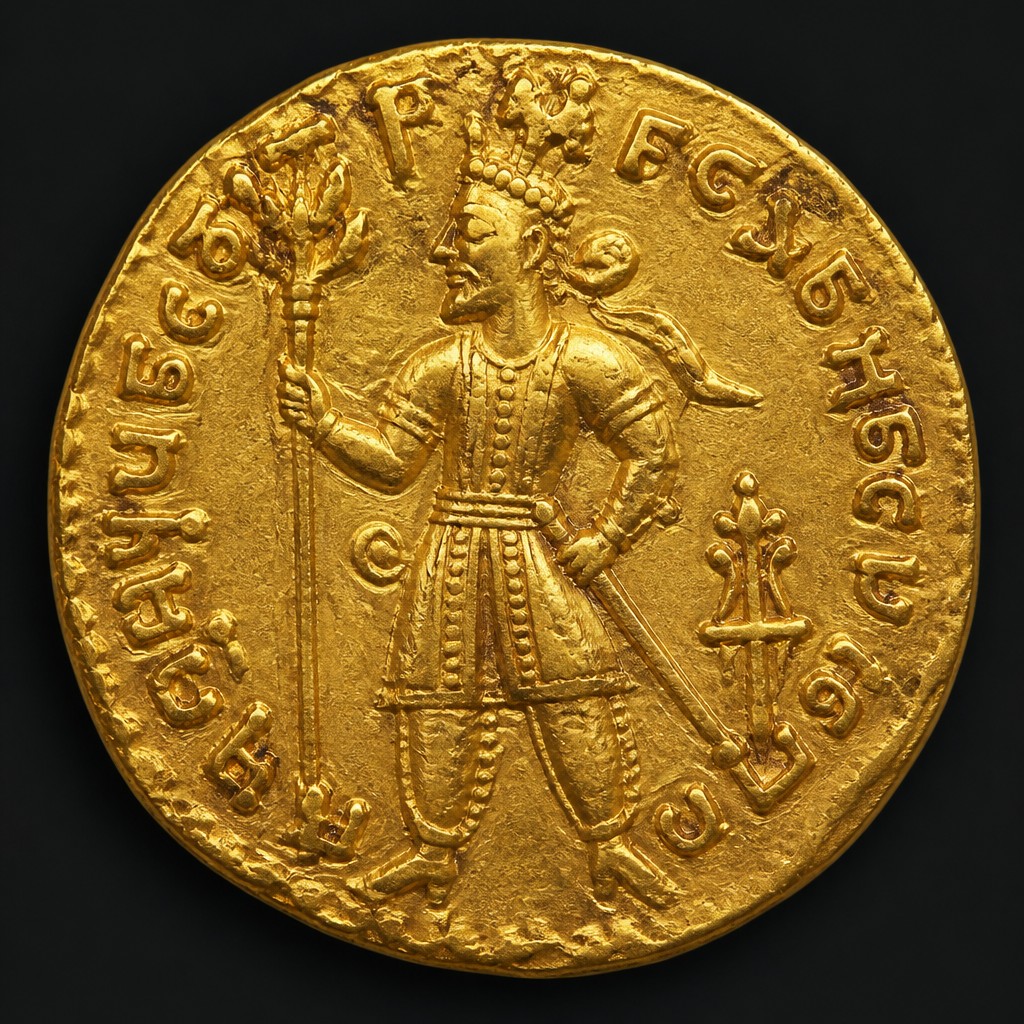
What It Is
The Kushan gold dinar was issued by the Kushan Empire, which controlled large parts of Central Asia and northern India roughly between the 1st and 3rd centuries CE. Its weight standard was modeled on the Roman aureus, and it was struck by rulers such as Vima Kadphises, Kanishka I, Huvishka, and Vasudeva I. Sitting astride the Silk Road trade routes, the Kushans absorbed artistic and religious influences from the Greco-Bactrian, Iranian, and Indian worlds, and their coinage is one of the richest visual records of that cultural blending in the ancient world.
Obverse Design & Inscriptions
The obverse typically shows the reigning king standing, often in ceremonial dress, performing a sacrifice at a small altar or holding a scepter or spear. A legend in the Bactrian language, written in Greek-derived script, runs around the border giving the king's name and titles, such as "shaonano shao" ("king of kings").
Reverse Design & Inscriptions
The reverse depicts a deity drawn from the Kushan pantheon, which blended Greek, Iranian, and Indian religious traditions. Common examples include Nana, Mithra/Miiro (a sun deity), Oesho (associated with Shiva), Ardoxsho, and, on rarer issues, a standing Buddha. The deity's name usually appears in Bactrian script beside the figure, along with a royal monogram (tamgha).
Size, Weight, Metal & Edge
It is a struck gold coin roughly 20mm in diameter, weighing close to 7.9 grams, matching the Roman aureus standard. As with most ancient coinage, the edge is plain and hand-struck rather than reeded or milled.
Mint Marks & Where to Find Them
Ancient Kushan dinars do not carry modern-style mint letters. Attribution to a specific ruler and workshop instead relies on the portrait style, the specific deity depicted on the reverse, the placement of the tamgha, and the paleography of the Bactrian legend.
Telling It Apart from Similar Coins
Individual rulers are distinguished primarily by the obverse portrait style and legend, since each king used distinct titulature, and by which deity appears on the reverse, since deity choice often shifted between reigns. Comparing tamgha shape is also useful, as it changed over time.
Judging Condition at a Glance
Because these are hand-struck ancient coins, check the centering of the strike, wear on the king's facial features and the deity's outline, and overall surface preservation; gold does not corrode, so genuine ancient pieces often retain a warm, undisturbed luster. Off-center strikes, where part of the design runs off the edge of the flan, are common on ancient dinars and are not necessarily a sign of a problem coin, simply a byproduct of hand striking.
Authenticity Red Flags
Ancient gold coins are frequent targets for casts and modern strikes made from transfer dies. Look for casting bubbles or seams, unnaturally sharp or "too perfect" details compared to documented genuine strikes, and verify the weight closely; genuine examples typically show slightly irregular, hand-cut die characteristics and natural die-flow lines rather than mechanically uniform detail.
Frequently asked questions
What weight standard does the Kushan dinar follow?
It follows the Roman aureus weight standard, at roughly 7.9 grams of gold, reflecting the Kushan Empire's trade contacts across Eurasia.
How do I know which king issued a particular dinar?
The Bactrian-script legend around the standing king on the obverse names the ruler and his titles, and this, along with the specific deity shown on the reverse, helps attribute the coin to a specific reign.
Why do different dinars show different gods on the reverse?
Kushan religious practice blended Greek, Iranian, and Indian traditions, and different rulers favored different deities such as Nana, Mithra, Oesho, or occasionally the Buddha.
Does the coin have a mint mark like modern coins?
No, ancient Kushan dinars lack modern mint letters; attribution relies on portrait style, deity choice, and the royal monogram (tamgha) rather than an inscribed mint symbol.
What should I watch for regarding fakes?
Be cautious of coins with unnaturally crisp or symmetrical details, incorrect weight, or visible casting seams, since ancient gold coins are commonly reproduced using cast or transfer-die methods.