
How to Identify the Kushan Gold Dinar of Kanishka
A gold coin of the Kushan emperor Kanishka I, notable for its Greco-Bactrian script legend, standing royal figure, and wide array of deity types on the reverse.
Read the full Kushan Gold Dinar of Kanishka encyclopedia entry →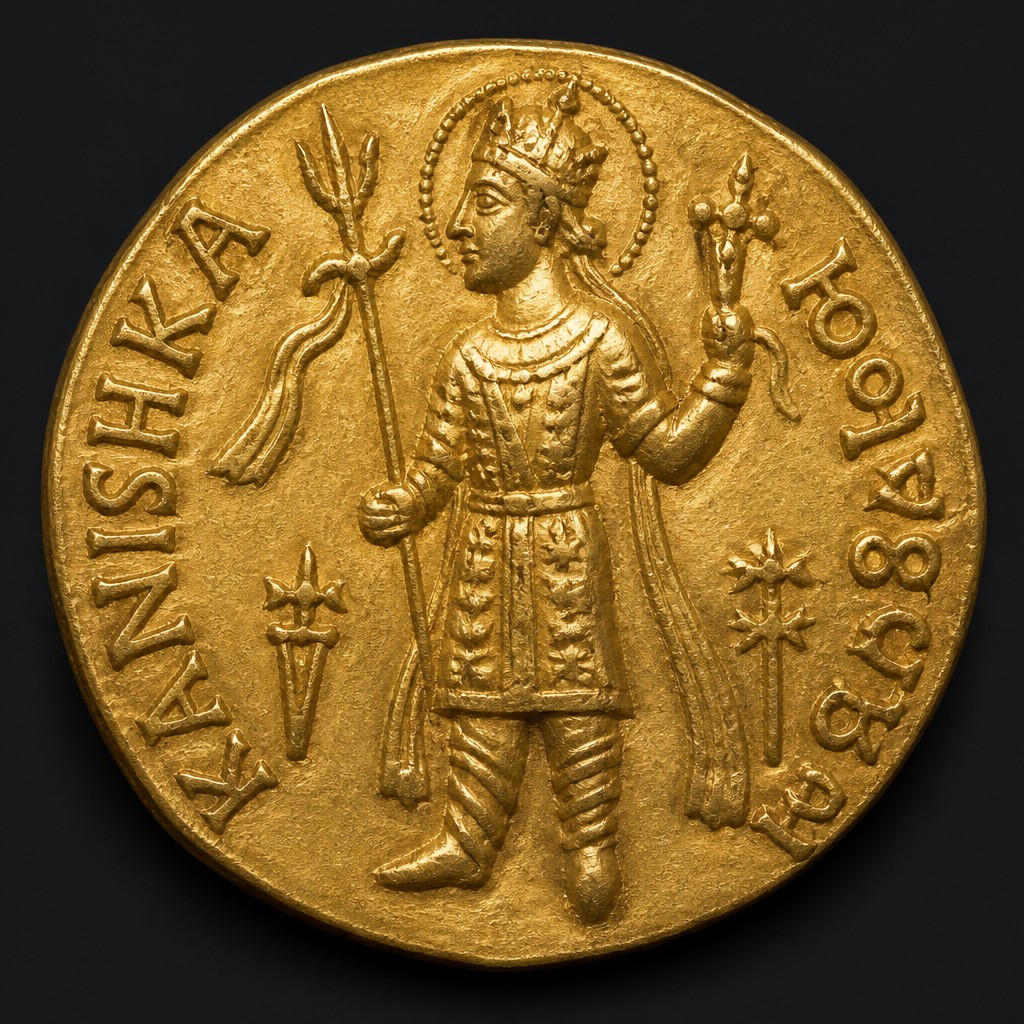
What the Coin Is
The Kushan gold dinar was introduced under King Vima Kadphises and continued under his successor Kanishka I, who ruled the Kushan Empire across Central Asia and northern India in the 2nd century CE. Modeled loosely on the Roman gold aureus in weight, the dinar reflects the empire's position at the crossroads of Greek, Iranian, and Indian cultures.
Obverse Design & Inscription
The obverse typically shows the king standing, often at a small altar, wearing a long coat and pointed cap or helmet, sometimes holding a scepter or making an offering with flames or smoke rising from the altar. A legend in Greek-derived Bactrian script runs around the border, usually rendering the king's name and titles such as "shaonanoshao" (king of kings).
Reverse Design & Deity Types
The reverse is the most distinctive feature: it depicts a single deity drawn from an eclectic pantheon that includes Greek, Iranian, and occasionally Indian or Buddhist figures, each identified by a name label in Bactrian script beside the figure. The specific deity shown varies from issue to issue, so the reverse figure is a key identifying feature for the exact type.
Size, Weight, Metal, Edge
The dinar is struck in high-purity gold, weighing approximately 7.9 to 8 grams, with a diameter of roughly 20 mm. The edge is plain, consistent with ancient hand-struck coinage, and the flan is often slightly irregular in shape rather than perfectly round.
Mint Marks & Symbols
Kushan dinars generally do not carry a separate mint-mark system like later coinages; instead, small control symbols (tamgas) sometimes appear in the field near the king or deity, used to track workshops or issues. These tamga marks are worth examining closely alongside the deity and legend to help pin down a specific type.
Telling It Apart from Similar Coins
Kushan dinars can be confused with contemporary Roman aurei due to similar weight, but the standing-king obverse and non-Latin Bactrian script immediately distinguish them. Later Kushano-Sasanian imitations exist as well, generally showing cruder style and different deity treatment; genuine Kanishka-period dies tend to have more refined, confident engraving. Coins of Kanishka's predecessor Vima Kadphises and successors such as Huvishka share the same general dinar format, so the specific royal name in the Bactrian legend, alongside subtle differences in headdress and pose, is what ultimately confirms an attribution to Kanishka.
Judging Condition & Authenticity
Because gold does not corrode, well-preserved examples can still show sharp detail after nearly 1,900 years; wear is usually limited to high points like the king's face and the deity's outline. Watch for modern casts, which often show a slightly grainy or bubbly surface texture, seam lines around the edge, and letters in the legend that look soft or blurred rather than crisply struck, all signs of a cast forgery rather than an authentic struck coin.
Frequently asked questions
How can I identify which deity is on the reverse?
Look for the Bactrian-script name label next to the figure and note the figure's attributes, such as a halo, flames, or specific pose, which together identify the specific deity type.
What metal and weight should a genuine dinar have?
Genuine examples are struck in high-purity gold and weigh close to 7.9-8 grams; a piece significantly lighter or of a different color/metal warrants caution.
Does the script on the coin read Greek?
It uses Greek-derived letters to write the Bactrian language, so while the alphabet looks Greek, the words themselves are Bactrian, not classical Greek.
What's a common sign of a cast forgery?
A grainy or bubbly surface, a visible seam around the edge, and soft, blurred lettering instead of crisp struck detail.
Is a small symbol near the king or deity meaningful?
Yes, these are control marks called tamgas that can help identify a specific workshop or issue within the broader Kanishka dinar series.